Part 6: Industrial and Everyday Applications of Microprocessors: From Automotive ECUs to IoT Smart Systems
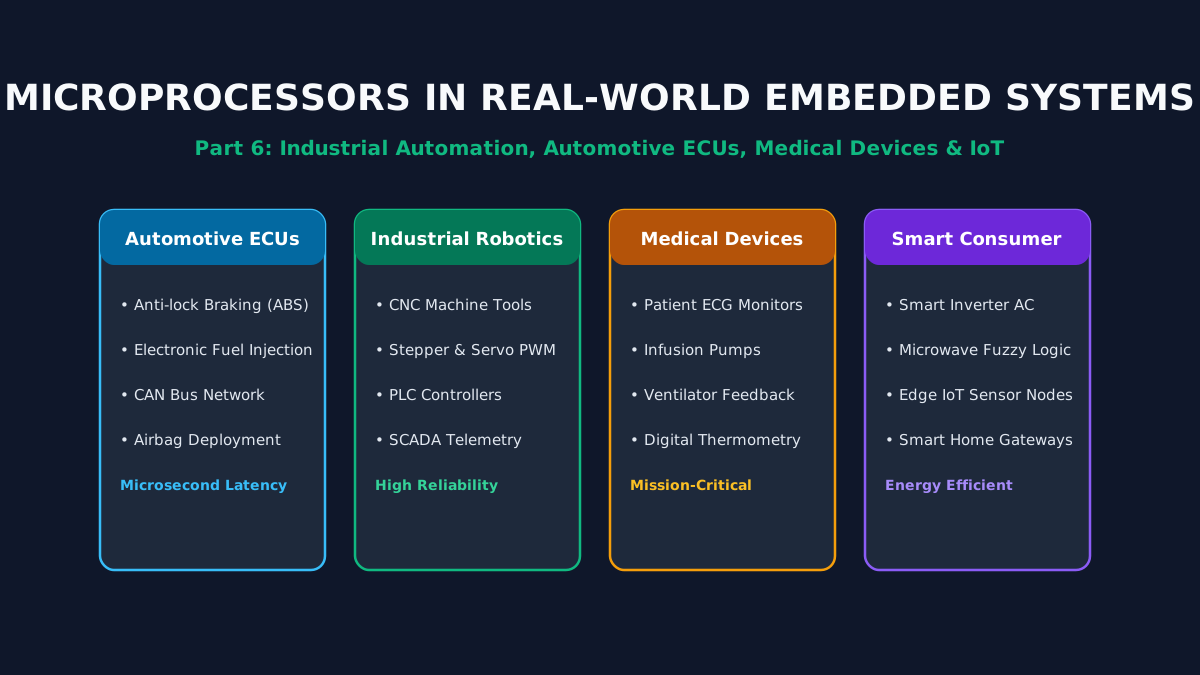
The Invisible Brains Driving Civilization
While desktop personal computers and data center servers represent the most visible deployments of microprocessors, over 98% of all microprocessors manufactured worldwide operate invisibly embedded within dedicated electronic systems. From fuel injection algorithms in modern vehicles to precise radiation therapy controls in oncology wards, microprocessors have become the foundational nervous system of modern physical infrastructure. In Part 6, we analyze key industrial domains and architectural design considerations.
1. Automotive Systems & Vehicular Networks
A premium modern automobile incorporates over 100 dedicated microprocessors structured as Electronic Control Units (ECUs) interconnected through high-reliability automotive bus protocols (CAN, LIN, FlexRay):
Powertrain & Fuel Injection (ECU)
Microprocessors sample throttle position, mass airflow, crankshaft angle, and exhaust oxygen sensors dozens of times per millisecond to calculate spark timing and fuel injector pulse width to maximize thermodynamic efficiency and minimize emissions.
Anti-Lock Braking (ABS) & ESC
Detects imminent wheel lockup during hard deceleration via inductive wheel speed sensors, pulsing hydraulic valves up to 20 times per second to prevent vehicle skid and maintain steerability.
Active Safety & Airbag Control
Hard real-time processing: MEMS accelerometers feed deceleration spikes into the safety processor, which must classify the crash severity and trigger pyrotechnic squibs within 15 milliseconds.
Infotainment & Telematics
Multi-core SoCs running real-time operating systems (RTOS) managing digital instrument clusters, GPS navigation, wireless cellular connectivity, and over-the-air firmware updates.
2. Industrial Automation & Process Control
In industrial environments, microprocessors must operate without interruption for decades under extreme ambient temperatures, vibration, and severe electromagnetic interference (EMI):
- Programmable Logic Controllers (PLCs): Microprocessors execute cyclic scan routines (Input Read $\rightarrow$ Logic Solve $\rightarrow$ Output Write) every few milliseconds, driving pneumatic actuators, contactors, and high-voltage factory motors.
- CNC Machining & Robotic Articulation: Microprocessors perform real-time trigonometric coordinate transformations and output Pulse Width Modulation (PWM) signals to drive multi-axis closed-loop brushless servo motors with sub-micron positioning repeatability.
- SCADA Telemetry: Supervisory Control and Data Acquisition units aggregate pipeline pressure, electrical grid phase angles, and chemical reactor temperatures, relaying cryptographic industrial telemetry over cellular or fiber networks.
3. Biomedical Instrumentation & Healthcare
In medical life-critical devices, software failure or processor lockups can result in fatal outcomes. Microprocessors deployed in medical equipment utilize rigorous fault-tolerant watchdogs and dual-channel verification:
Patient Vital Monitors
Digital signal processing microprocessors filter 60Hz mains noise from minute millivolt cardiac potentials (ECG) and calculate blood oxygen saturation ($SpO_2$) from photoplethysmogram waveforms.
Infusion Pumps
Microprocessors drive stepper motors to deliver micro-liters of intravenous medications per hour, coupled with optical drop counters and pressure sensors to immediately detect line occlusions.
Implantable Pacemakers
Ultra-low-power microcontrollers operating on nano-amperes of current, sensing intracardiac electrical rhythms and pacing the myocardium while surviving for 10+ years on a single hermetic lithium-iodine cell.
4. Critical Embedded Design Constraints
| Engineering Constraint | General Computing (PC/Server) | Embedded Systems |
|---|---|---|
| Timing Guarantee | Soft / Best-Effort (Average latency matters) | Hard Real-Time: Missing a deadline equals total system failure (e.g. airbag deployment). |
| Power Envelope | 65W to 350W+ with active liquid/fan cooling | Milliwatts or microwatts; fanless, battery or energy-harvested. |
| Environmental Tolerance | Climate-controlled office or server room | Automotive/Industrial grade: -40°C to +125°C, high vibration, moisture. |
| Software Architecture | Complex OS (Linux, Windows, macOS) with virtual memory | Bare-metal firmware or deterministic RTOS (FreeRTOS, VxWorks, Zephyr). |
Summary & Next Step
Having explored the broad industrial reach of microprocessors, we now transition into the 16-bit era. In Part 7, we examine the revolutionary architecture of the Intel 8086: its Bus Interface Unit (BIU), Execution Unit (EU), 6-byte instruction prefetch queue, and memory segmentation.
Related reading
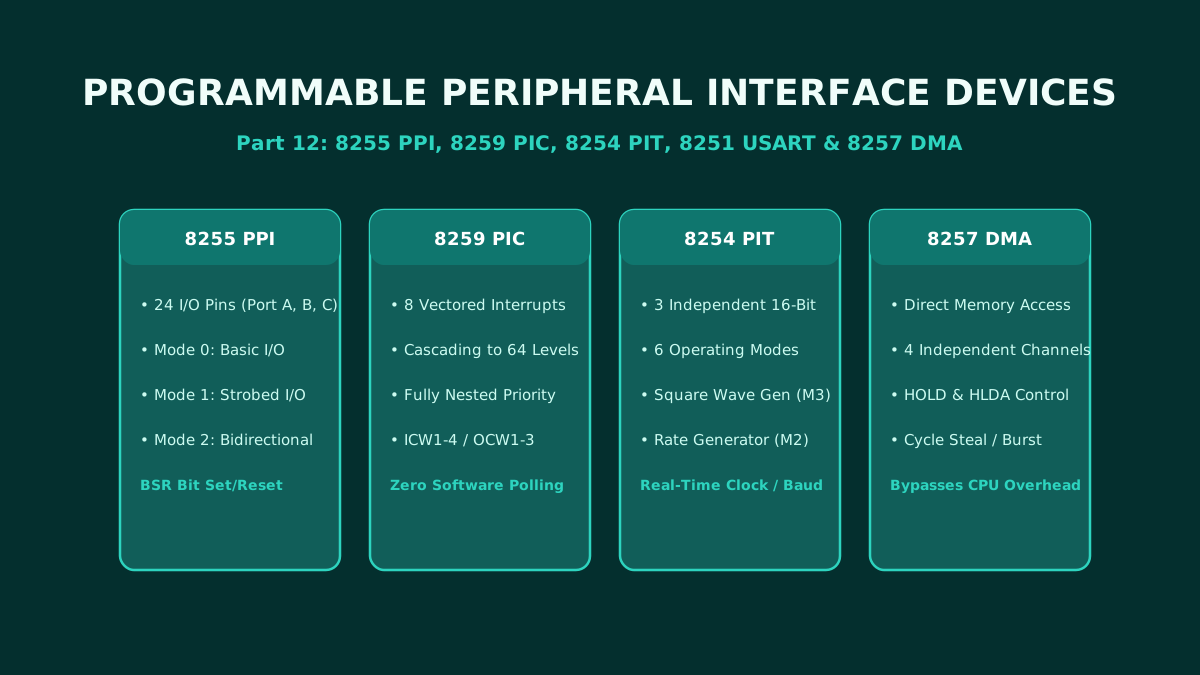
Part 12: Programmable Peripheral Interface ICs: Architecture and Pin Configuration of 8255, 8259, 8254, 8251, and 8257
The ultimate hardware reference for microprocessor peripheral interface adapters: complete architecture, pin configurations, and control word programming for the 8255 PPI, 8259 PIC, 8254 PIT, 8251 USART, and 8257 DMA controller.
By Md. Harun-Or-Roshid
Part 11: Intel 8051 Microcontroller Architecture: Harvard Memory Map, SFRs, and I/O Port Circuits
A master-level architectural analysis of the Intel 8051 microcontroller: Microprocessor vs Microcontroller paradigm, Harvard memory organization, 128-byte internal RAM layout, SFR registers, and internal circuits of Ports 0–3.
By Md. Harun-Or-Roshid
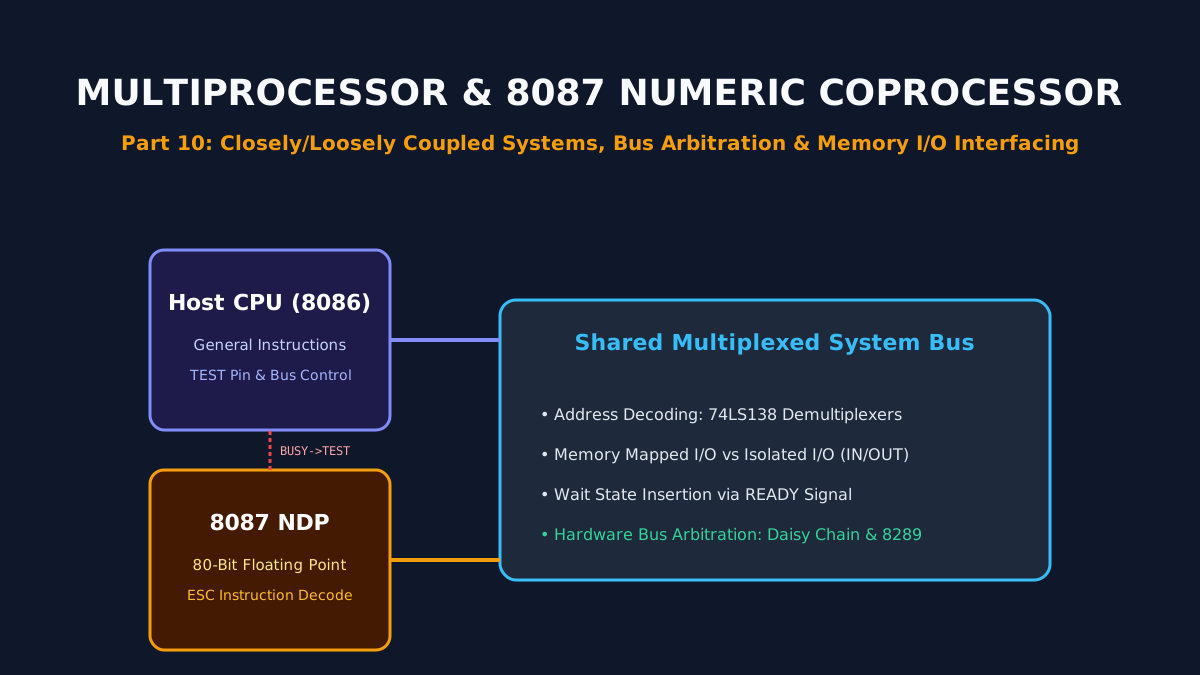
Part 10: Multiprocessor Configurations, 8087 Numeric Coprocessor, and Memory/IO Interfacing
Architectural principles of multiprocessor systems: closely vs loosely coupled topologies, hardware bus arbitration, the Intel 8087 floating-point NDP, and memory-mapped vs isolated I/O interfacing.
By Md. Harun-Or-Roshid
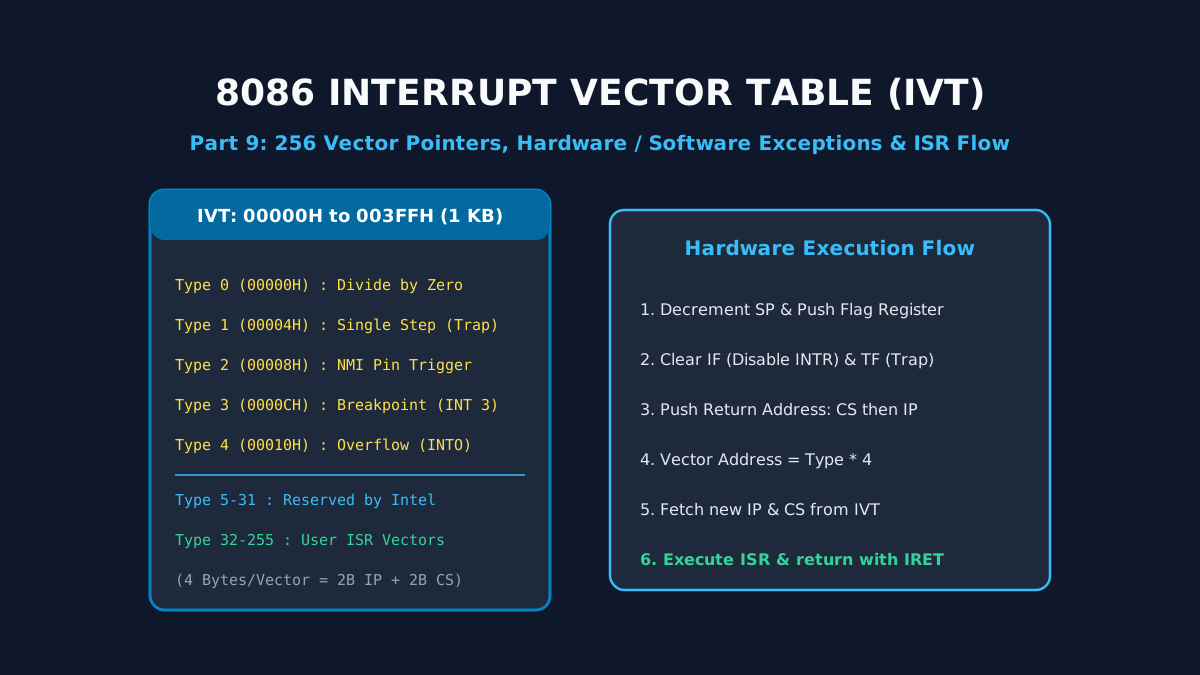
Part 9: Interrupt Structures and Vector Pointer Table in Intel 8086: Hardware, Software, and Exception Handling
A deep dive into 8086 interrupt processing: the 1 KB Interrupt Vector Table (IVT), dedicated Type 0–4 exceptions, hardware NMI/INTR lines, the 6-step interrupt response cycle, and the IRET sequence.
By Md. Harun-Or-Roshid