Part 2: Enterprise IT Infrastructure: Cloud Platforms, Networks & Edge
Module Overview
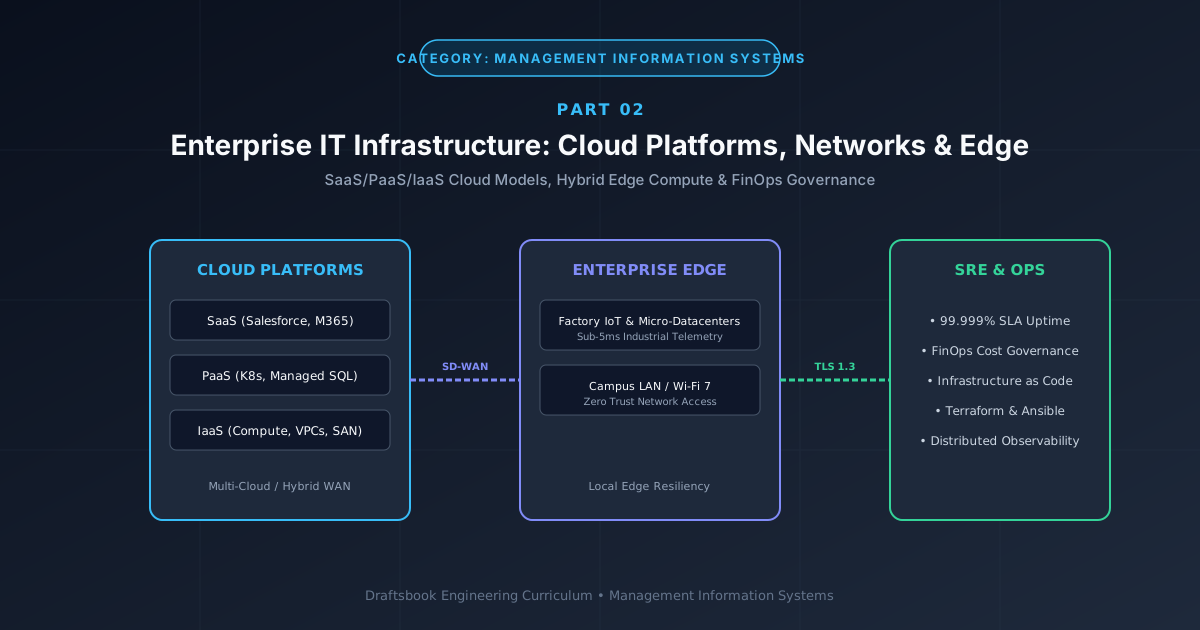
An enterprise cannot run advanced business intelligence or machine learning applications on brittle, unmonitored hardware. In this second installment of the Management Information Systems curriculum, we analyze the physical, virtual, and cloud architectures underpinning enterprise operations: the evolution from on-premise mainframe silos to Multi-Cloud & Hybrid architectures, service models (SaaS, PaaS, IaaS), Software-Defined Wide Area Networking (SD-WAN), edge computing in industrial operations, and modern FinOps financial governance.
1. The Cloud Service Taxonomy: IaaS, PaaS & SaaS
Corporate IT has migrated away from building and air-conditioning private physical server facilities toward elastic, utility-metered cloud services. The National Institute of Standards and Technology (NIST) defines three standardized abstraction tiers:
Infrastructure as a Service (IaaS)
Provides raw virtual compute instances (vCPUs), software-defined networks (VPCs), and scalable block storage (SAN/EBS). The cloud provider manages the physical silicon, hypervisors, and data center facilities; the enterprise customer retains full responsibility for operating system patching, runtime security, middleware, and application code. Examples: AWS EC2, Google Compute Engine, Microsoft Azure Virtual Machines.
Platform as a Service (PaaS)
Abstracts the operating system, container orchestration, and runtime environment. Developers simply push container images or source code repositories, allowing the platform to automatically handle autoscaling, SSL termination, load balancing, and database clustering. Examples: AWS Elastic Beanstalk, Google Cloud Run, Red Hat OpenShift.
Software as a Service (SaaS)
Complete, turnkey business application suites delivered over the web browser. The customer manages zero infrastructure or code, configuring only users, access policies, and organizational data. Examples: Salesforce CRM, Microsoft 365, Workday HCM, ServiceNow.
2. Hybrid Cloud & Distributed Edge Computing
While public clouds offer limitless elasticity, regulatory compliance (such as data sovereignty mandates) and physical physics (speed-of-light network latency) dictate that certain enterprise workloads remain on-premise or at the local network edge.
Hybrid Cloud Integration
Links private on-premise core databases with public hyperscalers via dedicated high-bandwidth fiber interconnects (AWS Direct Connect, Azure ExpressRoute). Sensitive financial transaction records remain behind corporate physical firewalls while seasonal customer checkout traffic bursts into public cloud clusters.
Industrial Edge Computing
Deploys micro-datacenters directly on factory manufacturing floors, smart hospitals, and retail hubs. High-frequency sensor streams (sub-5 millisecond response times) are analyzed locally by lightweight inference models, transmitting only aggregated summary events back to central cloud lakehouses.
3. Enterprise FinOps: Cloud Cost Governance
When physical hardware was capital expenditure (CapEx), IT departments purchased servers through multi-year depreciated budgets. In the cloud era, variable operational expenditure (OpEx) allows engineering teams to spin up expensive clusters with a single API call, creating massive cloud budget overruns.
FinOps is an evolving cloud financial management discipline that brings cultural shift, automated tagging, and operational accountability to cloud spending:
- Cost Allocation Tagging: Mandating strict metadata tags (
Environment=Production,CostCenter=Finance,Owner=TeamData) on every virtual machine and storage bucket to enable exact department chargebacks. - Commitment Discounts: Leveraging Reserved Instances (RIs) and Savings Plans (1-to-3-year commitments) for steady-state baseline workloads, reducing compute costs by up to 70% compared to On-Demand billing.
- Right-Sizing & Garbage Collection: Continuously automated scripts identifying unattached persistent volumes, idle load balancers, and over-provisioned vCPUs.
Next in Curriculum
In Part 3: Enterprise Resource Planning (ERP) & Modern CRM Architectures, we analyze how enterprise resource planning and customer relationship systems unify fractured corporate departments into a single source of truth.
Related reading
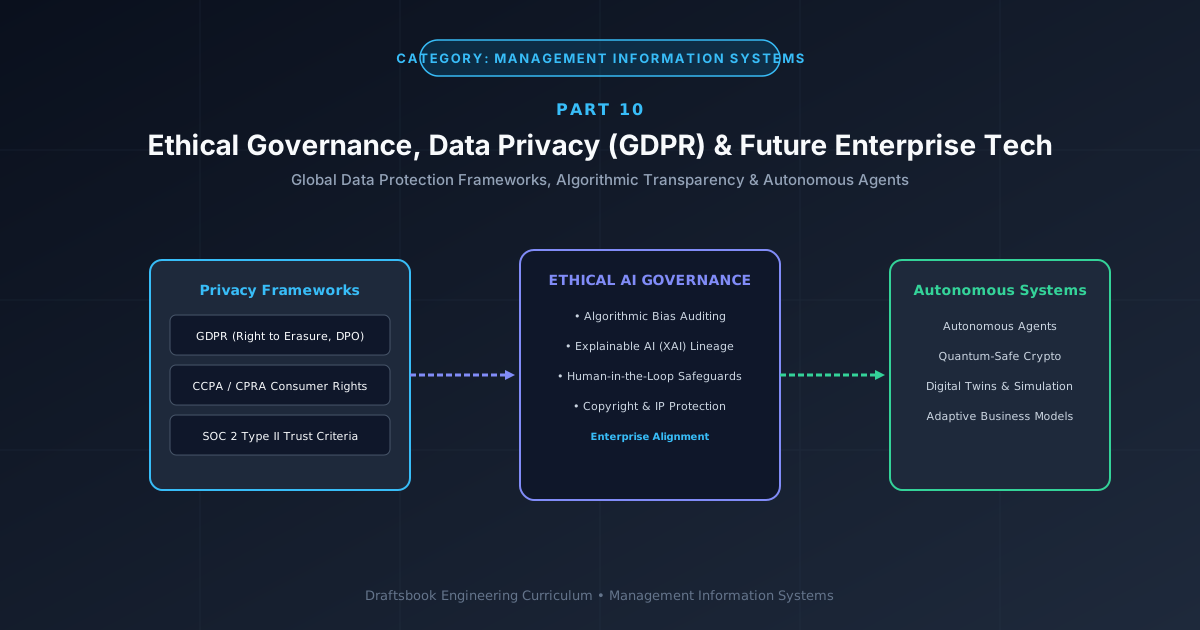
Part 10: Ethical Governance, Data Privacy (GDPR) & Future Enterprise Tech
Examine ethical information governance: GDPR/CCPA data privacy, algorithmic bias mitigation, explainable AI, autonomous digital agents, and quantum crypto.
By Md. Harun-Or-Roshid
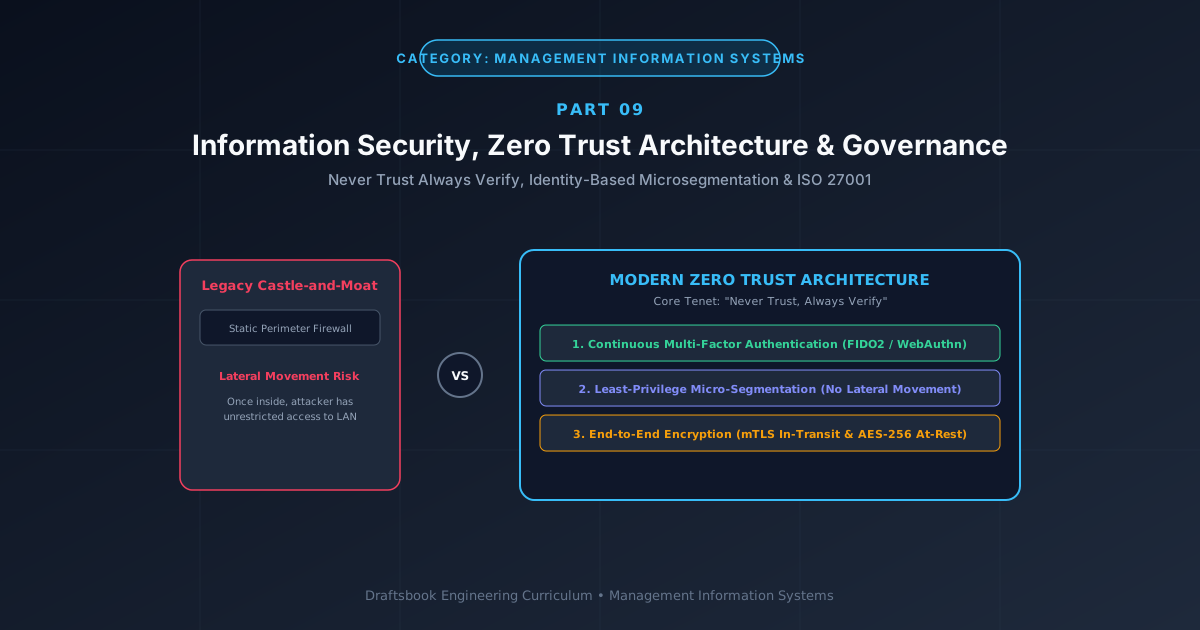
Part 9: Information Security, Zero Trust Architecture & Governance
Explore enterprise cybersecurity: the CIA triad, Zero Trust defense-in-depth, identity access management, SOC2/ISO 27001 compliance, and risk controls.
By Md. Harun-Or-Roshid
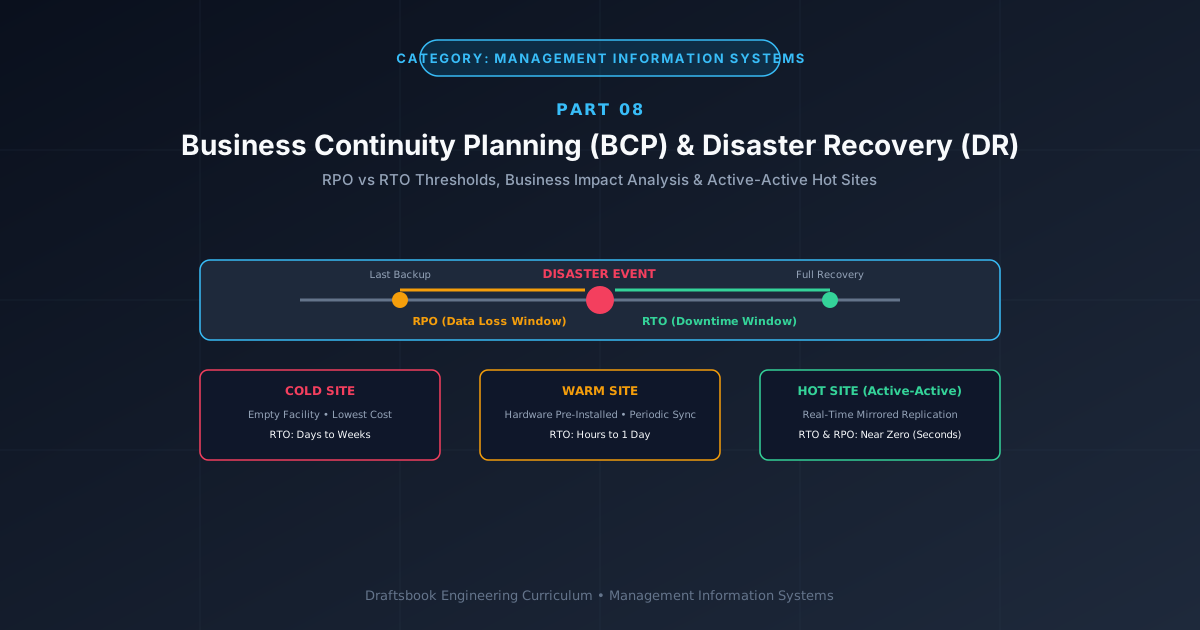
Part 8: Business Continuity Planning (BCP) & Disaster Recovery (DR)
Master Business Continuity Planning (BCP) and Disaster Recovery (DR): Business Impact Analysis, RPO vs RTO metrics, and cold vs hot failover sites.
By Md. Harun-Or-Roshid
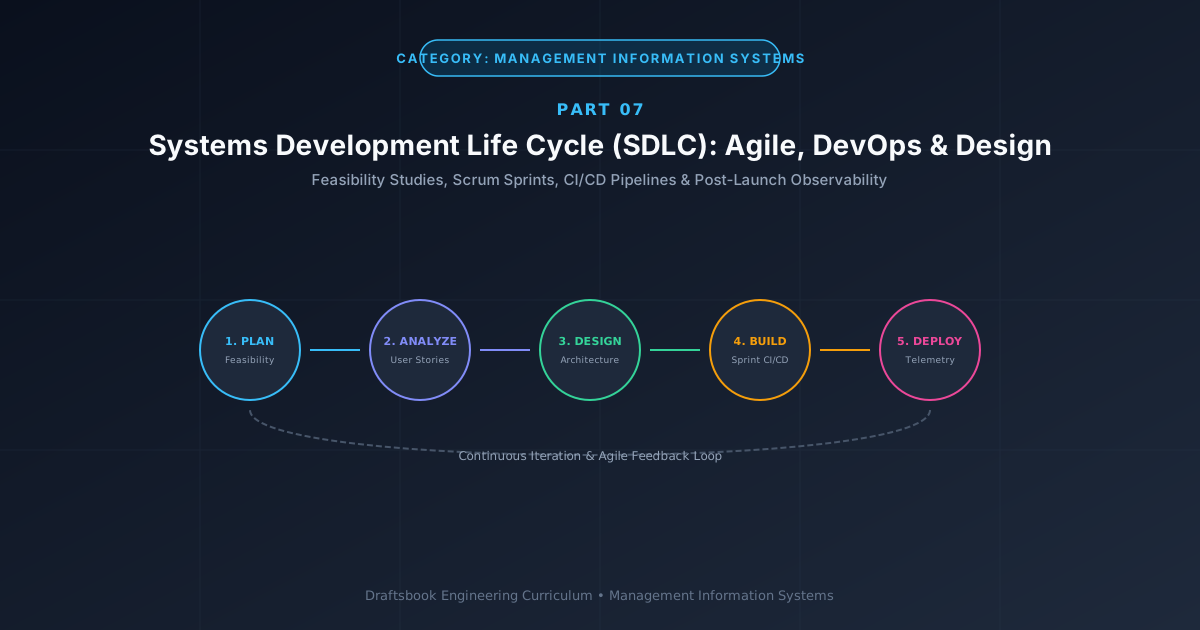
Part 7: Systems Development Life Cycle (SDLC): Agile, DevOps & Design
Master the Systems Development Life Cycle (SDLC): TELOS feasibility, Waterfall vs Agile Scrum, CI/CD automated deployment, and enterprise DevOps.
By Md. Harun-Or-Roshid