Part 10: Ethical Governance, Data Privacy (GDPR) & Future Enterprise Tech
Curriculum Capstone
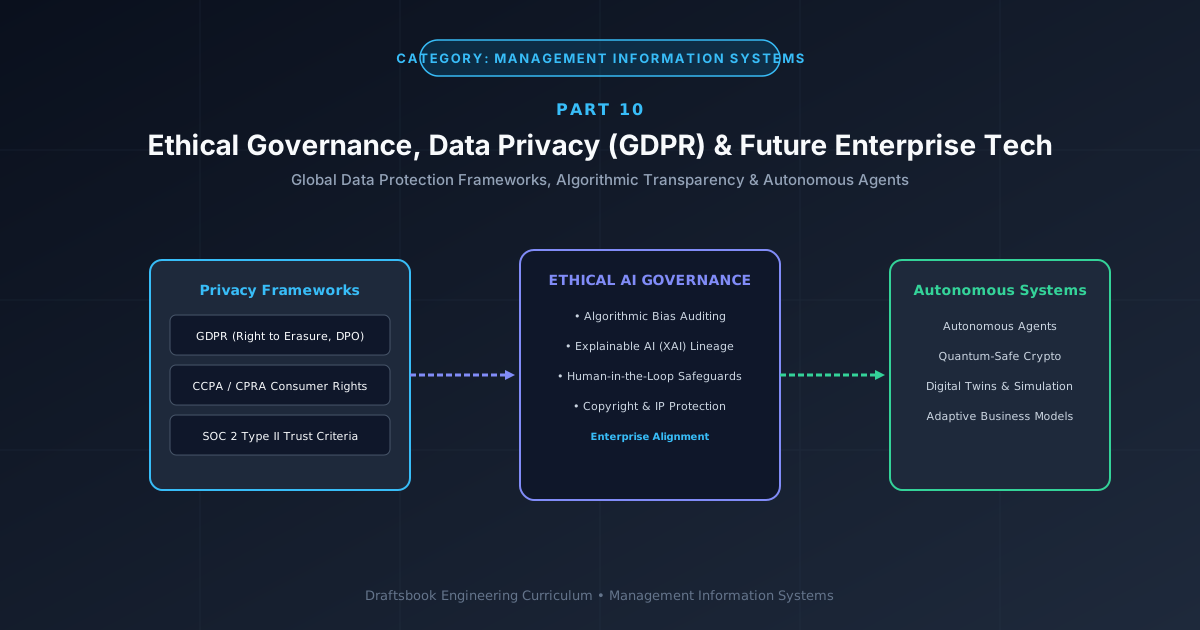
Information technology has permeated every facet of societal, economic, and political life. With immense technical power comes profound ethical responsibility. In this tenth and concluding installment of the Management Information Systems curriculum, we explore Ethical Governance & Emerging Horizons: international data protection frameworks (GDPR, CCPA/CPRA), algorithmic bias in enterprise AI, explainable decision-making, autonomous digital agents, and quantum-safe enterprise encryption.
1. International Data Privacy Frameworks: GDPR & CCPA
Regulatory compliance has shifted from voluntary internal guidelines to legally binding statutes carrying fines exceeding 4% of global annual turnover:
General Data Protection Regulation (GDPR)
Enacted by the European Union, GDPR establishes core consumer rights: the Right to Access, the Right to Rectification, the Right to be Forgotten (Erasure), and mandatory 72-hour breach notification rules. Requires appointment of dedicated Data Protection Officers (DPO).
California Consumer Privacy Act (CCPA / CPRA)
Empowers consumers with the right to know what personal information is collected, the right to delete personal data, and an absolute right to Opt-Out of the sale or sharing of their personal information to third-party ad networks.
2. Algorithmic Accountability & Ethical AI Governance
As enterprises integrate automated Machine Learning models into credit underwriting, hiring screenings, and healthcare diagnoses, IT leadership must address algorithmic ethics:
- Training Data Bias Mitigation: Historical data often reflects systemic human prejudice. If an automated resume-screening tool is trained on historical executive hiring records, it may penalize female or minority applicants unless rigorously balanced and audited.
- Explainable AI (XAI): Black-box deep neural networks that cannot articulate why a loan application was rejected violate fair-lending laws. Enterprises must implement interpretable models (SHAP, LIME) to provide auditable rationale for adverse decisions.
- Human-in-the-Loop Safeguards: Autonomous algorithms must serve as advisory decision-support tools for high-stakes outcomes, requiring explicit human executive sign-off.
3. Emerging Enterprise Horizons: Autonomous Agents & Quantum Resiliency
Enterprise information systems stand on the cusp of transformative structural shifts:
- Autonomous Digital Agents: Specialized AI agents equipped with tool-use APIs that autonomously navigate ERP databases, execute cross-system reconciliations, and resolve customer supply chain discrepancies without human mediation.
- Post-Quantum Cryptography (PQC): The impending arrival of quantum computing threatens classical RSA and ECC public-key encryption. Forward-looking enterprises are transitioning to NIST-standardized lattice-based cryptographic algorithms (CRYSTALS-Kyber, CRYSTALS-Dilithium).
- Digital Twins: Complete, real-time virtual simulations of entire physical factory floors and global shipping routes, allowing executives to stress-test scenarios in simulation before executing physical changes.
Curriculum Complete!
Congratulations! You have completed the 10-part Enterprise Management Information Systems curriculum, mastering the complete spectrum from organizational strategy and cloud infrastructure, through ERP/SCM and business intelligence, to decision support, DevOps, and ethical cybersecurity governance.
Related reading
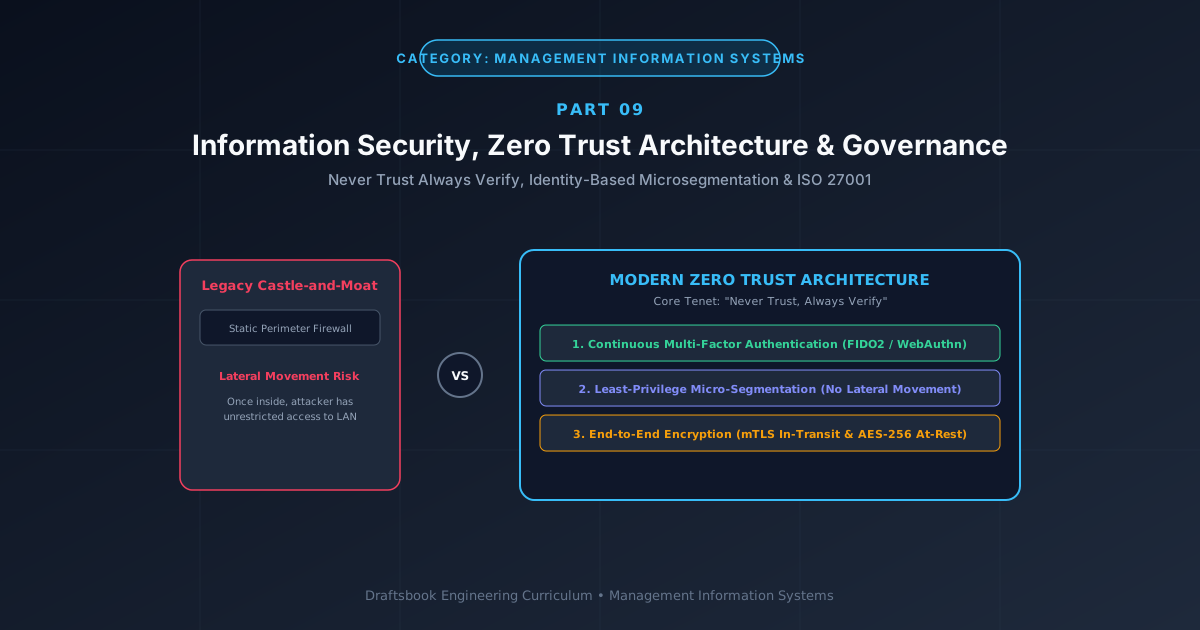
Part 9: Information Security, Zero Trust Architecture & Governance
Explore enterprise cybersecurity: the CIA triad, Zero Trust defense-in-depth, identity access management, SOC2/ISO 27001 compliance, and risk controls.
By Md. Harun-Or-Roshid
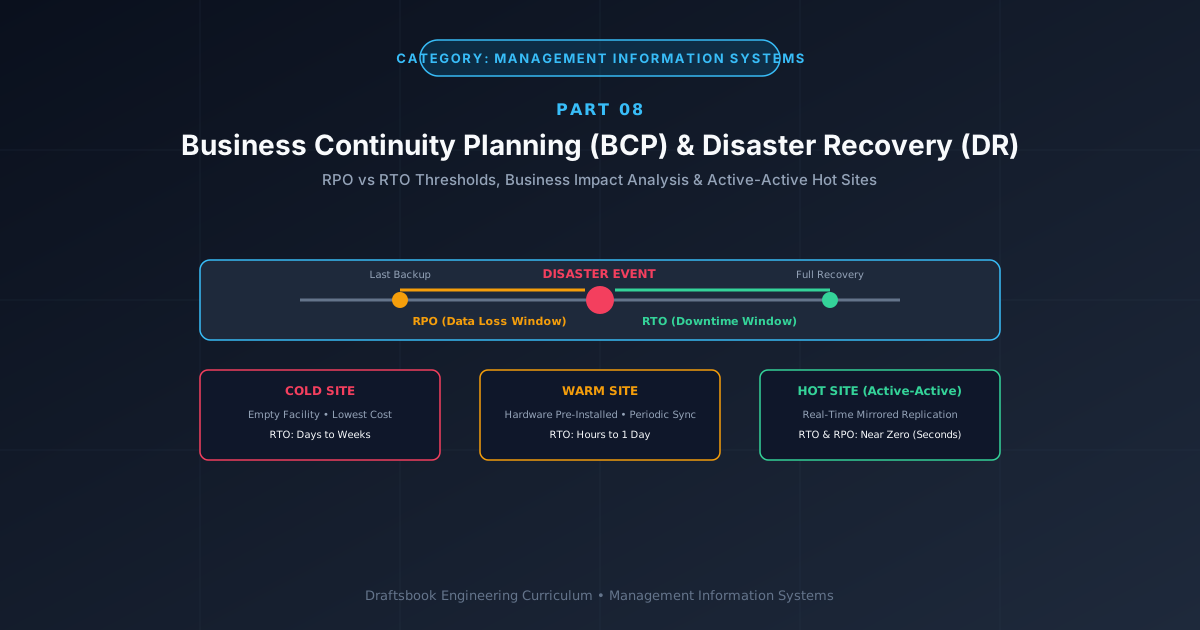
Part 8: Business Continuity Planning (BCP) & Disaster Recovery (DR)
Master Business Continuity Planning (BCP) and Disaster Recovery (DR): Business Impact Analysis, RPO vs RTO metrics, and cold vs hot failover sites.
By Md. Harun-Or-Roshid
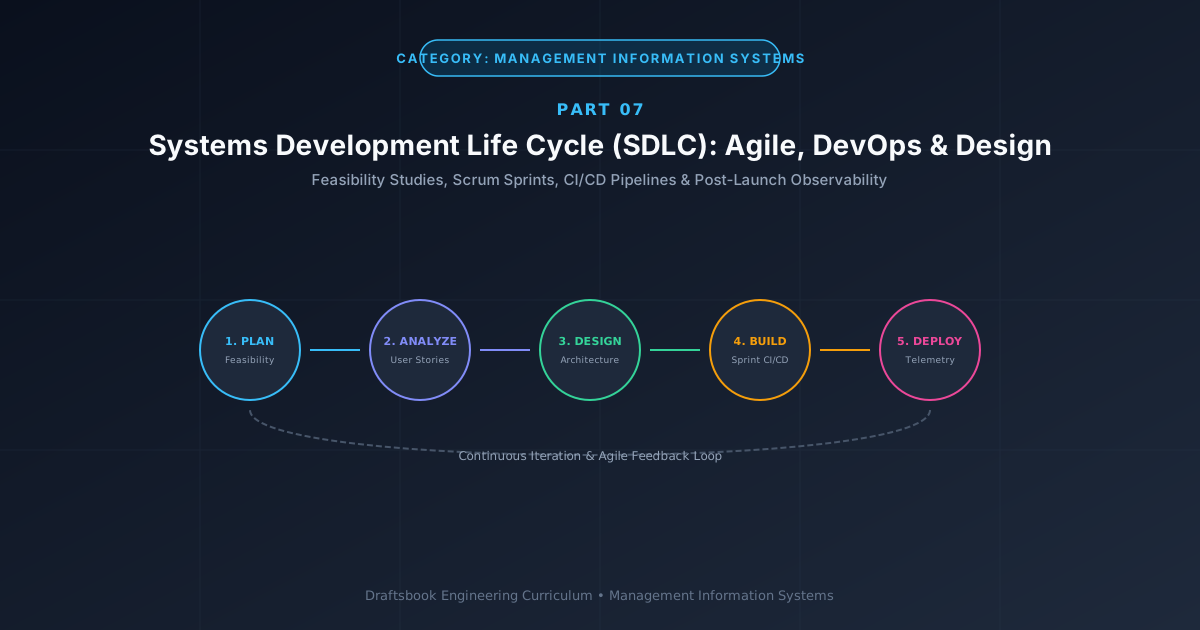
Part 7: Systems Development Life Cycle (SDLC): Agile, DevOps & Design
Master the Systems Development Life Cycle (SDLC): TELOS feasibility, Waterfall vs Agile Scrum, CI/CD automated deployment, and enterprise DevOps.
By Md. Harun-Or-Roshid
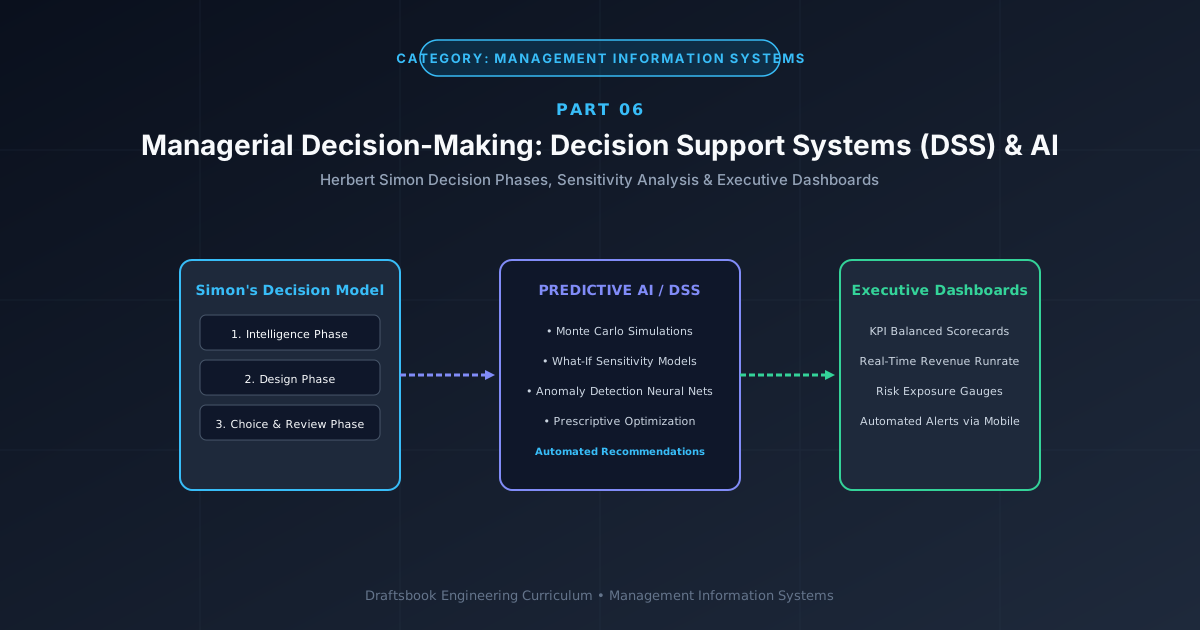
Part 6: Managerial Decision-Making: Decision Support Systems (DSS) & AI
Analyze managerial decision-making: Herbert Simon's decision phases, structured vs unstructured choices, DSS modeling, and predictive analytics engines.
By Md. Harun-Or-Roshid