Part 6: Managerial Decision-Making: Decision Support Systems (DSS) & AI
Module Overview
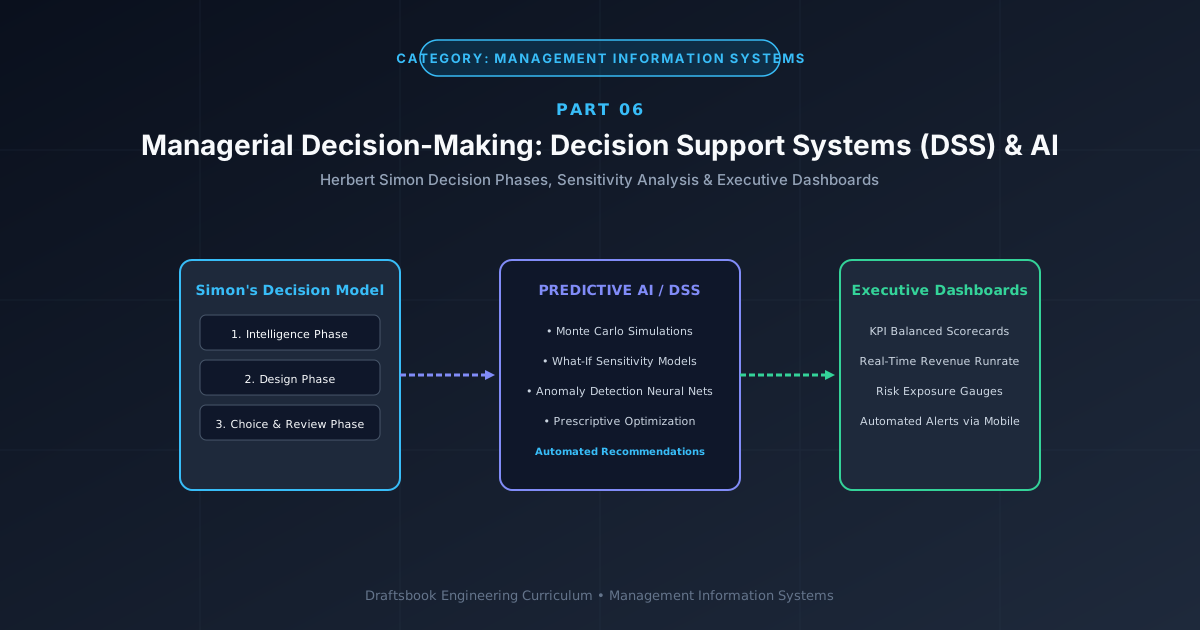
Management is fundamentally the science of allocating scarce enterprise resources under conditions of incomplete information and risk. In this sixth installment, we explore Managerial Decision-Making: Nobel laureate Herbert Simon's cognitive decision phases, structured versus unstructured problems, Decision Support Systems (DSS), Executive Information Systems (EIS), and the integration of modern predictive Machine Learning (ML) models into real-time managerial workflows.
1. Herbert Simon's Four Phases of Decision-Making
Economist and cognitive psychologist Herbert A. Simon formulated a systematic model that describes how human executives resolve complex problems:
2. Decision Classifications: Structured, Semi-Structured & Unstructured
Structured Decisions
Repetitive and routine procedures.
Problems with definite, mathematical decision rules. Can be completely delegated to automated software scripts without human intervention. Example: Granting credit card approvals based on FICO scores and automated debt-to-income algorithms.
Semi-Structured Decisions
Blend of algorithmic analysis and human judgment.
Only part of the problem has a clear-cut answer provided by an algorithmic model. Example: Evaluating an annual marketing budget where historical regression models estimate return on ad spend, but final brand positioning requires executive intuition.
Unstructured Decisions
Novel, non-routine, and strategic scenarios.
Problems with no predetermined procedure or algorithmic solution. Requires executive evaluation, negotiation, and judgment. Example: Deciding whether to exit a global market, acquire a competitor for \$2 billion, or pivot corporate business models.
3. Decision Support Systems (DSS) Capabilities
A Decision Support System (DSS) couples analytical modeling software with large database extracts to help middle managers make semi-structured decisions:
- What-If Analysis: Observing how changes in one variable (e.g., a 15% increase in raw steel tariff costs) impact output metrics (gross margin and product retail pricing).
- Sensitivity Analysis: Iteratively varying inputs across thousands of runs to identify which specific variable carries the highest risk or leverage over bottom-line outcomes.
- Goal-Seeking Analysis (Backward Calculation): Determining what input parameters are required to hit a desired target metric (e.g., "What volume of units must be sold in Q4 to achieve an 18% return on equity?").
- Monte Carlo Simulation: Running tens of thousands of random probability distributions to model complex risk envelopes in major capital investments.
4. The Machine Learning Paradigm Shift: Predictive to Prescriptive
Modern enterprise systems are evolving past passive historical descriptive reporting ("What happened?") toward automated autonomous intelligence:
- Descriptive Analytics: Historical SQL reports and static pivot tables summarizing past financial transactions.
- Diagnostic Analytics: Drill-down OLAP queries identifying root causes of system anomalies or sales variances.
- Predictive Analytics: Supervised Machine Learning models forecasting future events (e.g., predicting equipment pump failure 48 hours before physical breakdown).
- Prescriptive Analytics: Algorithmic decision engines that not only predict future outcomes but autonomously execute corrective interventions across enterprise ERP workflows.
Next in Curriculum
In Part 7: Systems Development Life Cycle (SDLC): Agile, DevOps & Design, we explore how enterprise software is planned, architected, and continuously delivered through Agile and DevOps engineering practices.
Related reading
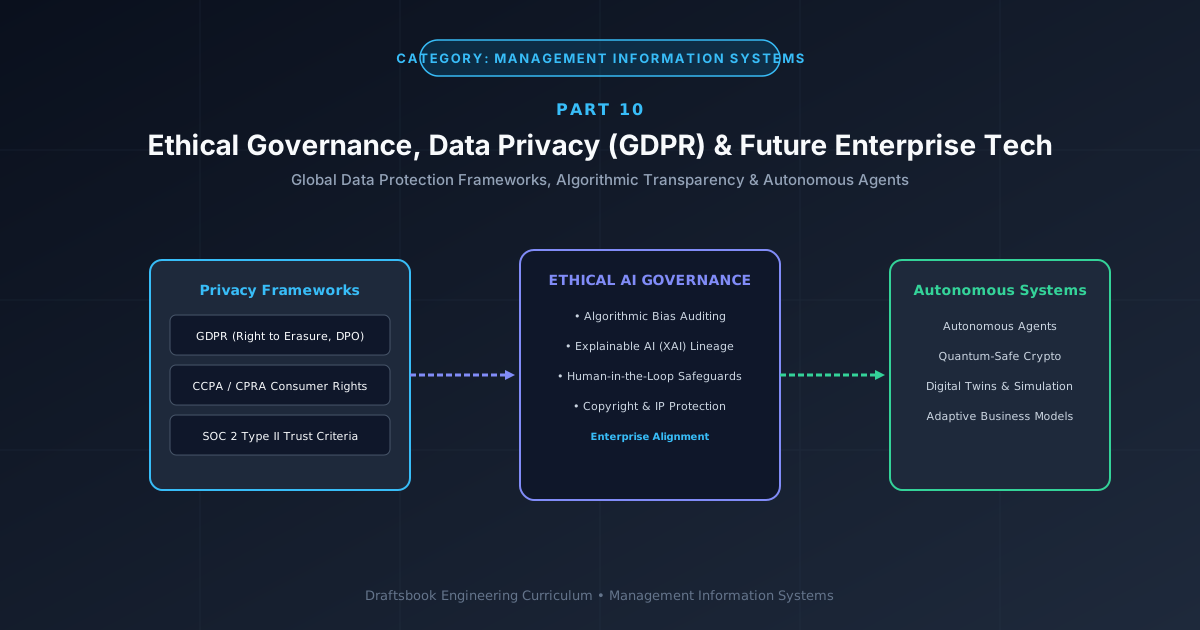
Part 10: Ethical Governance, Data Privacy (GDPR) & Future Enterprise Tech
Examine ethical information governance: GDPR/CCPA data privacy, algorithmic bias mitigation, explainable AI, autonomous digital agents, and quantum crypto.
By Md. Harun-Or-Roshid
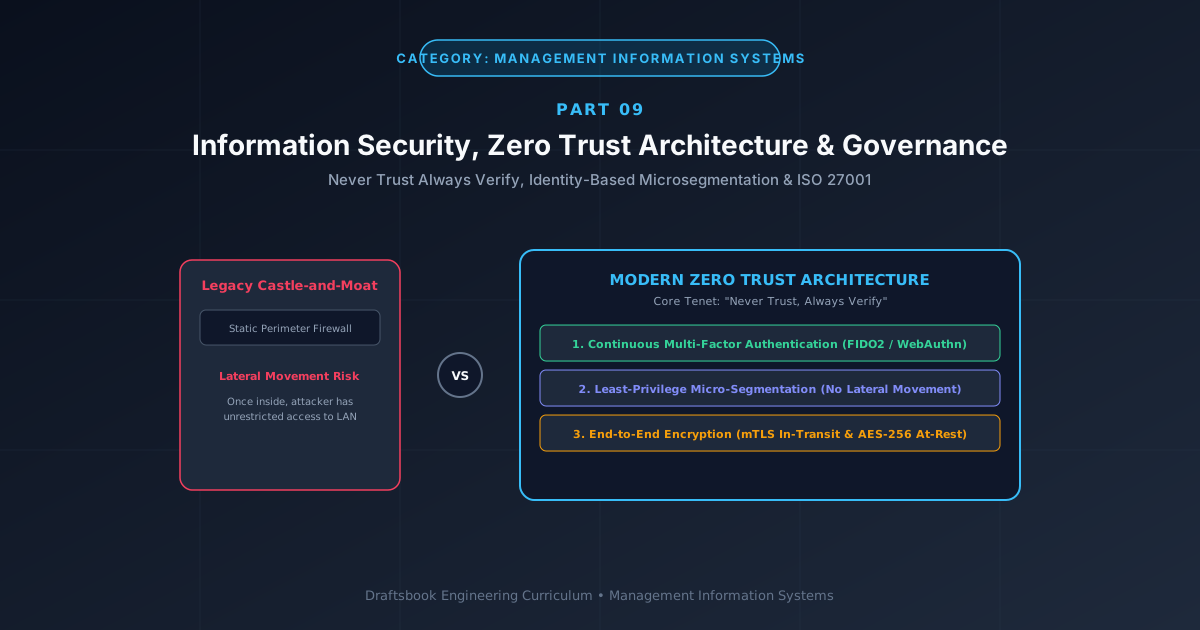
Part 9: Information Security, Zero Trust Architecture & Governance
Explore enterprise cybersecurity: the CIA triad, Zero Trust defense-in-depth, identity access management, SOC2/ISO 27001 compliance, and risk controls.
By Md. Harun-Or-Roshid
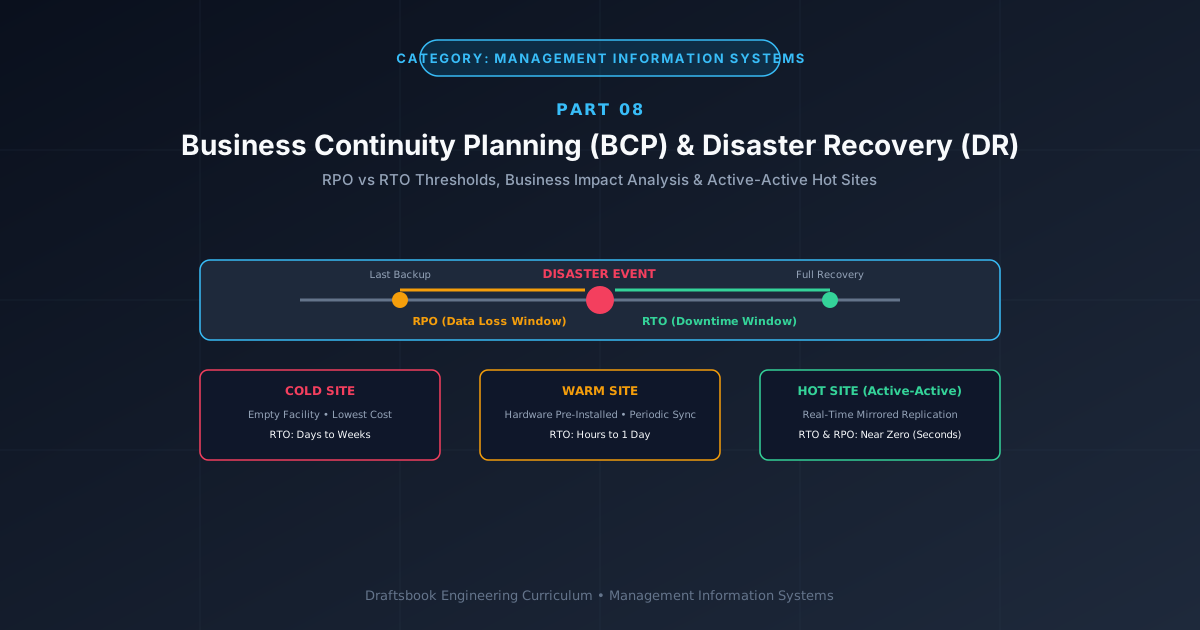
Part 8: Business Continuity Planning (BCP) & Disaster Recovery (DR)
Master Business Continuity Planning (BCP) and Disaster Recovery (DR): Business Impact Analysis, RPO vs RTO metrics, and cold vs hot failover sites.
By Md. Harun-Or-Roshid
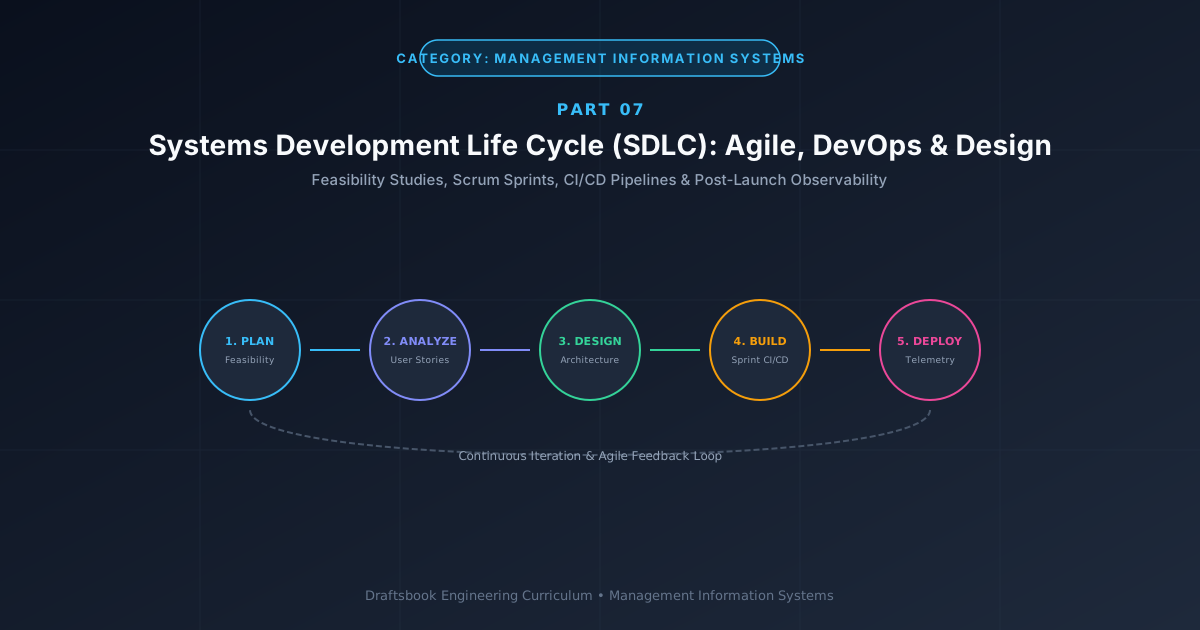
Part 7: Systems Development Life Cycle (SDLC): Agile, DevOps & Design
Master the Systems Development Life Cycle (SDLC): TELOS feasibility, Waterfall vs Agile Scrum, CI/CD automated deployment, and enterprise DevOps.
By Md. Harun-Or-Roshid