Part 8: Instruction Set Architecture: CISC vs RISC & The Open RISC-V Standard
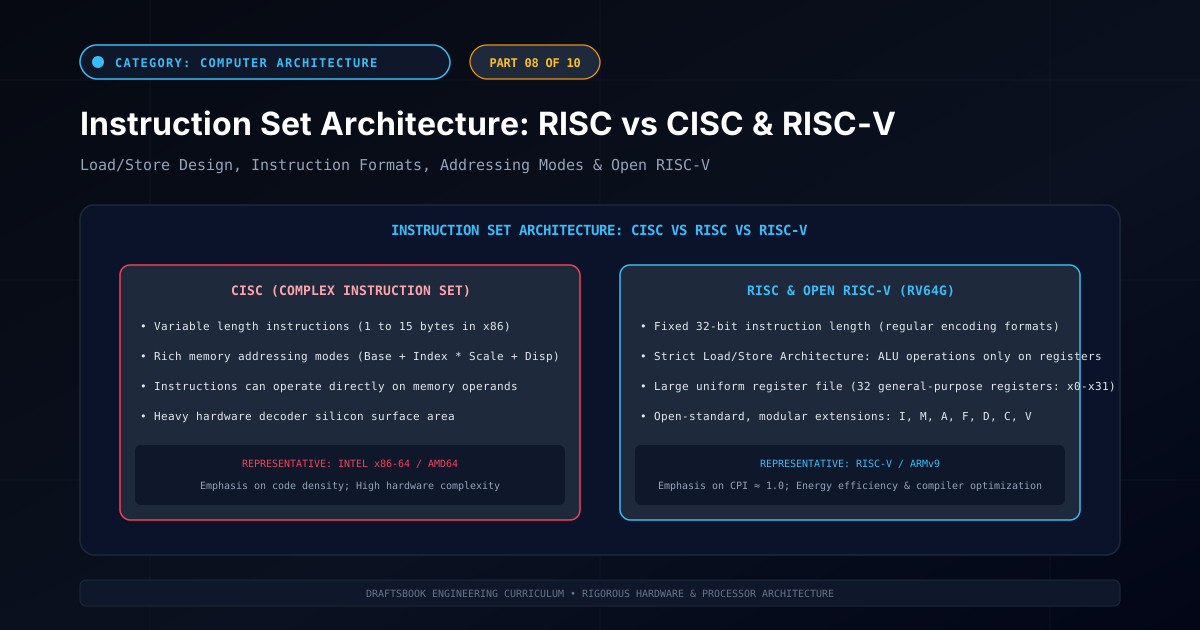
Instruction Set Architecture (ISA) Philosophy
The Instruction Set Architecture (ISA) serves as the fundamental abstraction boundary and contractual specification bridging software software (compilers, operating systems) and underlying hardware silicon. Historically, computer architecture polarized into two philosophical camps: CISC (Complex Instruction Set Computer), which prioritizes dense, variable-length instructions executing complex multi-step operations in hardware, and RISC (Reduced Instruction Set Computer), which prioritizes streamlined, fixed-length instructions, load/store semantics, and compiler optimization. In this article, we evaluate the architectural trade-offs between x86-64 and ARM, and dissect the modern open-standard RISC-V (RV64G) architecture.
1. The Architectural Divide: CISC vs. RISC
| Architectural Metric | CISC (e.g. Intel x86-64) | RISC (e.g. RISC-V, ARM) |
|---|---|---|
| Instruction Length | Variable length (1 to 15 bytes per instruction) | Uniform fixed 32-bit length (or 16-bit compressed) |
| Memory Access | Arithmetic ops can directly read/write memory operands | Strict Load/Store: ALU acts solely on registers |
| Register File Size | Relatively small (16 general registers in x86-64) | Large uniform file (32 general registers: x0-x31) |
| Decoder Complexity | Complex multi-stage decoders translating to internal μ-Ops | Ultra-simple single-cycle combinational hardwired decoders |
| Energy Efficiency | Higher idle power; higher transistor budget for decoding | Exceptional energy efficiency; dominates mobile & cloud servers |
2. The Iron Law of Processor Performance
The execution time of a computer program is governed by the universal performance formula:
- CISC Philosophy: Focuses on minimizing the number of instructions per program ($\frac{\text{Instructions}}{\text{Program}}$) by providing expressive, complex instructions, tolerating a higher CPI.
- RISC Philosophy: Minimizes the clock cycles per instruction ($\text{CPI} \to 1.0$) and enables shorter clock periods, accepting a modestly higher total instruction count handled by optimizing compilers.
3. The RISC-V Open Architecture Standard (RV64G)
Developed at UC Berkeley by Krste Asanović, David Patterson, and colleagues, RISC-V is a free and open instruction set architecture governed by RISC-V International. Unlike proprietary ISAs (x86 licensed by Intel/AMD, ARM licensed by Arm Ltd), RISC-V is completely unencumbered by royalties or patents.
RISC-V is designed around a clean, modular base integer ISA with optional standardized extensions:
- RV64I: 64-bit base integer instruction set with 32 general-purpose registers (
x0is hardwired to 0). - M Extension: Standard integer multiplication and division hardware.
- A Extension: Atomic memory instructions (load-reserved / store-conditional) for OS concurrency locks.
- F & D Extensions: Single-precision (32-bit) and double-precision (64-bit) IEEE 754 floating-point units with 32 floating-point registers (
f0-f31). - C Extension: 16-bit compressed instructions, yielding equal or superior code density compared to CISC x86.
- V Extension: Variable-length vector processing extensions for high-throughput AI/ML and scientific computing.
Related reading
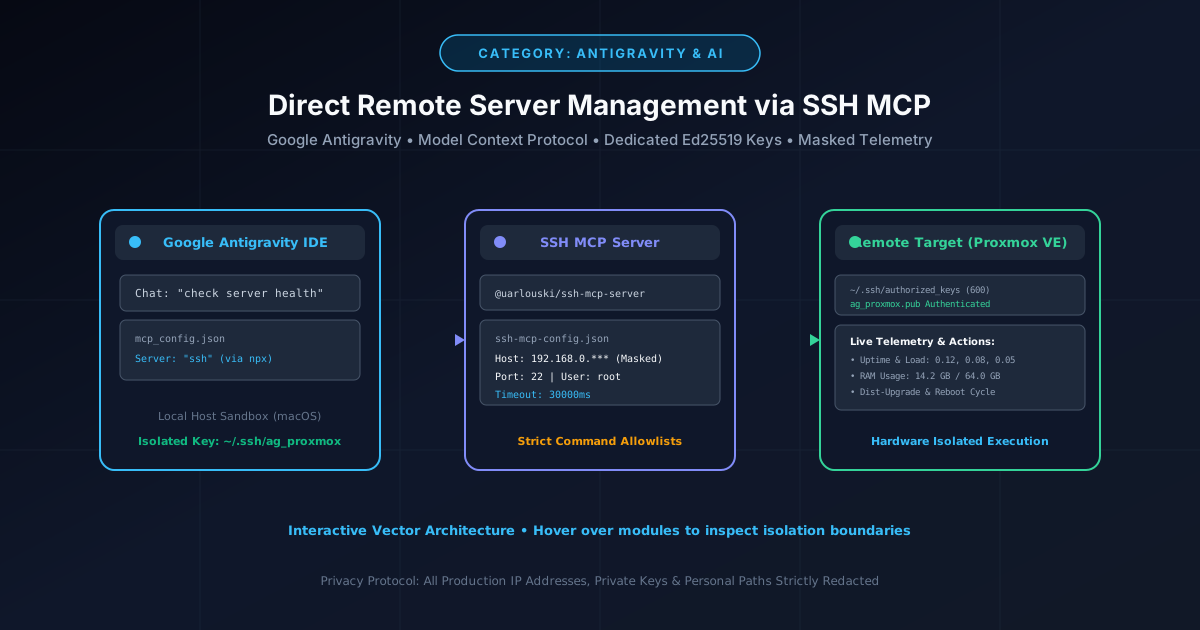
How to Give Google Antigravity Direct SSH Access to Remote Servers (Proxmox & Linux)
Connect Google Antigravity directly to Proxmox and Linux servers using the Model Context Protocol (MCP), dedicated Ed25519 keys, and automated updates.
By Md. Harun-Or-Roshid
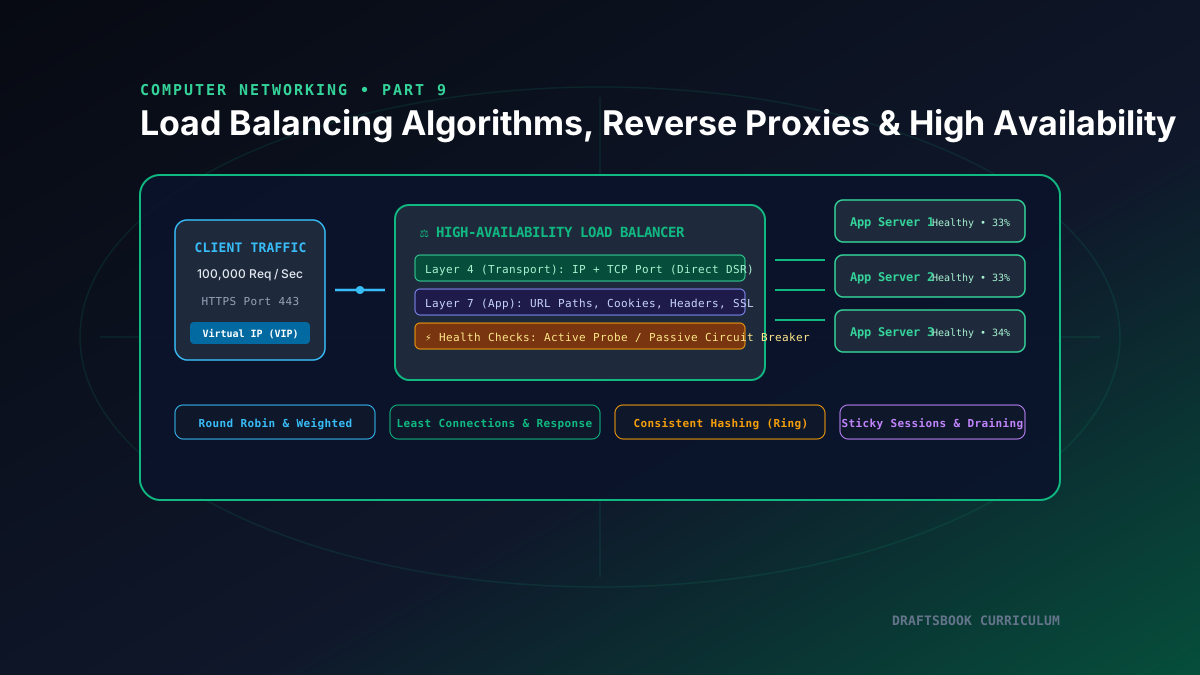
Part 9: Load Balancing: Layer 4 vs Layer 7, Algorithms, Reverse Proxies & High Availability
Master high-availability load balancing, comparing Layer 4 transport vs Layer 7 application routing, consistent hashing rings, and health checks.
By Md. Harun-Or-Roshid
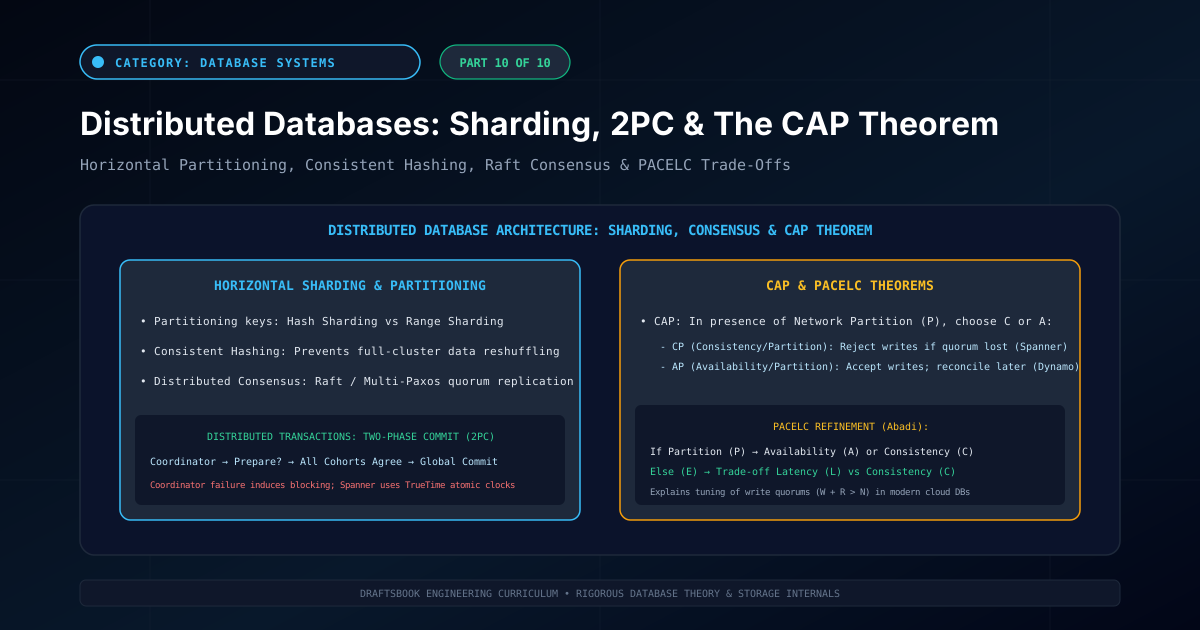
Part 10: Distributed Databases: Partitioning, Sharding, 2PC & CAP Theorem
Master distributed database architecture: horizontal sharding, consistent hashing, two-phase commit (2PC), CAP theorem trade-offs, and NewSQL engines.
By Md. Harun-Or-Roshid
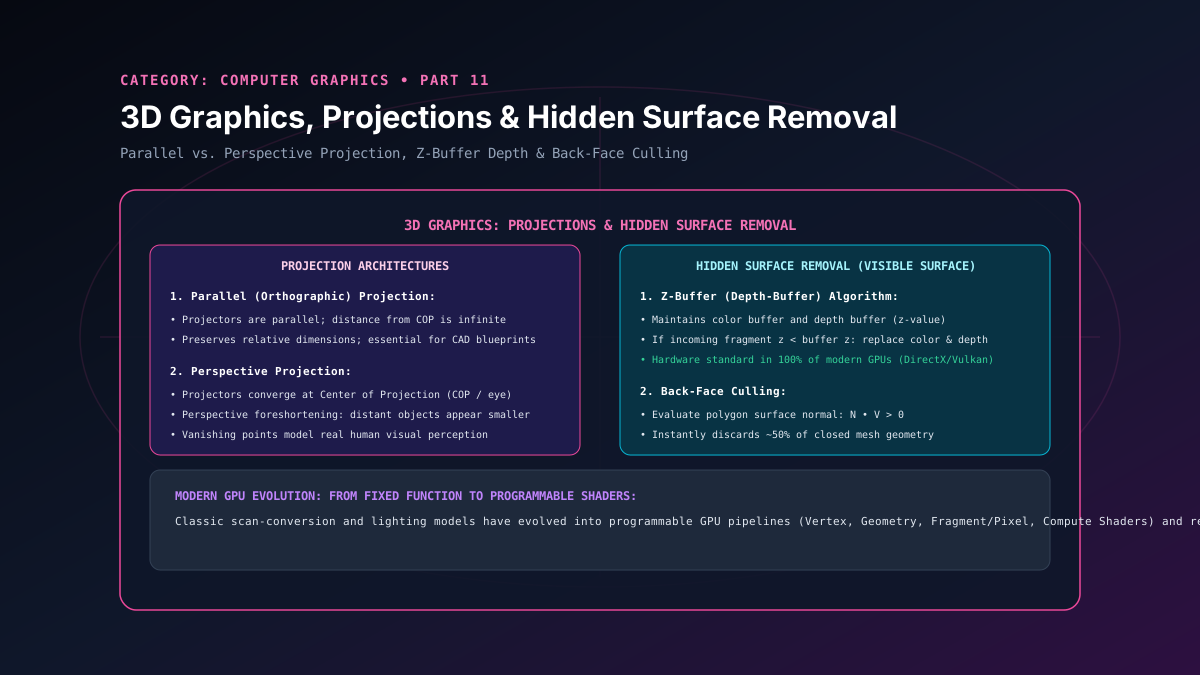
Part 11: 3D Graphics: Parallel & Perspective Projections & Hidden Surface Removal
A masterclass in 3D rendering pipelines, parallel and perspective projections, vanishing points, back-face culling, and GPU hardware Z-buffer depth testing.
By Md. Harun-Or-Roshid