Part 5: Modulation Techniques: ASK, FSK, PSK, QAM, AM & FM in Communications
Lesson Overview & Learning Objectives
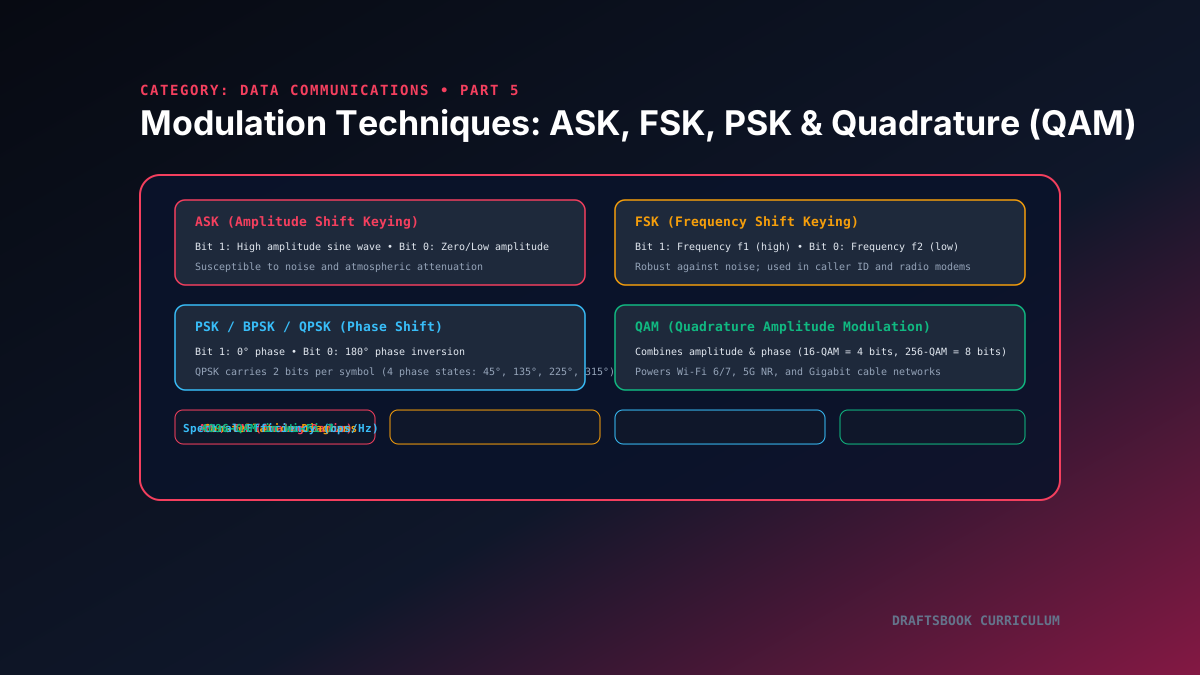
Modulation is the process of converting digital binary information into analog signals capable of travelling through physical bandpass channels. By altering the amplitude, frequency, or phase of a carrier sine wave, engineers can transmit thousands of bits per hertz of available spectrum. In this masterclass installment, we compare digital modulation schemes—Amplitude Shift Keying (ASK), Frequency Shift Keying (FSK), Phase Shift Keying (BPSK, QPSK), and Quadrature Amplitude Modulation (QAM)—and analyze constellation diagrams.
1. Digital-to-Analog Modulation Primitives
1. Amplitude Shift Keying (ASK)
In ASK, the carrier frequency and phase remain constant while the amplitude varies according to the digital bits. The simplest form is On-Off Keying (OOK), where bit 1 is a carrier wave and bit 0 is silence. Highly susceptible to noise and fading.
2. Frequency Shift Keying (FSK)
In FSK, the amplitude and phase remain constant while frequency varies between two values (\(f_1\) for bit 1, \(f_2\) for bit 0). FSK is resistant to noise (amplitude spikes do not alter frequency), making it ideal for radio telemetry.
3. Phase Shift Keying (PSK)
In PSK, amplitude and frequency remain constant while the phase of the carrier is shifted. In Binary PSK (BPSK), bit 1 is phase 0° and bit 0 is 180°. In Quadrature PSK (QPSK), 4 phase states (45°, 135°, 225°, 315°) encode 2 bits per symbol.
4. Quadrature Amplitude Modulation (QAM)
QAM modulates both amplitude and phase simultaneously by combining two carrier waves shifted by 90° (In-phase \(I\) and Quadrature \(Q\)). 16-QAM encodes 4 bits per symbol, 256-QAM encodes 8 bits, and modern Wi-Fi 7 utilizes 4096-QAM (12 bits per symbol).
2. Comparative Summary of Modulation Schemes
| Modulation | Parameter Altered | Bits per Symbol | Noise Immunity | Primary Application |
|---|---|---|---|---|
| ASK / OOK | Amplitude | 1 | Poor | Optical fiber (light pulses), RFID keyfobs |
| BFSK | Frequency | 1 | High | Caller ID tones, legacy modems, Bluetooth basic rate |
| QPSK | Phase (4 states) | 2 | High | Satellite TV (DVB-S), cellular control channels |
| 256-QAM | Amplitude + Phase | 8 | Moderate (Needs High SNR) | DOCSIS cable modems, LTE-Advanced, Wi-Fi 5 |
| 4096-QAM | Amplitude + Phase | 12 | Requires pristine SNR | Wi-Fi 7 (802.11be), 5G NR Ultra-Wideband |
Related reading
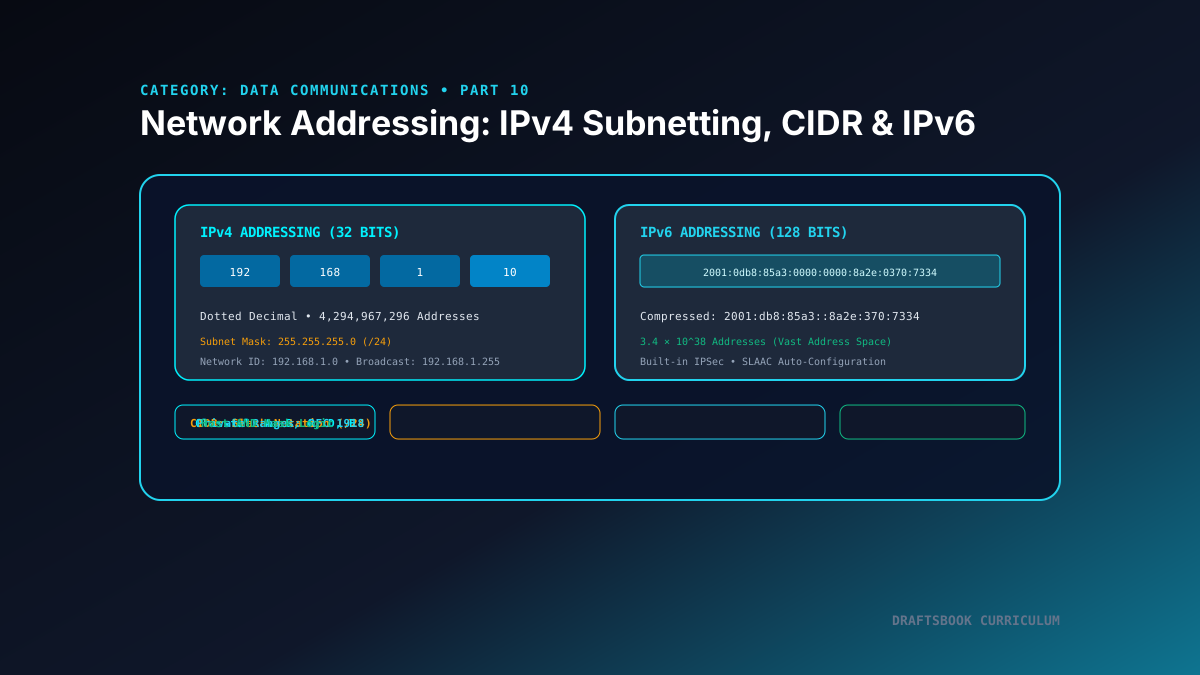
Part 10: Network Layer Addressing: IPv4 Subnetting, CIDR & IPv6 Architecture
Master logical network addressing: explore IPv4 classful ranges, CIDR slash notation, subnet mask bitwise ANDing, and modern 128-bit IPv6 architecture.
By Md. Harun-Or-Roshid
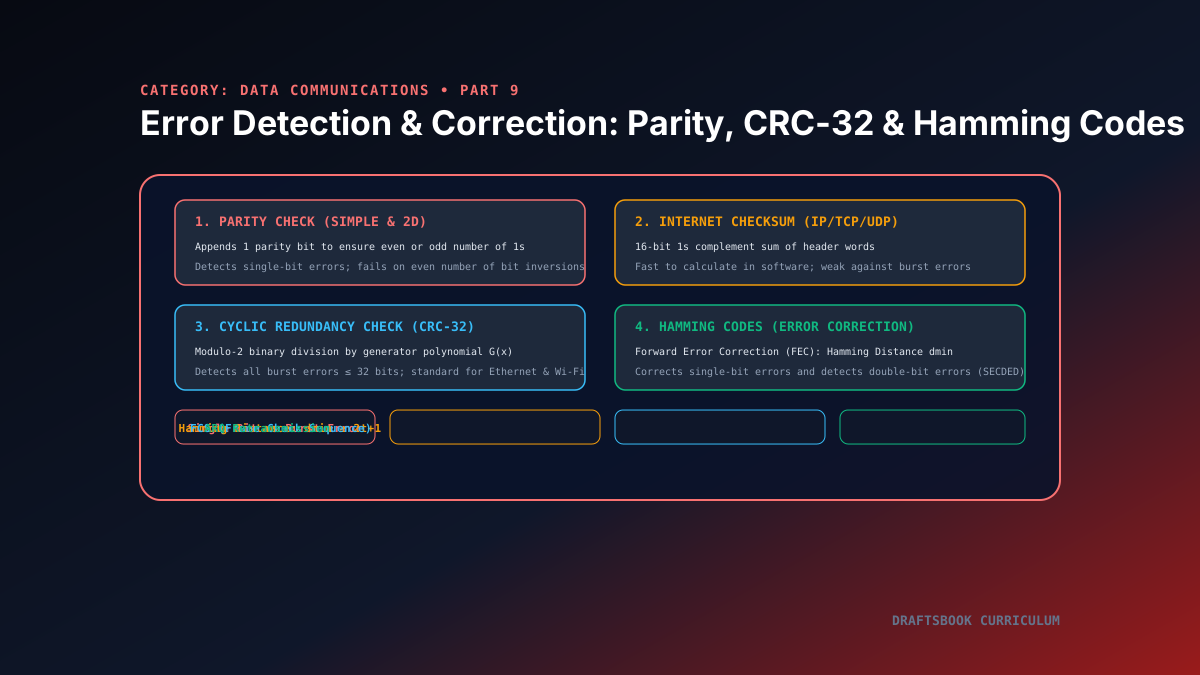
Part 9: Error Detection and Correction: Parity, Checksums, CRC-32 & Hamming
A deep dive into data integrity: comparing simple parity, Internet Checksums, Cyclic Redundancy Checks (CRC-32), and Hamming forward error correction.
By Md. Harun-Or-Roshid
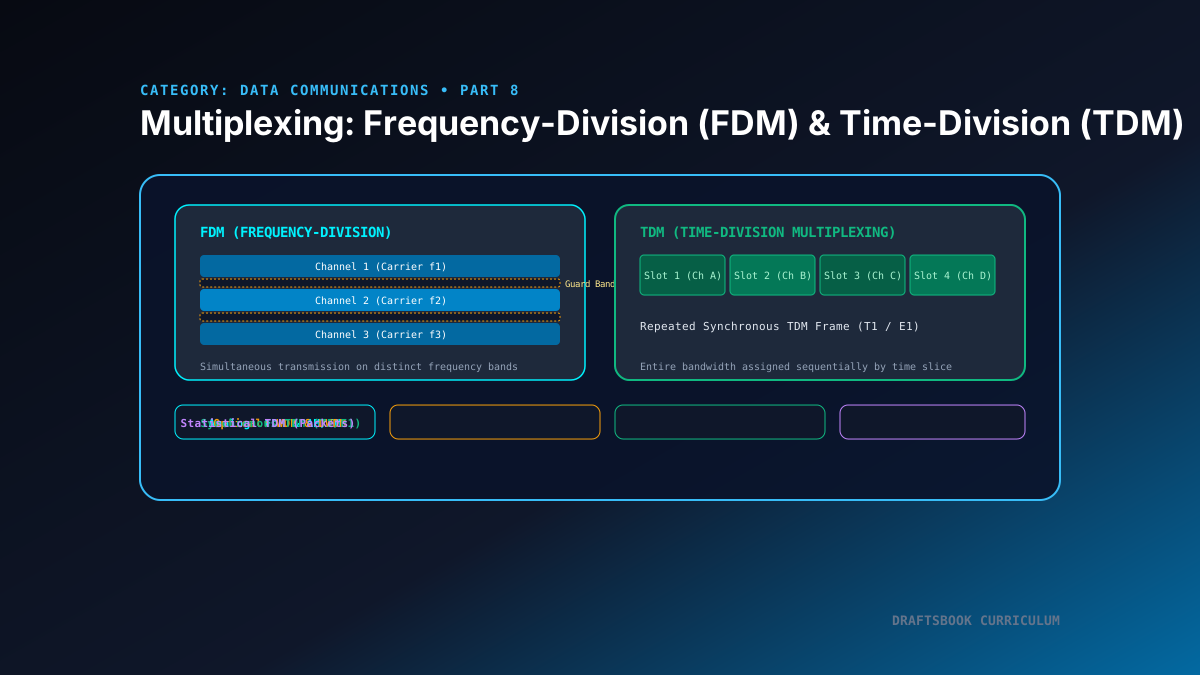
Part 8: Multiplexing Techniques: Frequency-Division (FDM) & Time-Division (TDM)
A comprehensive guide to signal multiplexing: analyzing Frequency-Division (FDM), Synchronous and Statistical Time-Division (TDM), and optical WDM.
By Md. Harun-Or-Roshid
Part 7: Pulse Modulation & Companding: PAM, PWM, PPM, PCM & Quantization
Explore analog-to-digital signal conversion: comparing PAM, PWM, PPM, Pulse Code Modulation (PCM) sampling, quantization error, and µ-law/A-law companding.
By Md. Harun-Or-Roshid