Part 6: Wireless Transmission Fundamentals: RF Spectrum, Antennas & Path Loss
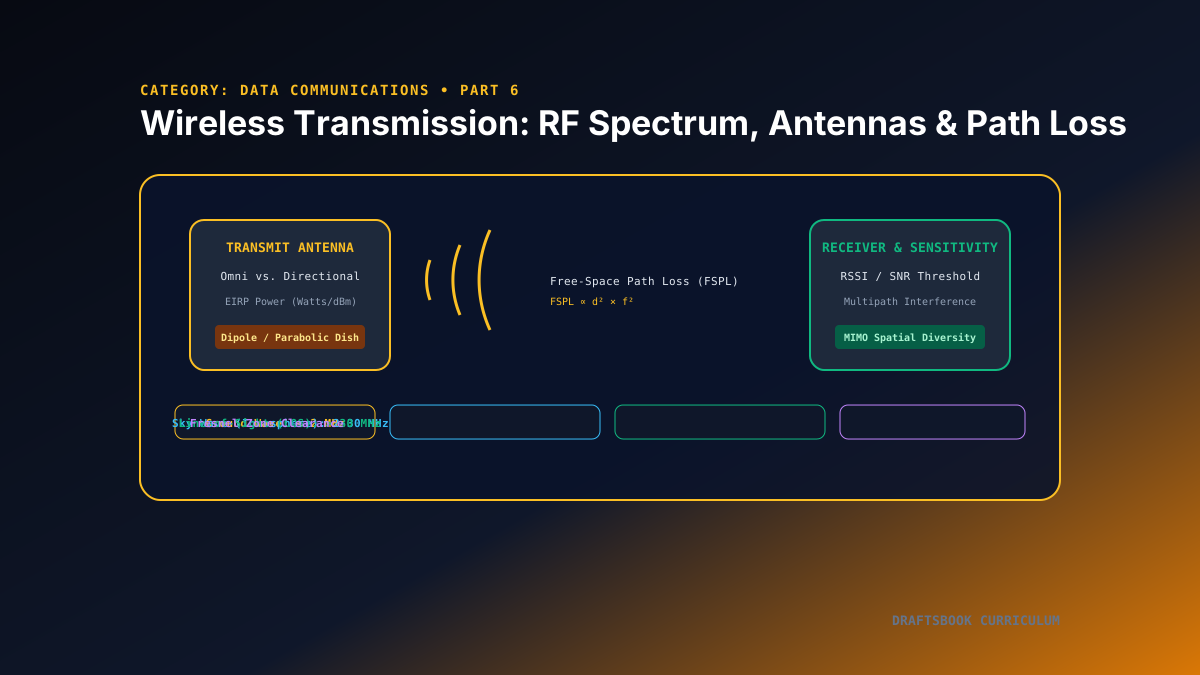
Lesson Overview & Learning Objectives
Unguided media transport electromagnetic signals without using a physical conductor. Instead, signals are radiated through air, water, and vacuum via wireless transmission. In this installment, we explore the Electromagnetic Radio Frequency (RF) Spectrum (from 3 kHz to 300 GHz), investigate the three physical modes of wave propagation (Ground Wave, Sky Wave, Line-of-Sight), calculate signal attenuation using the Free-Space Path Loss (FSPL) equation, and examine modern spatial antenna arrays (MIMO).
1. The Three Propagation Modes
1. Ground Wave (< 2 MHz)
Low-frequency radio waves follow the curvature of the earth by hugging the surface. Electromagnetic energy diffracts over hills and obstacles, providing long-range maritime and submarine communications (AM broadcast, VLF).
2. Sky Wave (2 MHz – 30 MHz)
High-frequency (HF) waves radiate into the upper atmosphere and reflect off the ionosphere back to earth. This "ionospheric skip" allows intercontinental amateur radio broadcasts without satellites or cables.
3. Line-of-Sight (> 30 MHz)
VHF, UHF, and Microwave signals travel in straight lines between transmit and receive antennas. Antennas must have unobstructed optical clearance (Fresnel Zone). Powers Wi-Fi, 4G/5G, and satellite uplinks.
2. Free-Space Path Loss (FSPL) Formula
As electromagnetic waves propagate outward from an isotropic antenna, their power spreads over the spherical surface of radius \(d\). The Free-Space Path Loss is mathematically expressed as:
A crucial architectural takeaway: higher frequencies attenuate faster over distance. This fundamental physics rule explains why a 2.4 GHz Wi-Fi signal penetrates walls better than 5 GHz or 6 GHz Wi-Fi, and why 5G mmWave base stations require micro-cells spaced every 200 meters.
3. Modern MIMO and Spatial Diversity
In urban environments, wireless signals bounce off buildings, walls, and terrain, creating multiple out-of-phase copies called Multipath Interference. While historically considered a nuisance, modern MIMO (Multiple-Input Multiple-Output) turns multipath into an advantage. By using multiple antennas to transmit independent spatial streams simultaneously, MIMO multiplies data throughput without consuming extra radio spectrum.
Related reading
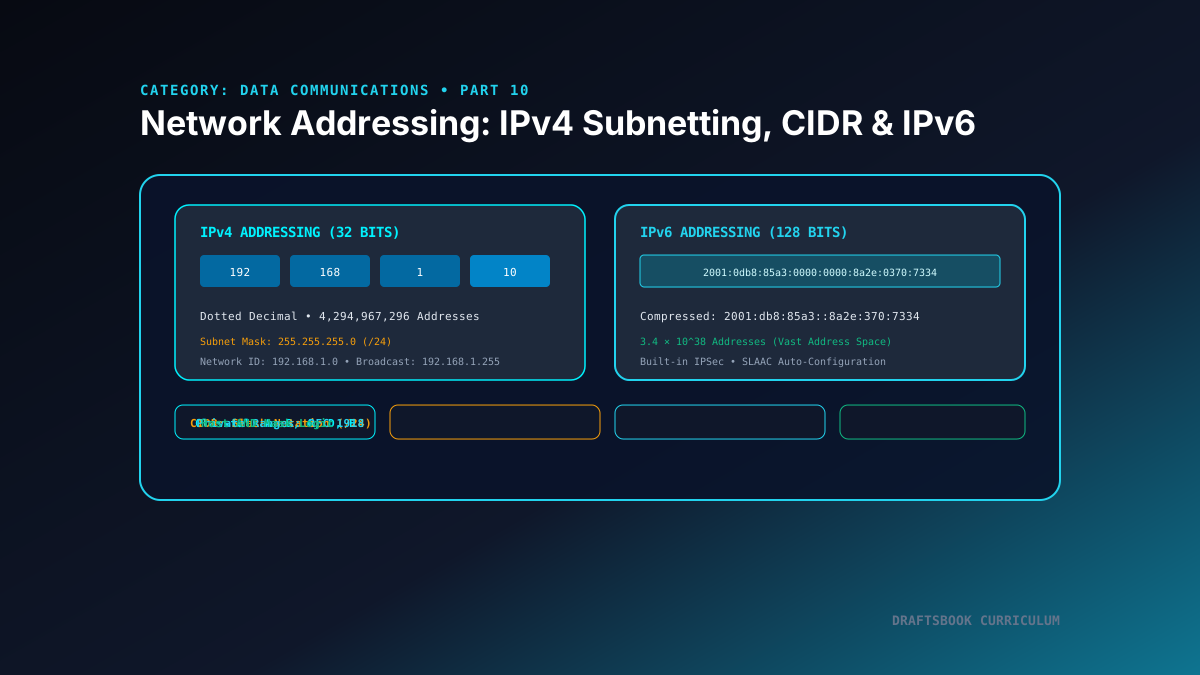
Part 10: Network Layer Addressing: IPv4 Subnetting, CIDR & IPv6 Architecture
Master logical network addressing: explore IPv4 classful ranges, CIDR slash notation, subnet mask bitwise ANDing, and modern 128-bit IPv6 architecture.
By Md. Harun-Or-Roshid
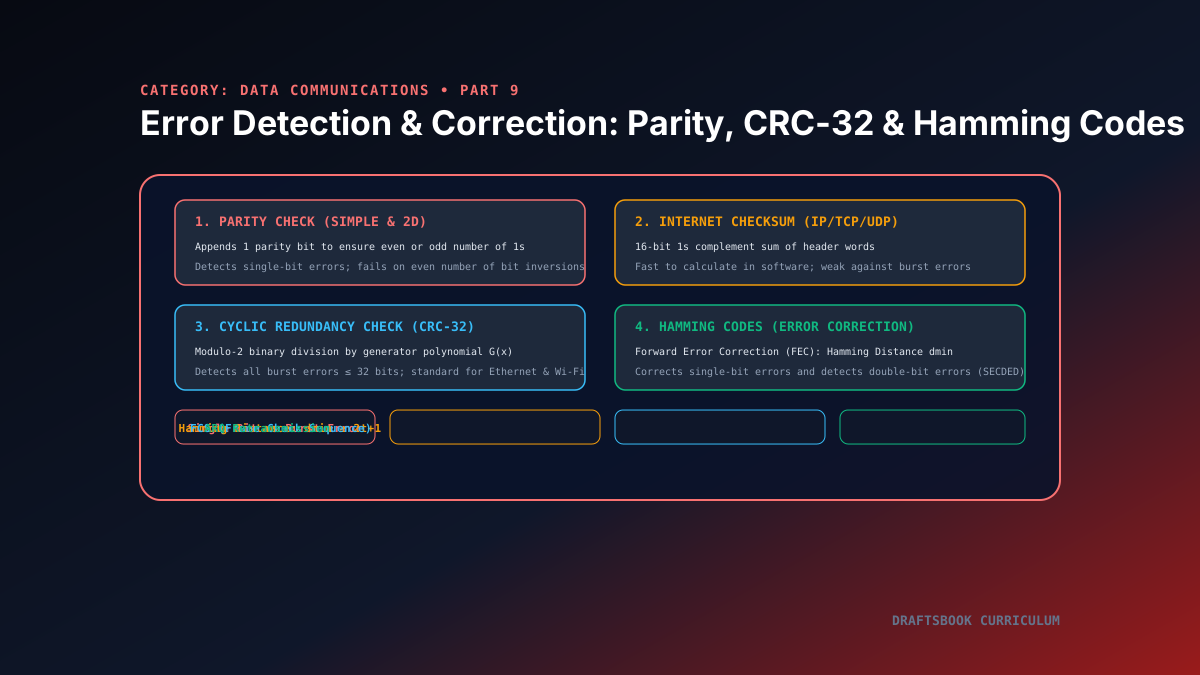
Part 9: Error Detection and Correction: Parity, Checksums, CRC-32 & Hamming
A deep dive into data integrity: comparing simple parity, Internet Checksums, Cyclic Redundancy Checks (CRC-32), and Hamming forward error correction.
By Md. Harun-Or-Roshid
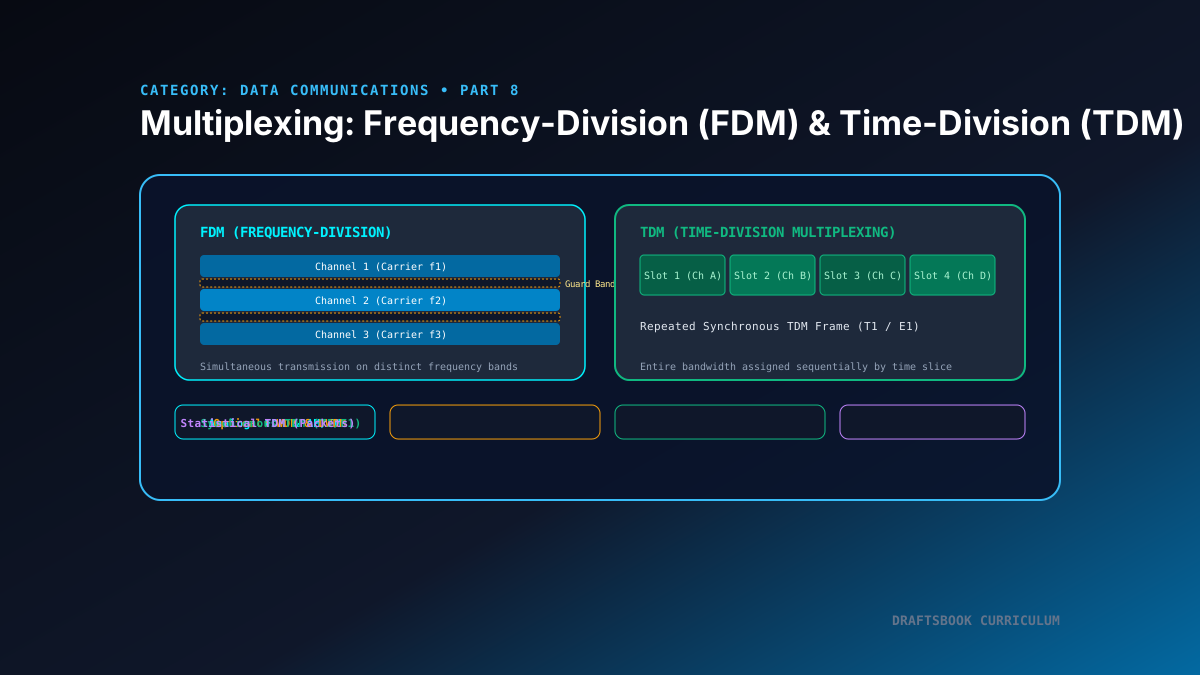
Part 8: Multiplexing Techniques: Frequency-Division (FDM) & Time-Division (TDM)
A comprehensive guide to signal multiplexing: analyzing Frequency-Division (FDM), Synchronous and Statistical Time-Division (TDM), and optical WDM.
By Md. Harun-Or-Roshid
Part 7: Pulse Modulation & Companding: PAM, PWM, PPM, PCM & Quantization
Explore analog-to-digital signal conversion: comparing PAM, PWM, PPM, Pulse Code Modulation (PCM) sampling, quantization error, and µ-law/A-law companding.
By Md. Harun-Or-Roshid