Part 7: Pulse Modulation & Companding: PAM, PWM, PPM, PCM & Quantization
Lesson Overview & Learning Objectives
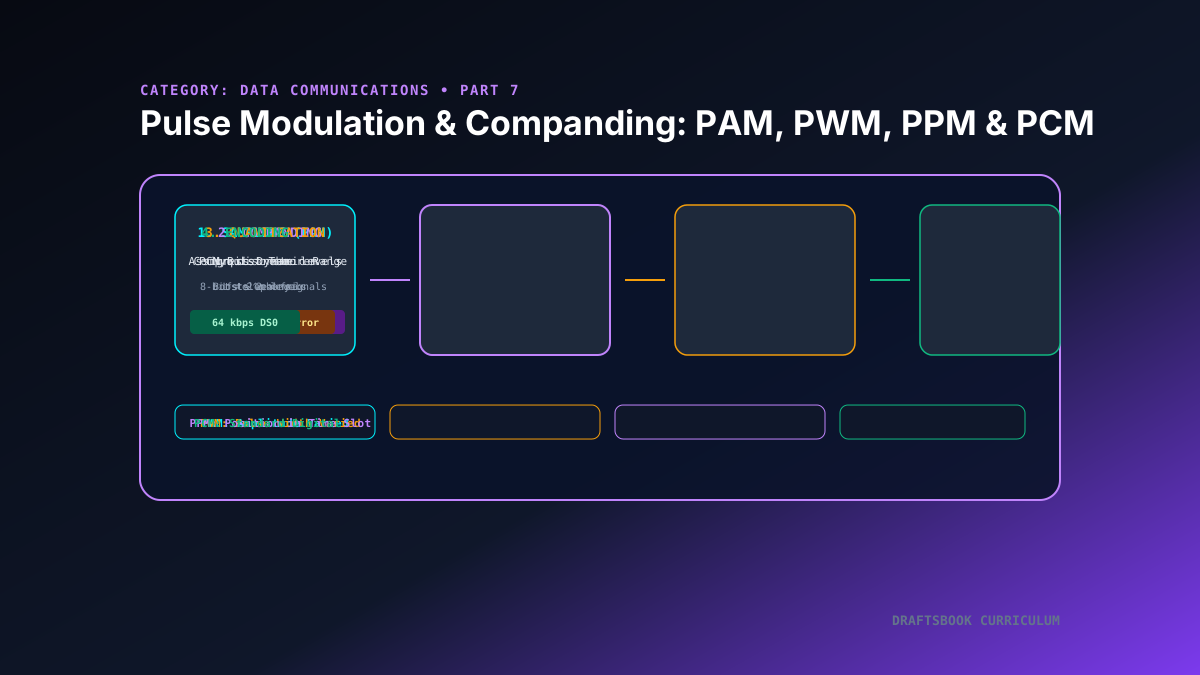
How do we digitize a continuous, fluctuating physical quantity—such as human speech or analog music—into clean, digital binary streams for computer transmission? The answer lies in Pulse Modulation and Pulse Code Modulation (PCM). In this deep dive, we compare analog pulse modulation (PAM, PWM, PPM), trace the four-stage pipeline of PCM (Sampling, Companding, Quantization, Encoding), analyze quantization noise, and explore non-linear \(\mu\)-law and A-law logarithmic companding curves.
1. The Analog Pulse Modulation Family
PAM (Pulse Amplitude Modulation)
The amplitude of periodic pulse trains is modulated in proportion to the instantaneous amplitude of the continuous analog message signal.
PWM (Pulse Width Modulation)
The duration (width) of each pulse is varied in proportion to the message amplitude, keeping pulse height constant. Widely used in motor control and DC power supplies.
PPM (Pulse Position Modulation)
The time position of a constant-width, constant-height pulse within its designated time slot is shifted based on message amplitude. Highly noise-immune for optical channels.
2. Pulse Code Modulation (PCM): From Audio to 64 kbps Digital Stream
PCM is the global standard for digitizing analog audio signals in telecommunications. The transformation follows four stages:
Stage 1: Sampling (Nyquist-Shannon Sampling Theorem)
An analog signal must be sampled at a rate at least twice its highest frequency: \(f_s \ge 2 \cdot f_{max}\). For standard telephone voice (\(f_{max} = 4 ext{ kHz}\)), sampling occurs exactly 8,000 times per second (every 125 microseconds).
Stage 2: Non-Linear Companding (μ-Law / A-Law)
Human speech contains many quiet, low-amplitude sounds and few loud bursts. Uniform quantization introduces severe relative error on quiet syllables. Companding (Compressing + Expanding) uses logarithmic amplification to allocate finer quantization steps to weak signals and coarser steps to loud signals. North America and Japan use μ-Law (\(\mu = 255\)); Europe and the rest of the world use A-Law (\(A = 87.6\)).
Stage 3: Quantization
The continuous PAM pulse amplitude is rounded to the nearest discrete level. In 8-bit PCM telephony, there are \(2^8 = 256\) discrete quantization levels. The unavoidable difference between actual signal and rounded level is Quantization Distortion.
Stage 4: Binary Encoding
Each quantized level is translated into an 8-bit binary word. With 8,000 samples per second and 8 bits per sample, the fundamental standard digital telephone voice channel operates at:
Related reading
Part 10: Network Layer Addressing: IPv4 Subnetting, CIDR & IPv6 Architecture
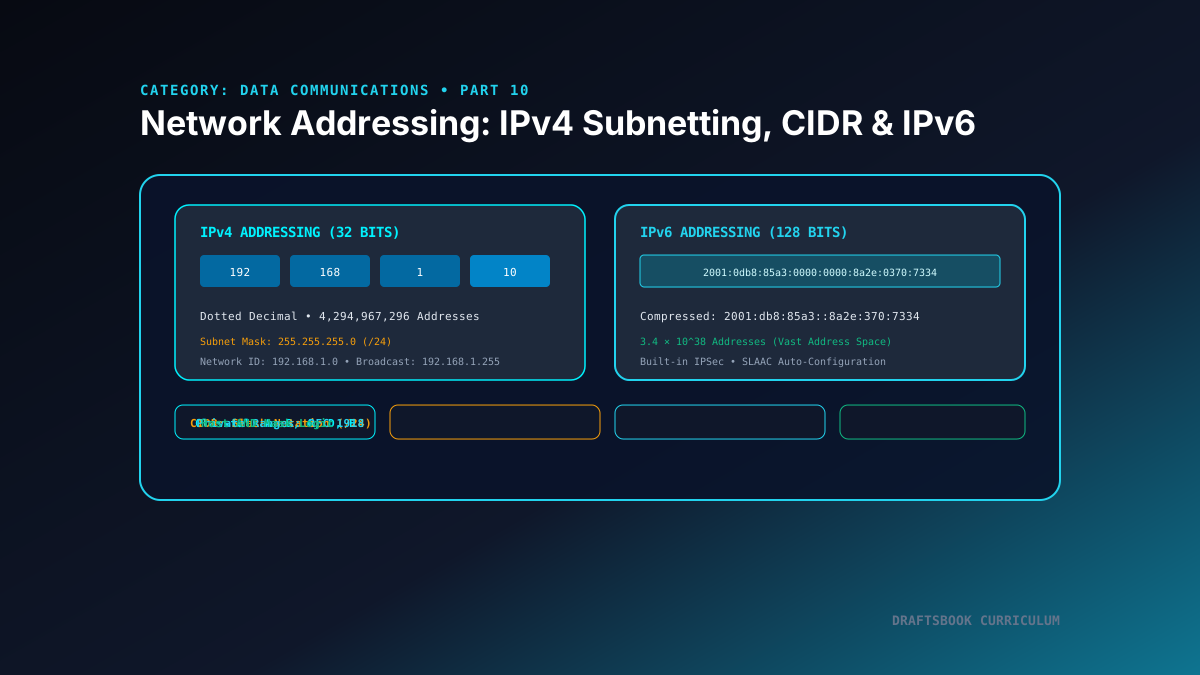
Master logical network addressing: explore IPv4 classful ranges, CIDR slash notation, subnet mask bitwise ANDing, and modern 128-bit IPv6 architecture.
By Md. Harun-Or-Roshid
Part 9: Error Detection and Correction: Parity, Checksums, CRC-32 & Hamming
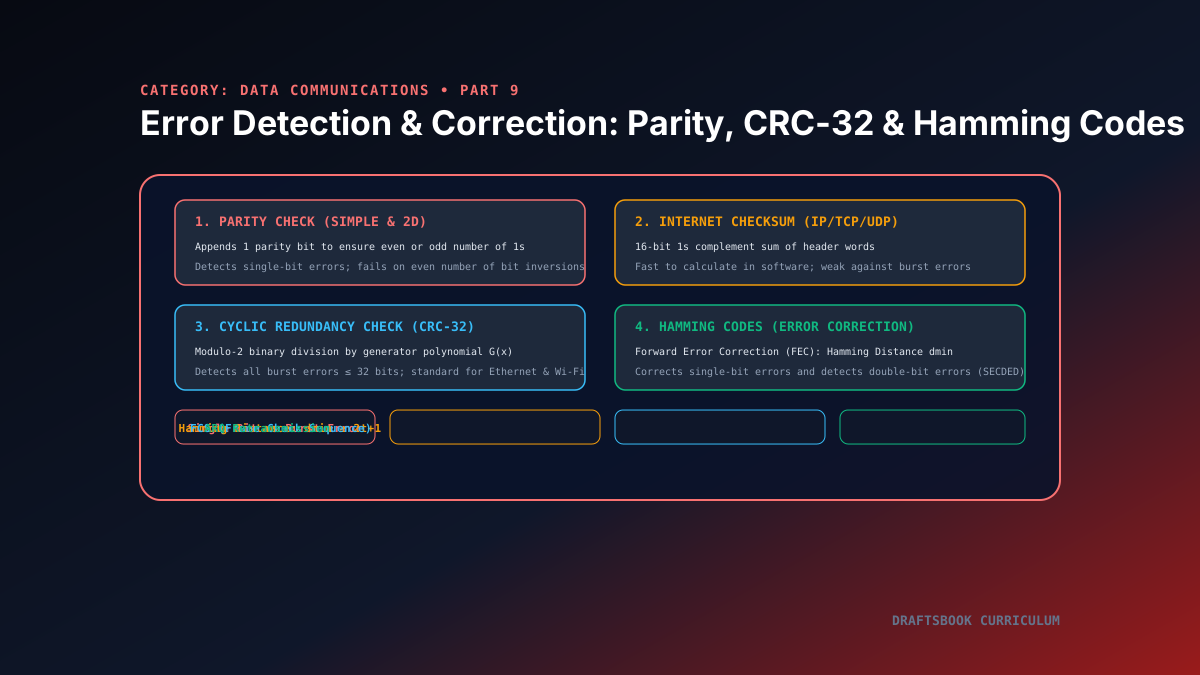
A deep dive into data integrity: comparing simple parity, Internet Checksums, Cyclic Redundancy Checks (CRC-32), and Hamming forward error correction.
By Md. Harun-Or-Roshid
Part 8: Multiplexing Techniques: Frequency-Division (FDM) & Time-Division (TDM)
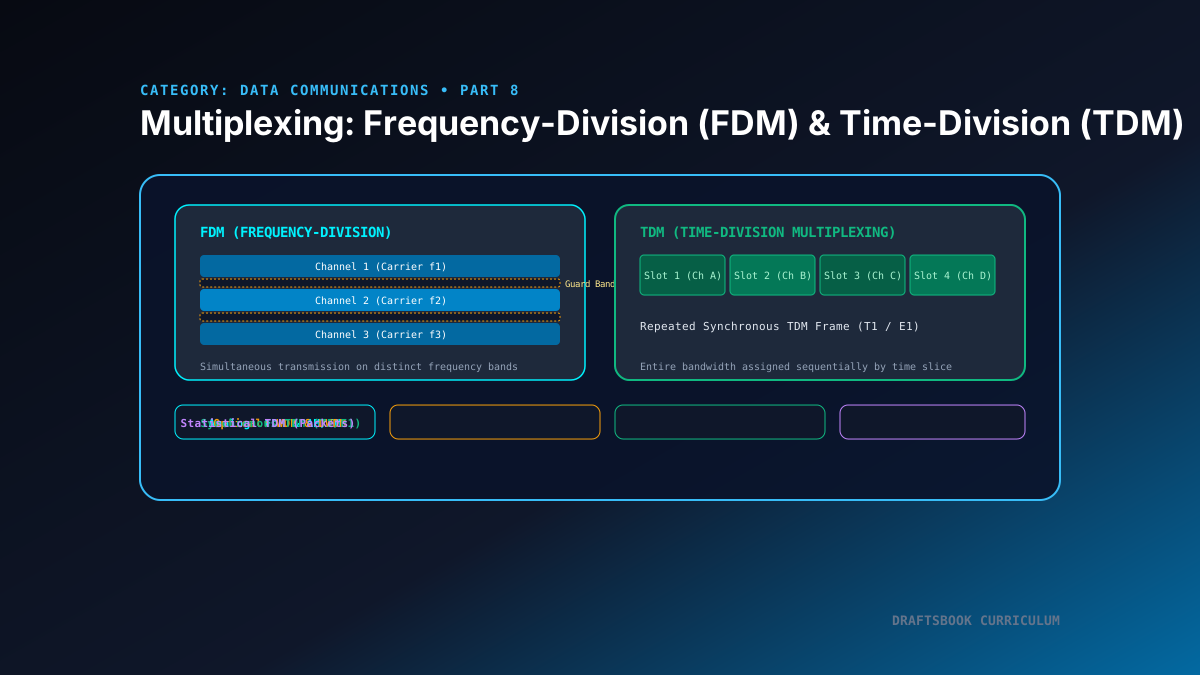
A comprehensive guide to signal multiplexing: analyzing Frequency-Division (FDM), Synchronous and Statistical Time-Division (TDM), and optical WDM.
By Md. Harun-Or-Roshid
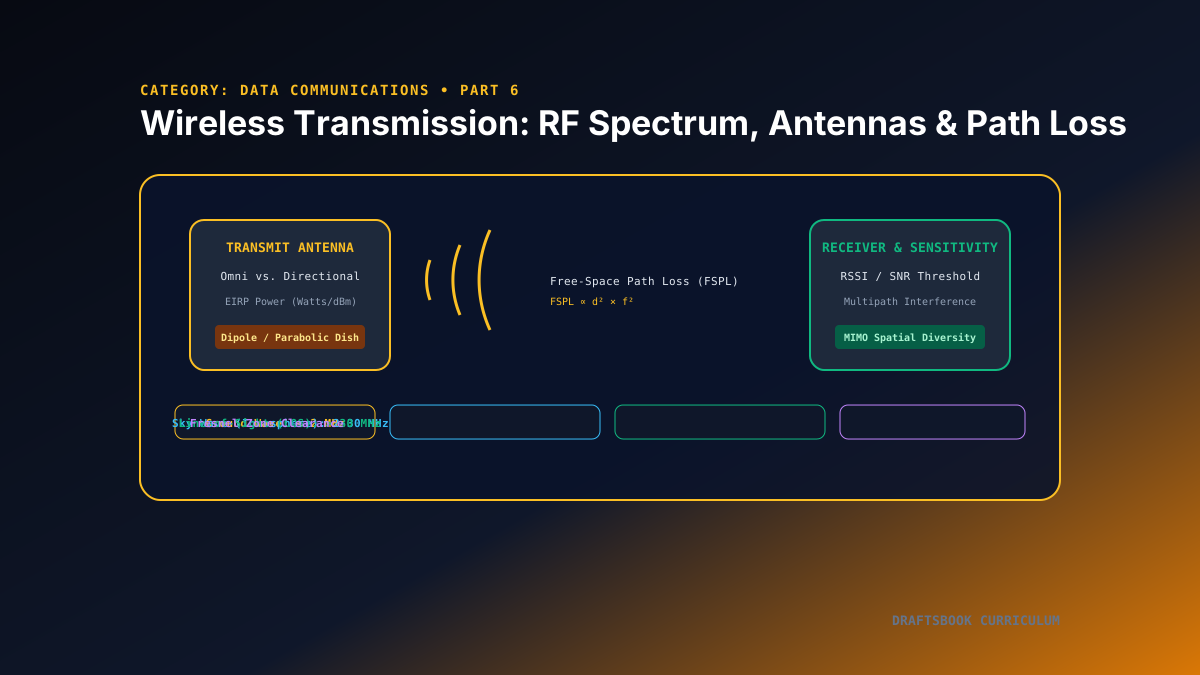
Part 6: Wireless Transmission Fundamentals: RF Spectrum, Antennas & Path Loss
Explore unguided wireless communications: analyzing radio frequency spectrum allocations, propagation modes, free-space path loss, and MIMO antennas.
By Md. Harun-Or-Roshid