Part 8: Multiplexing Techniques: Frequency-Division (FDM) & Time-Division (TDM)
Lesson Overview & Learning Objectives
Running a separate physical cable between every sender and receiver is economically impossible. To maximize the capacity of expensive transmission media, telecommunication networks employ Multiplexing—the set of techniques that allows the simultaneous transmission of multiple signals across a single shared data link. In this guide, we break down analog Frequency-Division Multiplexing (FDM), digital Time-Division Multiplexing (TDM), evaluate synchronous vs. statistical time slots, and explore fiber-optic Wavelength-Division Multiplexing (WDM).
1. Frequency-Division Multiplexing (FDM)
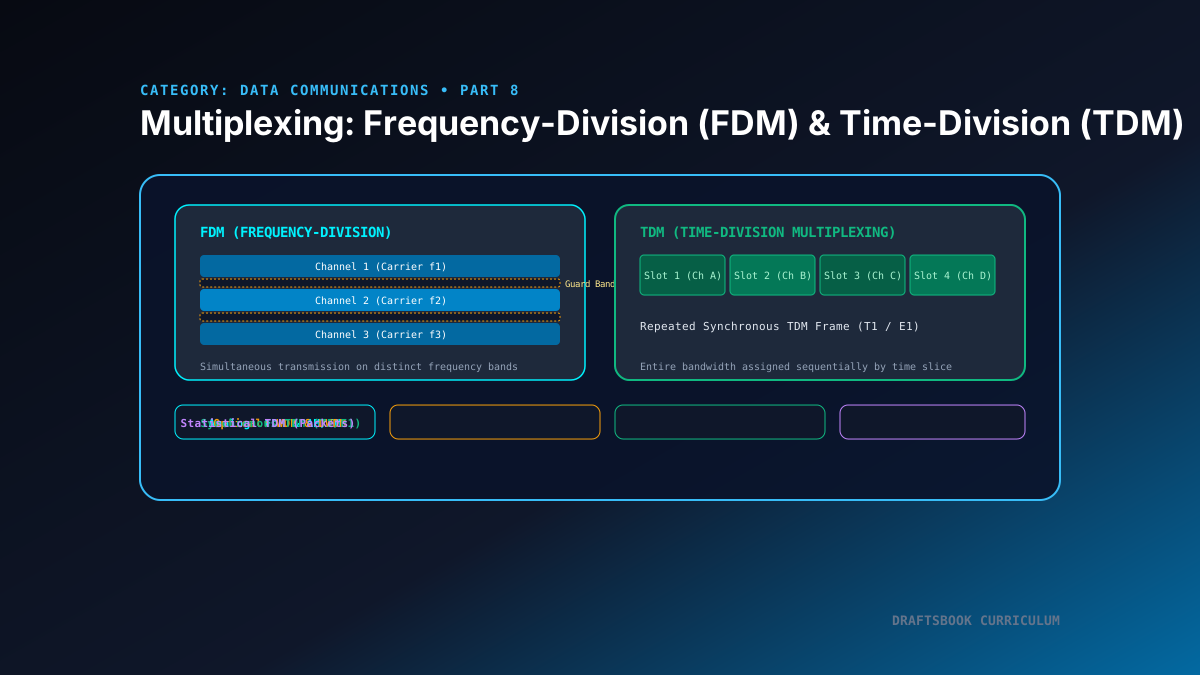
FDM is an analog technique applied when the total bandwidth of a link is greater than the combined bandwidths of the signals to be transmitted:
- Each signal modulates a distinct carrier frequency.
- Channels are separated by unused strips of spectrum called Guard Bands to prevent adjacent signal overlapping and cross-talk.
- Common Applications: Broadcast radio (AM/FM stations simultaneously on the airwaves), cable television channels, cellular uplink/downlink bands.
2. Time-Division Multiplexing: Synchronous vs. Statistical
Synchronous TDM
Each input device is allocated a fixed time slot in the output frame, whether it has data to send or not. If a device is idle, its time slot remains empty, wasting bandwidth. Standardized in digital telephone hierarchies (T1 carrier: 24 voice channels multiplexed into a 1.544 Mbps bitstream).
Statistical TDM (Asynchronous)
Time slots are dynamically allocated on demand only to active lines. To know which recipient receives which data, each slot includes an address header. This eliminates empty idle slots and forms the basis for modern packet-switched networking.
3. Optical Wavelength-Division Multiplexing (WDM)
WDM is conceptually identical to FDM, but operates in the optical electromagnetic spectrum inside glass fiber cables. Multiple laser beams of different optical wavelengths (colors of infrared light) are combined into a single strand of fiber using a prism multiplexer. In Dense WDM (DWDM), up to 160 optical channels spaced mere fractions of a nanometer apart achieve single-fiber aggregate throughput exceeding 100 Terabits per second.
Related reading
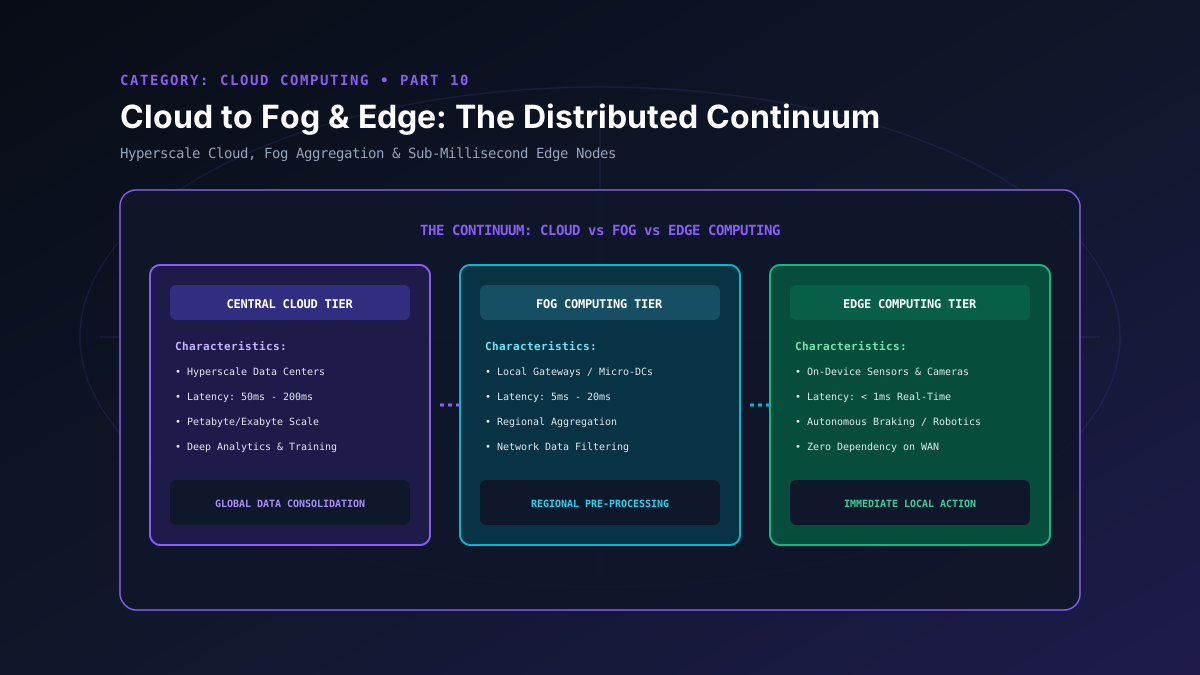
Part 10: Cloud to Fog & Edge: Architecting the Distributed Continuum
Explore the distributed computing continuum: compare centralized cloud, fog computing gateways, and real-time edge nodes for latency-critical IoT systems.
By Md. Harun-Or-Roshid
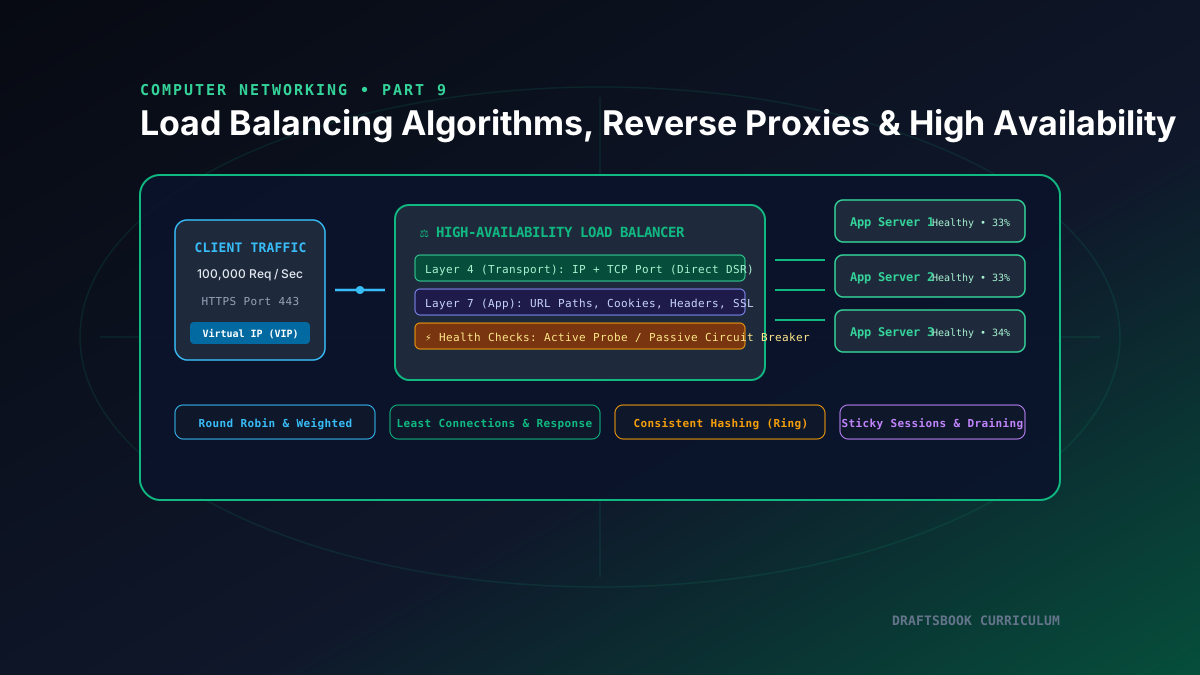
Part 9: Load Balancing: Layer 4 vs Layer 7, Algorithms, Reverse Proxies & High Availability
Master high-availability load balancing, comparing Layer 4 transport vs Layer 7 application routing, consistent hashing rings, and health checks.
By Md. Harun-Or-Roshid
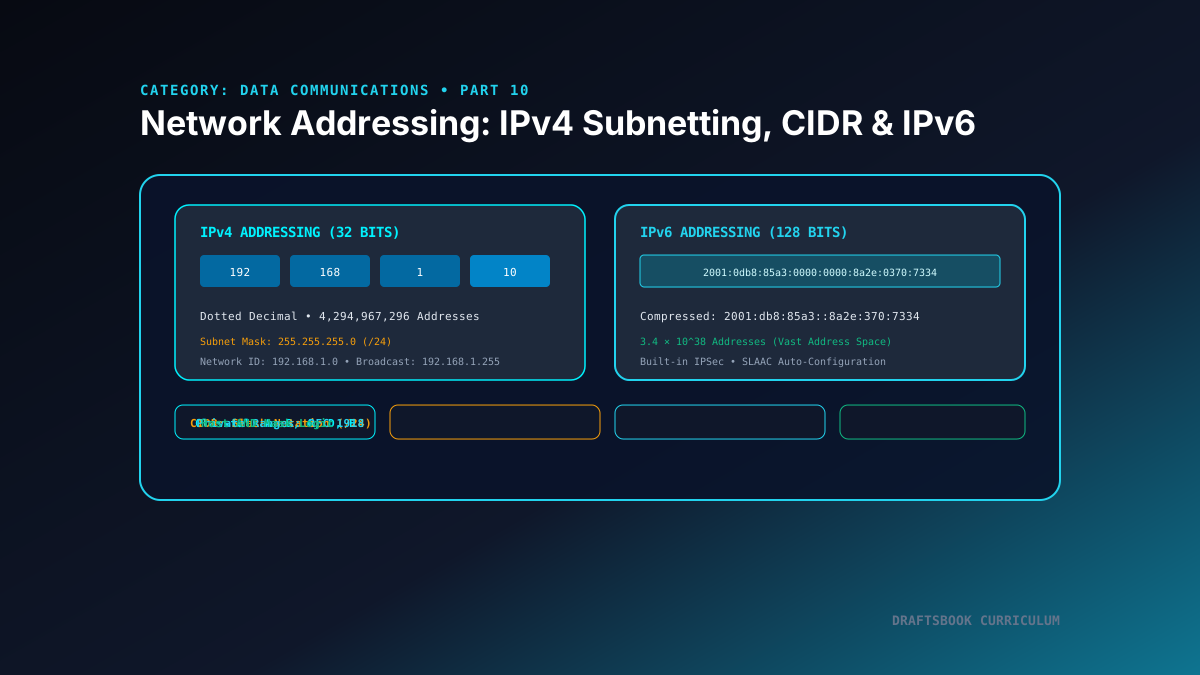
Part 10: Network Layer Addressing: IPv4 Subnetting, CIDR & IPv6 Architecture
Master logical network addressing: explore IPv4 classful ranges, CIDR slash notation, subnet mask bitwise ANDing, and modern 128-bit IPv6 architecture.
By Md. Harun-Or-Roshid
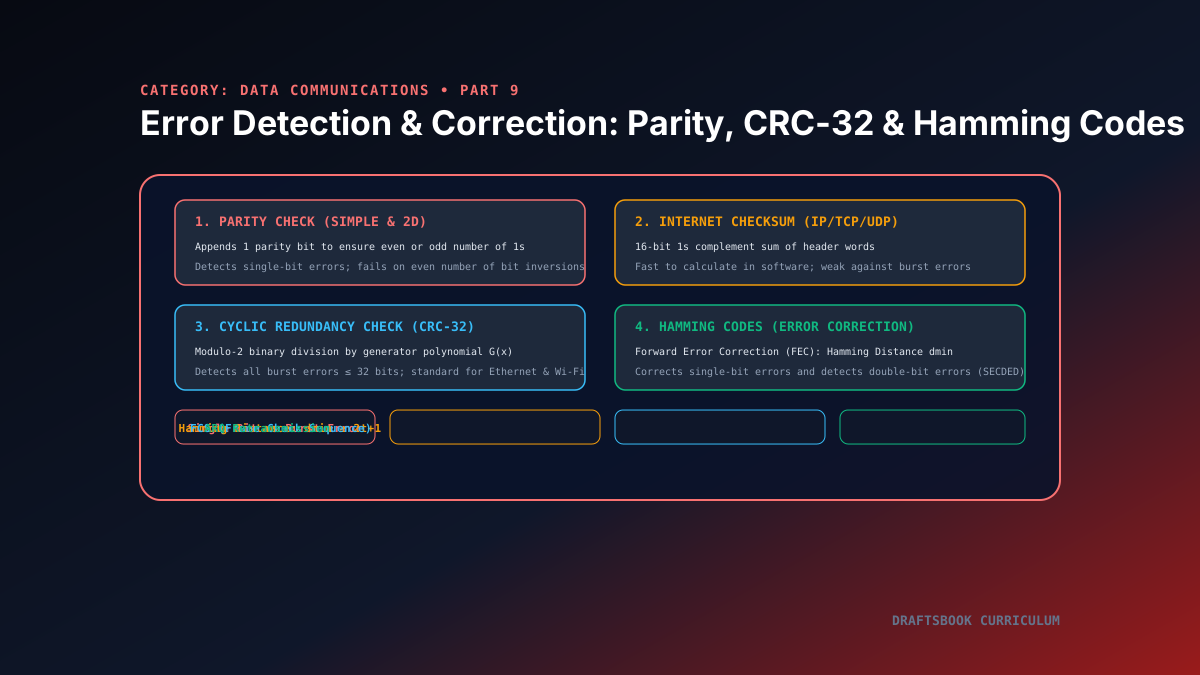
Part 9: Error Detection and Correction: Parity, Checksums, CRC-32 & Hamming
A deep dive into data integrity: comparing simple parity, Internet Checksums, Cyclic Redundancy Checks (CRC-32), and Hamming forward error correction.
By Md. Harun-Or-Roshid