Part 4: Modems: Modulation, Demodulation, Baud Rate & Signal Constellations
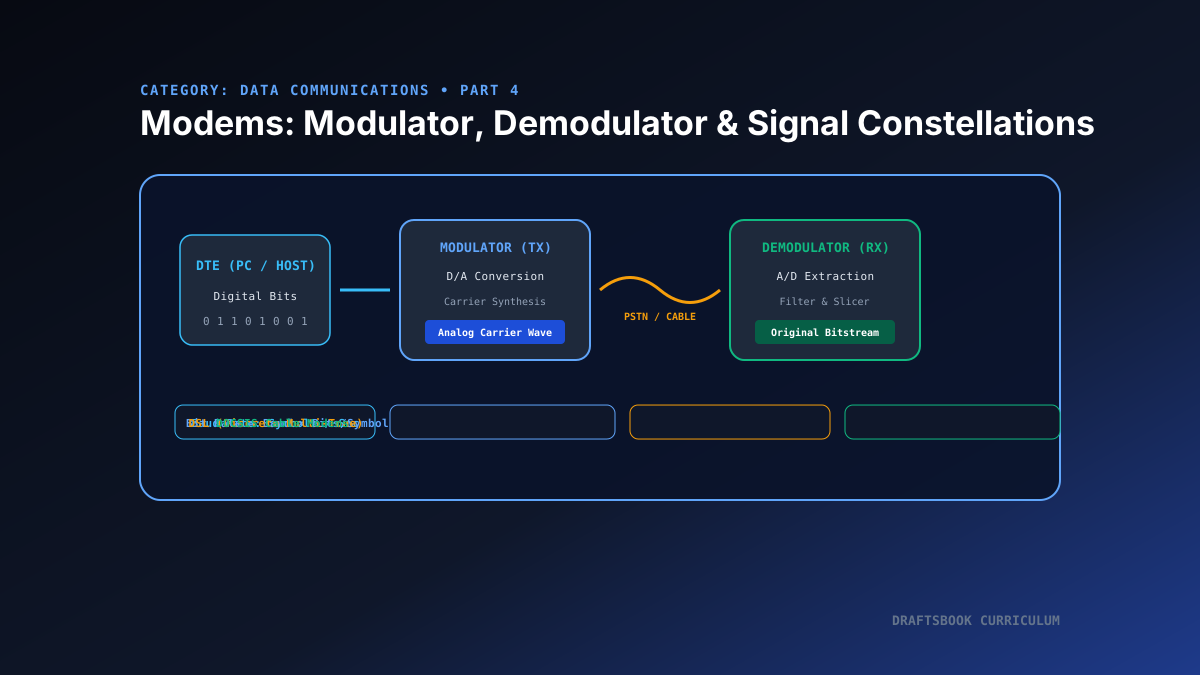
Lesson Overview & Learning Objectives
Computers process and store information as discrete digital binary zeros and ones. However, traditional communication media—such as telephone subscriber copper loops, cable TV coaxial networks, and wireless airwaves—were engineered exclusively to propagate continuous analog waveforms. The Modem (MOdulator / DEModulator) is the essential interface bridge enabling digital computers to communicate across analog facilities. In this guide, we break down modem operation, distinguish Baud Rate from Bit Rate, inspect constellation diagrams, and trace modern broadband evolution.
1. Modulation vs. Demodulation
Modulation (Transmitter Side)
Converts the computer's digital bitstream into an analog signal by modifying one or more characteristics of a high-frequency carrier wave (its amplitude, frequency, or phase) according to the input bits.
Demodulation (Receiver Side)
Captures the incoming modulated analog wave, strips away the high-frequency carrier, filters noise, and reconstructs the exact original stream of digital bits for the receiving computer.
2. Bit Rate vs. Baud Rate (Symbol Rate)
Engineers frequently conflate baud rate and bit rate, but they measure distinct physical quantities:
- Bit Rate (bps): The number of binary bits (0s and 1s) transmitted per second.
- Baud Rate (Baud): The number of signal state transitions (symbols) occurring per second on the transmission line.
If a modern modem uses 16-QAM modulation (where each distinct signal state represents 4 bits), a symbol rate of 2400 Baud produces an effective bit rate of \(2400 imes 4 = 9600 ext{ bps}\). By packing 8 to 12 bits per symbol, gigabit modems achieve massive speeds over physical voice and cable lines.
3. Modern Broadband: DSL & DOCSIS Cable
| Technology | Physical Media | Modulation Scheme | Architecture Notes |
|---|---|---|---|
| DSL / VDSL2 | Twisted-pair copper phone line | Discrete Multi-Tone (DMT) | Splits line into 256 or 4096 separate 4.3125 kHz carrier channels using FDM |
| DOCSIS 3.1 / 4.0 | Hybrid Fiber-Coaxial (HFC) cable | OFDM with 4096-QAM | Delivers multi-gigabit downstream speeds over community coaxial cables |
Related reading
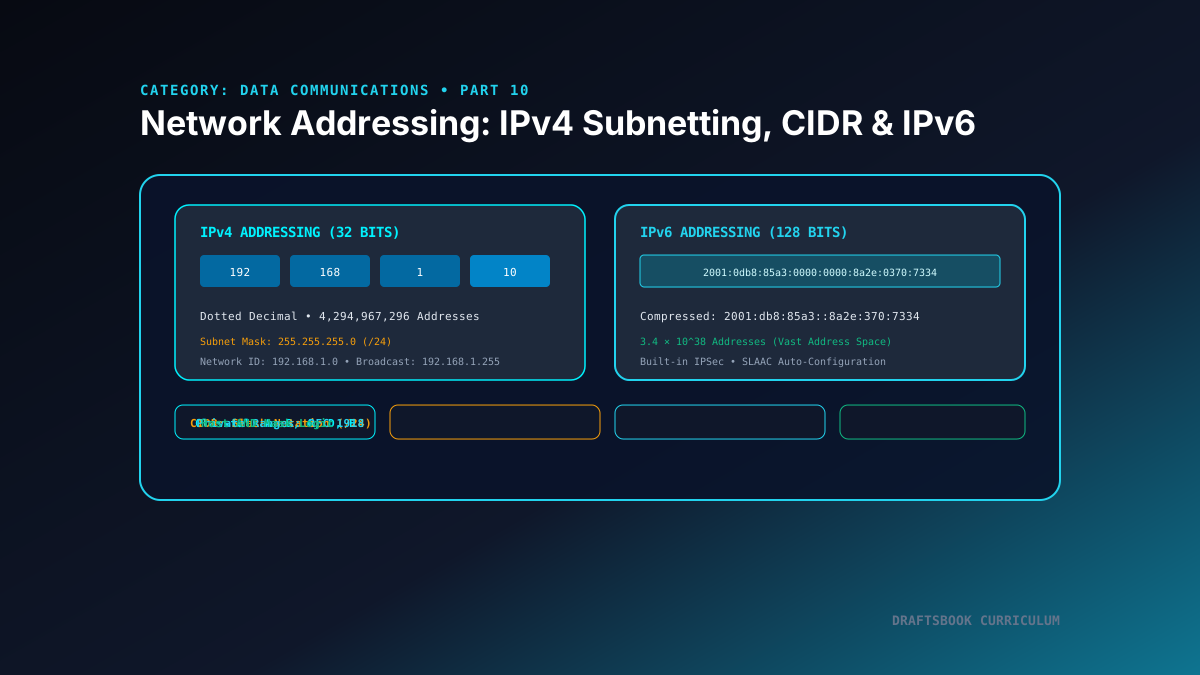
Part 10: Network Layer Addressing: IPv4 Subnetting, CIDR & IPv6 Architecture
Master logical network addressing: explore IPv4 classful ranges, CIDR slash notation, subnet mask bitwise ANDing, and modern 128-bit IPv6 architecture.
By Md. Harun-Or-Roshid
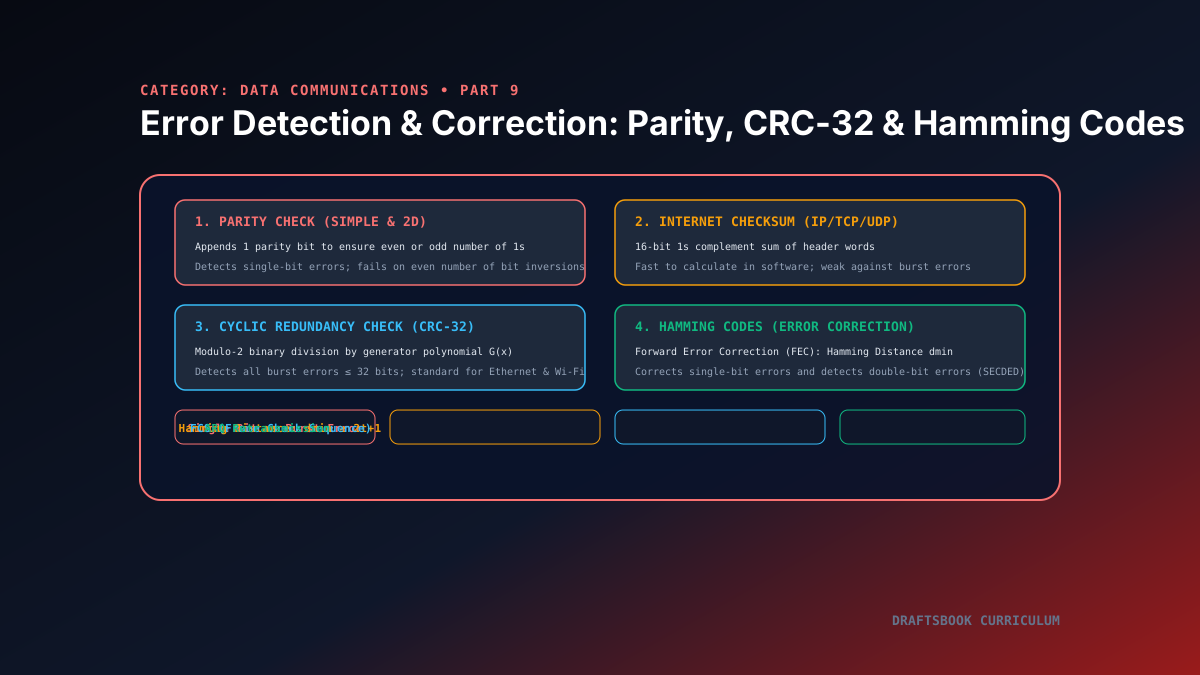
Part 9: Error Detection and Correction: Parity, Checksums, CRC-32 & Hamming
A deep dive into data integrity: comparing simple parity, Internet Checksums, Cyclic Redundancy Checks (CRC-32), and Hamming forward error correction.
By Md. Harun-Or-Roshid
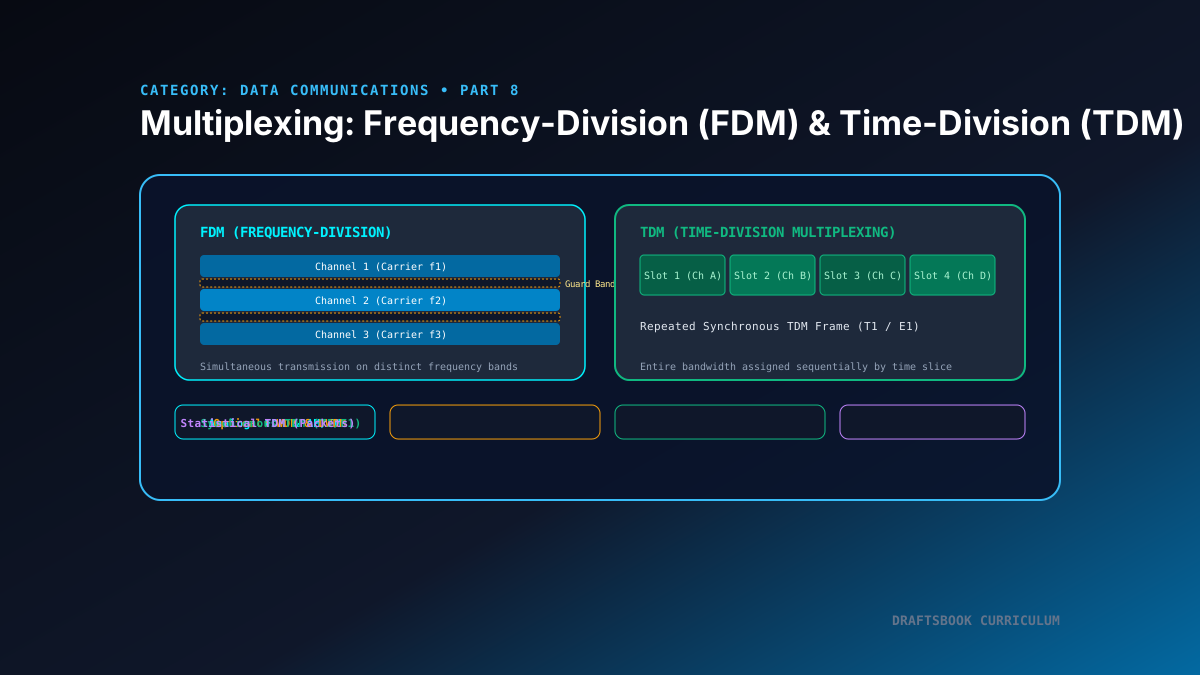
Part 8: Multiplexing Techniques: Frequency-Division (FDM) & Time-Division (TDM)
A comprehensive guide to signal multiplexing: analyzing Frequency-Division (FDM), Synchronous and Statistical Time-Division (TDM), and optical WDM.
By Md. Harun-Or-Roshid
Part 7: Pulse Modulation & Companding: PAM, PWM, PPM, PCM & Quantization
Explore analog-to-digital signal conversion: comparing PAM, PWM, PPM, Pulse Code Modulation (PCM) sampling, quantization error, and µ-law/A-law companding.
By Md. Harun-Or-Roshid