Part 5: Midpoint Ellipse Generation Algorithm: Two-Region Scan Conversion
Two-Region Conic Rasterization
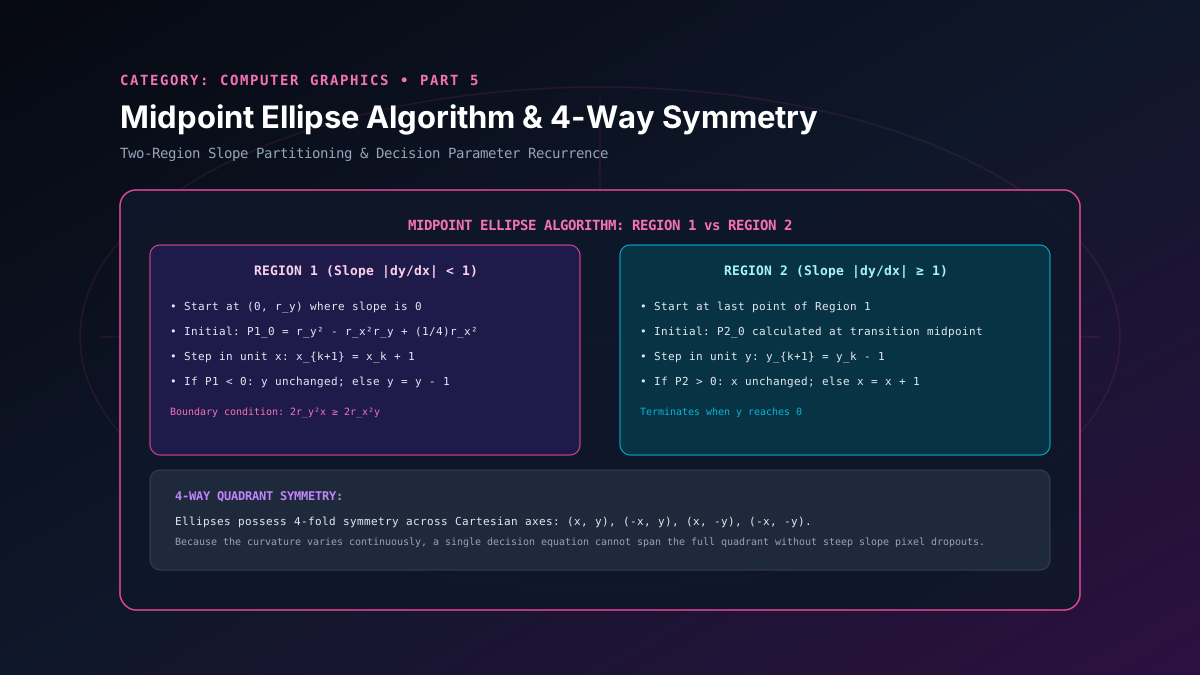
An ellipse is an altered conic section defined by two radii: a semi-major axis $r_x$ and a semi-minor axis $r_y$. Because the curvature of an ellipse varies non-uniformly across its perimeter, simple 8-way octant symmetry cannot be applied; instead, rasterization relies on 4-way quadrant symmetry. Furthermore, because the tangent slope $dy/dx$ varies from $0$ to $-\infty$ within a single quadrant, the scan conversion domain must be bifurcated into two distinct operational regions separated by the boundary where $|dy/dx| = 1$. In this article, we rigorously analyze the Midpoint Ellipse Algorithm, derive both region decision parameters, and examine its integer implementation.
1. Implicit Ellipse Function & 4-Way Symmetry
An ellipse centered at the origin $(0, 0)$ with horizontal semi-major radius $r_x$ and vertical semi-minor radius $r_y$ satisfies the standard implicit algebraic form:
In an ellipse, reflection across both coordinate axes yields 4-way quadrant symmetry:
Thus, rasterizing the first quadrant from $(0, r_y)$ to $(r_x, 0)$ completely determines all four quadrants through coordinate negation.
2. Two-Region Boundary Condition
Calculating the implicit derivative $\frac{dy}{dx}$ gives:
The quadrant is partitioned into two regions based on the absolute slope $|dy/dx|$:
Region 1: $|dy/dx| < 1$
Condition: $2 r_y^2 x < 2 r_x^2 y$. The curve is flatter. We step along the $x$-axis in unit increments: $\Delta x = +1$. The candidate pixels are East $(x_k + 1, y_k)$ and South-East $(x_k + 1, y_k - 1)$.
Region 2: $|dy/dx| \ge 1$
Condition: $2 r_y^2 x \ge 2 r_x^2 y$. The curve is steeper. We step along the $y$-axis in unit decrements: $\Delta y = -1$. The candidate pixels are South $(x_k, y_k - 1)$ and South-East $(x_k + 1, y_k - 1)$.
3. Region 1 Decision Parameter Formulation
Evaluating the implicit ellipse function at the midpoint $M = (x_k + 1, y_k - \frac{1}{2})$:
At the starting point $(x_0, y_0) = (0, r_y)$, the initial decision parameter for Region 1 is:
- If $P1_k < 0$: Midpoint is inside. Select East $(x_k + 1, y_k)$.
P1_{k+1} = P1_k + 2 r_y^2 x_{k+1} + r_y^2 - If $P1_k \ge 0$: Midpoint is outside. Select South-East $(x_k + 1, y_k - 1)$.
P1_{k+1} = P1_k + 2 r_y^2 x_{k+1} - 2 r_x^2 y_{k+1} + r_y^2
4. Region 2 Decision Parameter Formulation
In Region 2, the midpoint is $M = (x_k + \frac{1}{2}, y_k - 1)$. The decision parameter is:
The initial parameter $P2_0$ is evaluated at the last point $(x_e, y_e)$ calculated in Region 1:
- If $P2_k > 0$: Midpoint is outside. Select South $(x_k, y_k - 1)$.
P2_{k+1} = P2_k - 2 r_x^2 y_{k+1} + r_x^2 - If $P2_k \le 0$: Midpoint is inside. Select South-East $(x_k + 1, y_k - 1)$.
P2_{k+1} = P2_k + 2 r_y^2 x_{k+1} - 2 r_x^2 y_{k+1} + r_x^2
Related reading
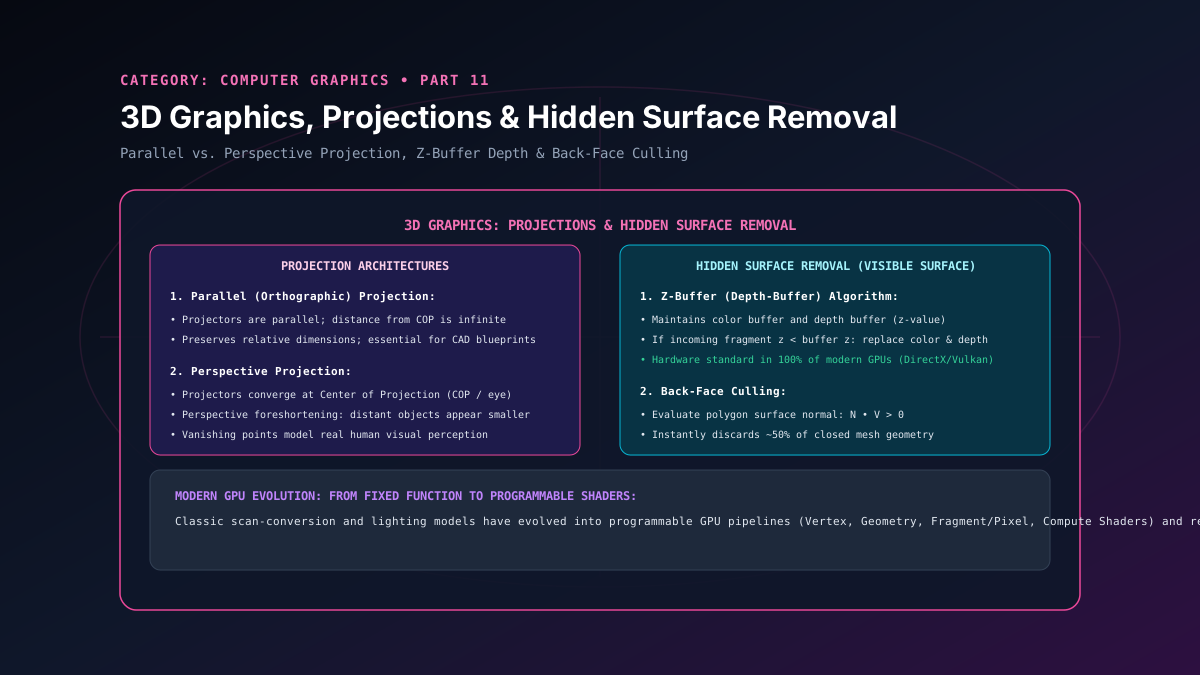
Part 11: 3D Graphics: Parallel & Perspective Projections & Hidden Surface Removal
A masterclass in 3D rendering pipelines, parallel and perspective projections, vanishing points, back-face culling, and GPU hardware Z-buffer depth testing.
By Md. Harun-Or-Roshid
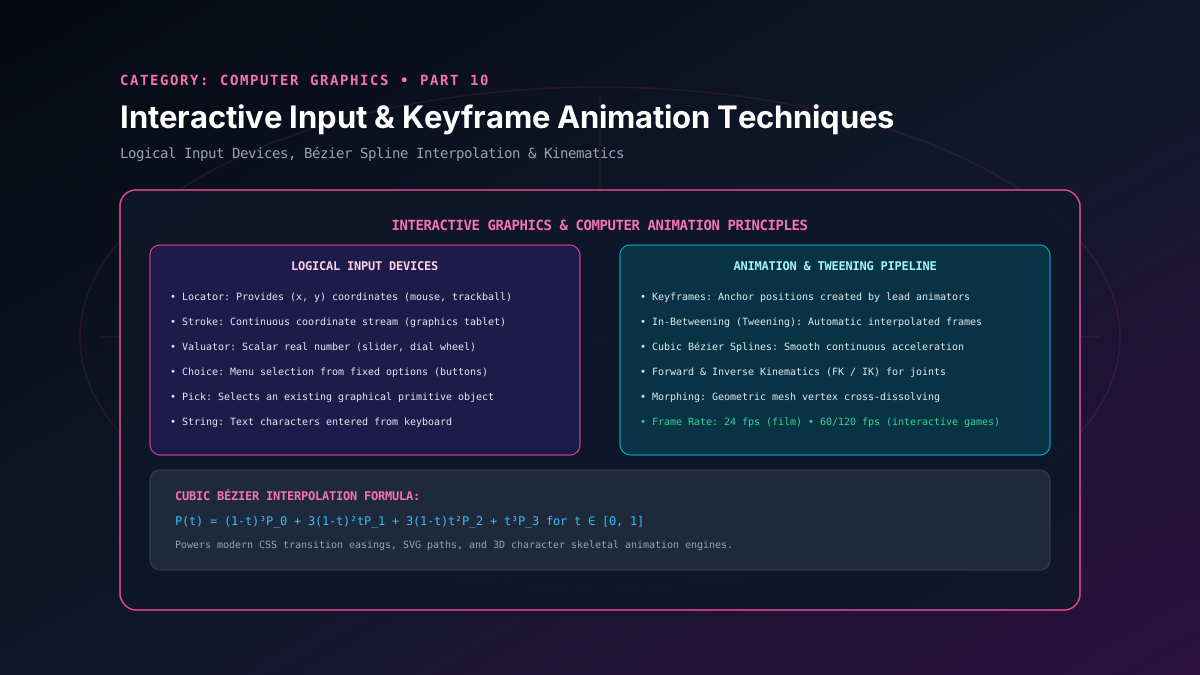
Part 10: Interactive Graphics & Computer Animation: Input Devices & Keyframes
A study of interactive input architectures and animation principles, covering logical input devices, keyframing, tweening, and cubic Bezier curve interpolation.
By Md. Harun-Or-Roshid
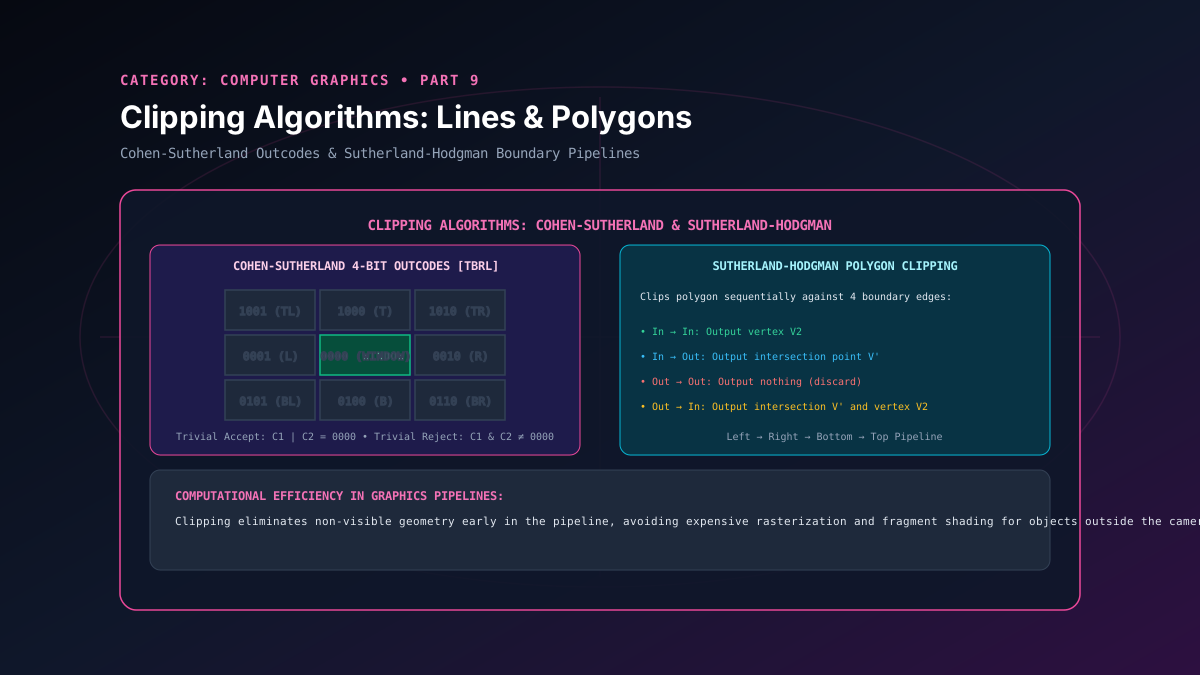
Part 9: Clipping Algorithms: Cohen-Sutherland Line & Sutherland-Hodgman Polygon
A deep analysis of 2D geometric clipping algorithms, detailing Cohen-Sutherland 4-bit region outcodes and Sutherland-Hodgman sequential polygon clipping.
By Md. Harun-Or-Roshid
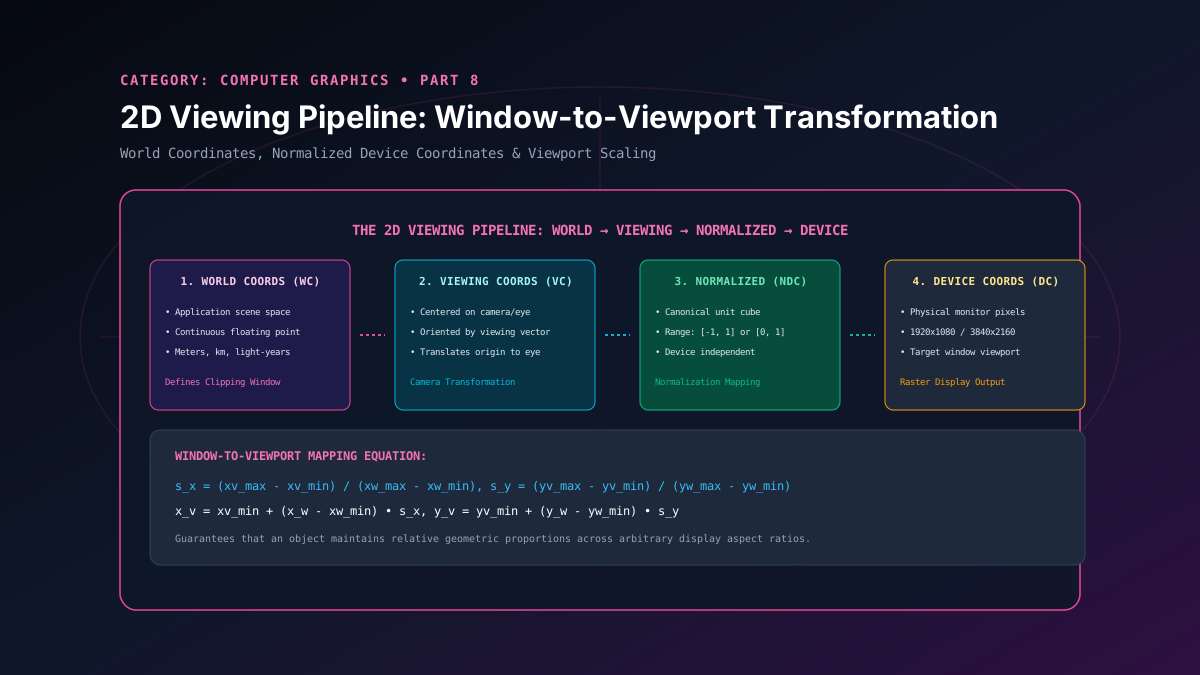
Part 8: 2D Viewing Pipeline: Window-to-Viewport Transformation Coordinates
A study of the 2D viewing transformation pipeline, detailing coordinate normalization, world window to viewport scaling derivation, and aspect ratio preservation.
By Md. Harun-Or-Roshid