Part 9: Clipping Algorithms: Cohen-Sutherland Line & Sutherland-Hodgman Polygon
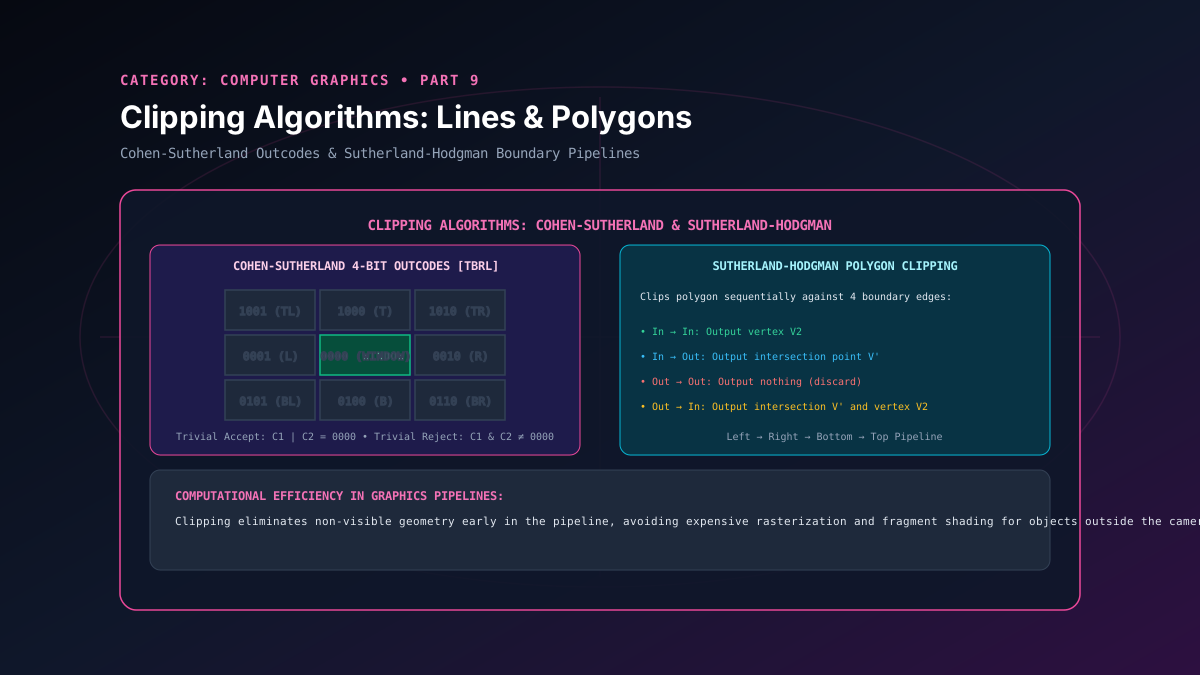
Geometric Pruning & Clipping
Rendering geometry that lies outside the visible display window wastes precious GPU fillrate and memory bandwidth, and can trigger out-of-bounds memory writes in framebuffers. Clipping is the computer graphics procedure that identifies geometric primitives (points, lines, polygons) intersecting the clipping boundary, preserves visible portions, and discards invisible exterior segments. In this article, we rigorously analyze two classic algorithms that form the bedrock of rendering pipelines: Cohen-Sutherland Line Clipping (utilizing 4-bit region outcodes) and Sutherland-Hodgman Polygon Clipping (utilizing boundary-by-boundary vertex pipelines).
1. Cohen-Sutherland Line Clipping Algorithm
The Cohen-Sutherland algorithm accelerates line clipping by dividing the 2D plane into 9 regions using the 4 boundaries of the rectangular clipping window: $x = xw_{\min}$, $x = xw_{\max}$, $y = yw_{\min}$, and $y = yw_{\max}$.
The 4-Bit Region Outcode (TBRL)
Every endpoint $(x, y)$ is assigned a 4-bit binary code (Outcode) where each bit is set according to spatial position:
| Bit Position | Boundary | Condition | Bit Assignment |
|---|---|---|---|
| Bit 1 (MSB) | Top | y > yw_max | 1 (else 0) |
| Bit 2 | Bottom | y < yw_min | 1 (else 0) |
| Bit 3 | Right | x > xw_max | 1 (else 0) |
| Bit 4 (LSB) | Left | x < xw_min | 1 (else 0) |
Fast Bitwise Tests: Trivial Accept & Reject
Trivial Accept (Bitwise OR)
Both endpoints lie entirely inside the clipping window. The line is rendered completely without computing intersection points.
Trivial Reject (Bitwise AND)
Both endpoints share an outside region (e.g. both are to the left of $xw_{\min}$). The line cannot cross the window and is discarded immediately.
Intersection Calculation
If a line cannot be trivially accepted or rejected, it is clipped against an outside boundary edge. Using the line slope $m = \frac{y_2 - y_1}{x_2 - x_1}$:
- Intersection with vertical edge ($x = xw_{\min}$ or $xw_{\max}$):
y = y_1 + m \cdot (x - x_1)
- Intersection with horizontal edge ($y = yw_{\min}$ or $yw_{\max}$):
x = x_1 + \frac{1}{m} \cdot (y - y_1)
The exterior endpoint is replaced by the calculated intersection, its Outcode is recomputed, and the loop repeats until trivial accept or reject occurs.
2. Sutherland-Hodgman Polygon Clipping Algorithm
Clipping a polygon is fundamentally different from clipping independent lines: clipping must produce a closed polygon with valid perimeter edges, not a disconnected set of floating segments.
The Sutherland-Hodgman Algorithm clips an arbitrary polygon against each infinite window boundary edge sequentially (Left → Right → Bottom → Top) in a pipeline architecture.
The 4 Edge-Crossing Cases
For each boundary clipper, directed edges connecting vertex $V_1$ to vertex $V_2$ are tested against the boundary line:
Case 1: In to In
Both $V_1$ and $V_2$ lie inside the boundary.
Case 2: In to Out
$V_1$ is inside, $V_2$ is outside.
Case 3: Out to Out
Both $V_1$ and $V_2$ lie outside.
Case 4: Out to In
$V_1$ is outside, $V_2$ is inside.
Related reading
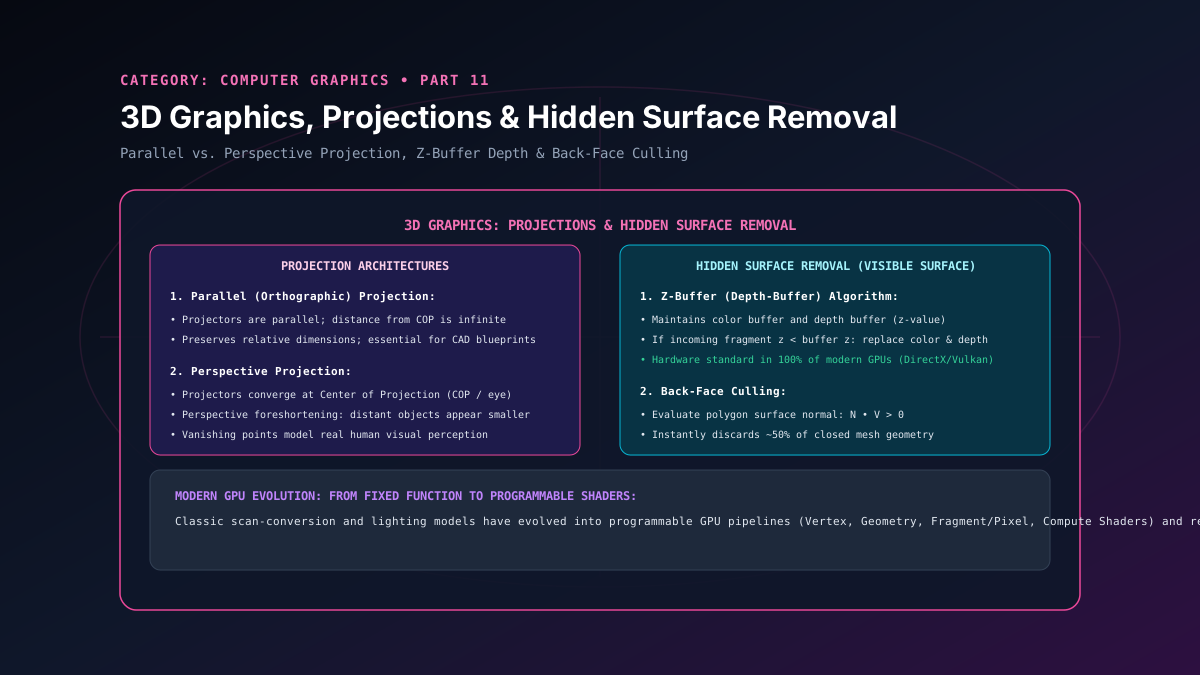
Part 11: 3D Graphics: Parallel & Perspective Projections & Hidden Surface Removal
A masterclass in 3D rendering pipelines, parallel and perspective projections, vanishing points, back-face culling, and GPU hardware Z-buffer depth testing.
By Super Admin
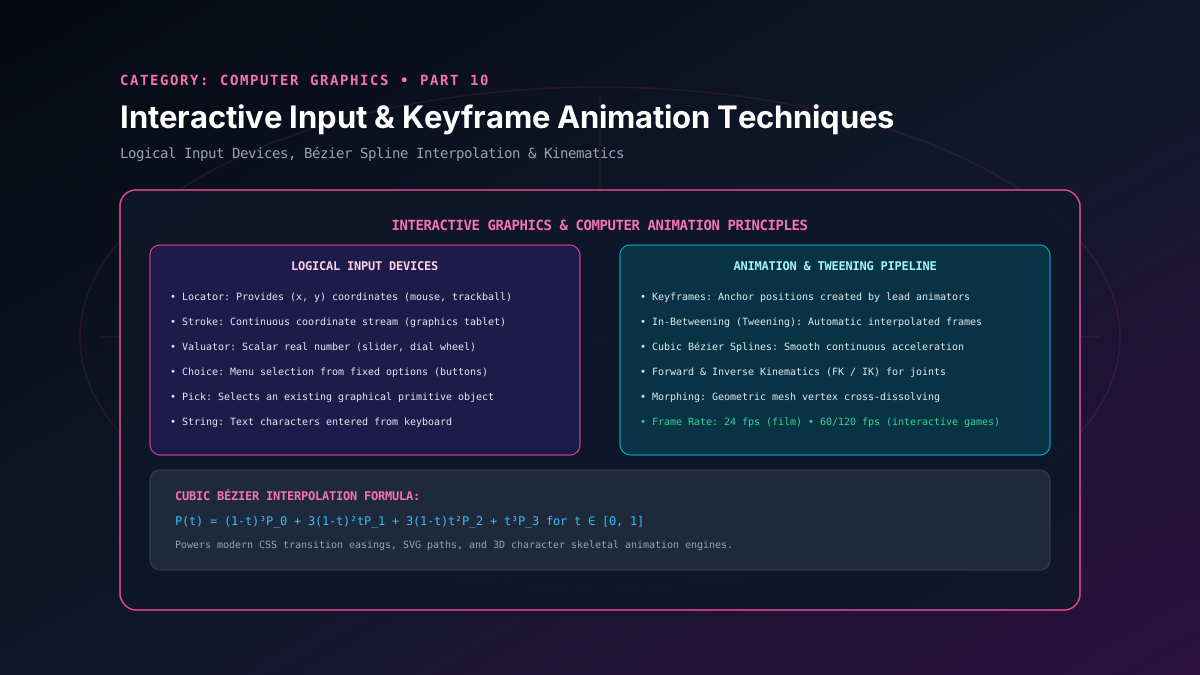
Part 10: Interactive Graphics & Computer Animation: Input Devices & Keyframes
A study of interactive input architectures and animation principles, covering logical input devices, keyframing, tweening, and cubic Bezier curve interpolation.
By Super Admin
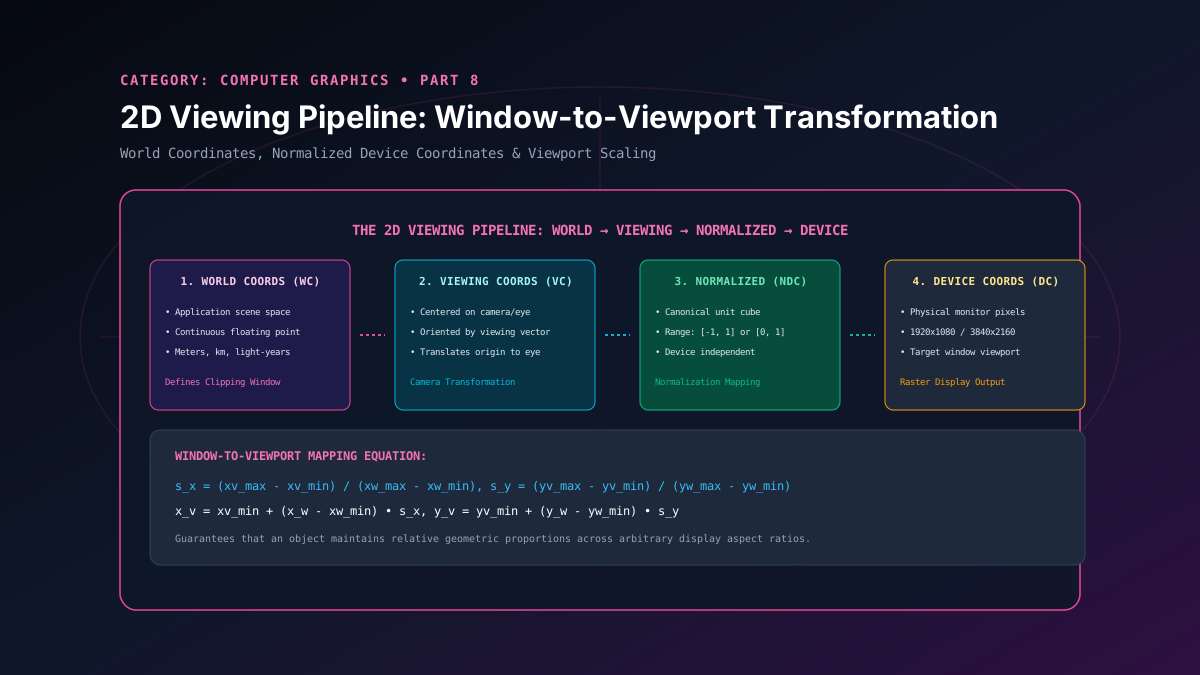
Part 8: 2D Viewing Pipeline: Window-to-Viewport Transformation Coordinates
A study of the 2D viewing transformation pipeline, detailing coordinate normalization, world window to viewport scaling derivation, and aspect ratio preservation.
By Super Admin
Part 7: 2D Geometric Transformations: Translation, Scaling, Rotation & Matrices
A rigorous exploration of 2D affine geometric transformations, homogeneous coordinates, 3x3 transformation matrices, and composite pivot-point rotations.
By Super Admin