Part 4: Bresenham's and Midpoint Circle Generation Algorithm
High-Speed Curved Rasterization
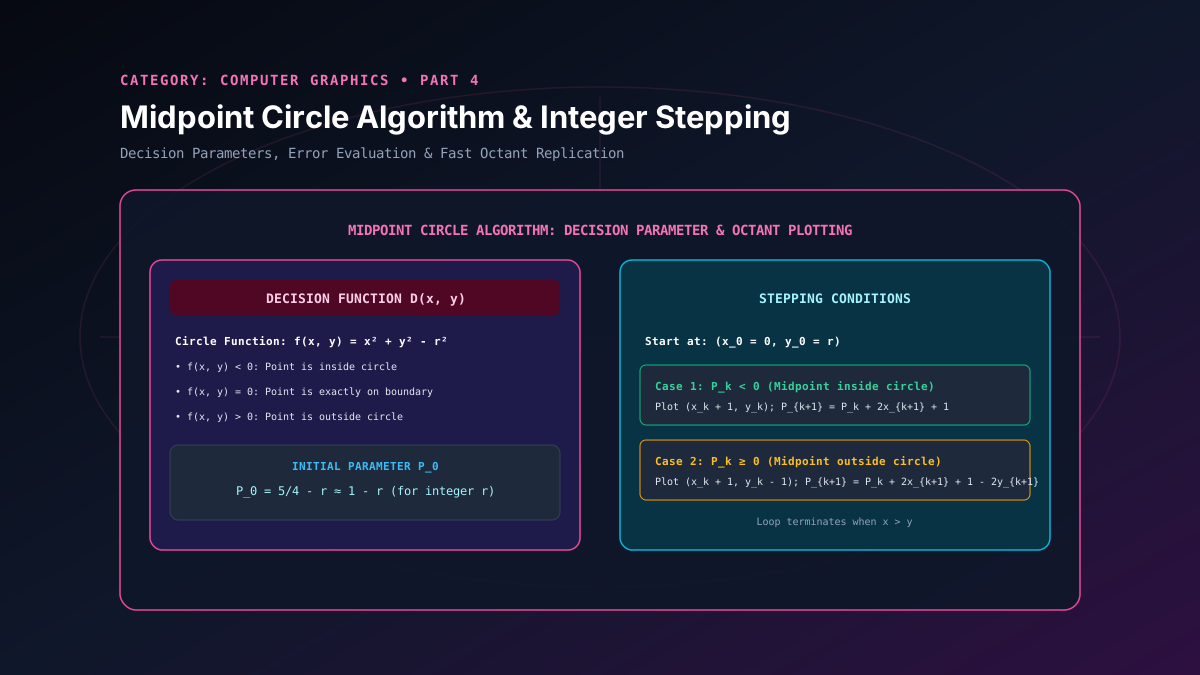
While naive Cartesian and polar algorithms suffer from expensive square roots and trigonometric calls, the Midpoint Circle Algorithm (a specialized adaptation of Bresenham's raster formulation) renders circles using pure integer additions, subtractions, and bit shifts. By testing the position of the midpoint between candidate grid pixels relative to the implicit circle boundary, the algorithm decides pixel steps incrementally with mathematical precision. In this article, we rigorously derive the initial decision parameter, establish the recurrence formulas, and walk through a concrete numeric execution.
1. Implicit Circle Function & The Midpoint Test
Consider the implicit function for a circle of radius $r$ centered at $(0, 0)$:
The value of $F(x, y)$ provides an exact spatial relationship for any point $(x, y)$:
- $F(x, y) < 0$: The point lies strictly inside the circle boundary.
- $F(x, y) = 0$: The point lies precisely on the circle boundary.
- $F(x, y) > 0$: The point lies strictly outside the circle boundary.
In the second octant (from $x = 0$ to $x = y$, where the slope magnitude $|dy/dx| \le 1$), we initialize rasterization at $(0, r)$ and step $x$ incrementally by $+1$. Having plotted pixel $(x_k, y_k)$, the next candidate pixel is either:
- East (E): $(x_k + 1, y_k)$
- South-East (SE): $(x_k + 1, y_k - 1)$
The spatial midpoint $M$ between these candidate pixels is $M = (x_k + 1, y_k - \frac{1}{2})$. The decision parameter $P_k$ is defined by evaluating the implicit circle function at this midpoint:
2. Derivation of the Decision Recurrence
At the subsequent step $k+1$, the decision parameter is:
Subtracting $P_k$ from $P_{k+1}$ gives the difference formula:
Case 1: $P_k < 0$ (Midpoint Inside)
The circle perimeter passes above the midpoint. Select pixel E $(x_k + 1, y_k)$. Since $y_{k+1} = y_k$:
Case 2: $P_k \ge 0$ (Midpoint Outside)
The circle perimeter passes below the midpoint. Select pixel SE $(x_k + 1, y_k - 1)$. Since $y_{k+1} = y_k - 1$:
3. Initial Parameter $P_0$ & Integer Optimization
The circle begins at $(x_0, y_0) = (0, r)$. Evaluating $P_0$:
Because all pixel coordinates and the radius $r$ are strictly integers:
- If $r$ is an integer, $\frac{5}{4} - r$ is negative whenever $1 - r < 0$.
- We can round $\frac{5}{4}$ to $1$ with zero impact on integer sign decisions:
P_0 = 1 - r
4. Step-by-Step Numeric Execution ($r = 10$)
| Step $k$ | Decision $P_k$ | Plotted $(x, y)$ | $2x_{k+1}$ | $2y_{k+1}$ | Next $P_{k+1}$ |
|---|---|---|---|---|---|
| 0 | -9 ($1 - 10$) | (0, 10) | 2 | 20 | -9 + 2(1) + 1 = -6 |
| 1 | -6 (< 0) | (1, 10) | 4 | 20 | -6 + 2(2) + 1 = -1 |
| 2 | -1 (< 0) | (2, 10) | 6 | 20 | -1 + 2(3) + 1 = +6 |
| 3 | +6 (>= 0) | (3, 10) | 8 | 18 | 6 + 2(4) + 1 - 2(9) = -3 |
| 4 | -3 (< 0) | (4, 9) | 10 | 18 | -3 + 2(5) + 1 = +8 |
| 5 | +8 (>= 0) | (5, 9) | 12 | 16 | 8 + 2(6) + 1 - 2(8) = +5 |
| 6 | +5 (>= 0) | (6, 8) | 14 | 14 | Loop terminates: $x \ge y$ ($7 \ge 7$) |
Related reading
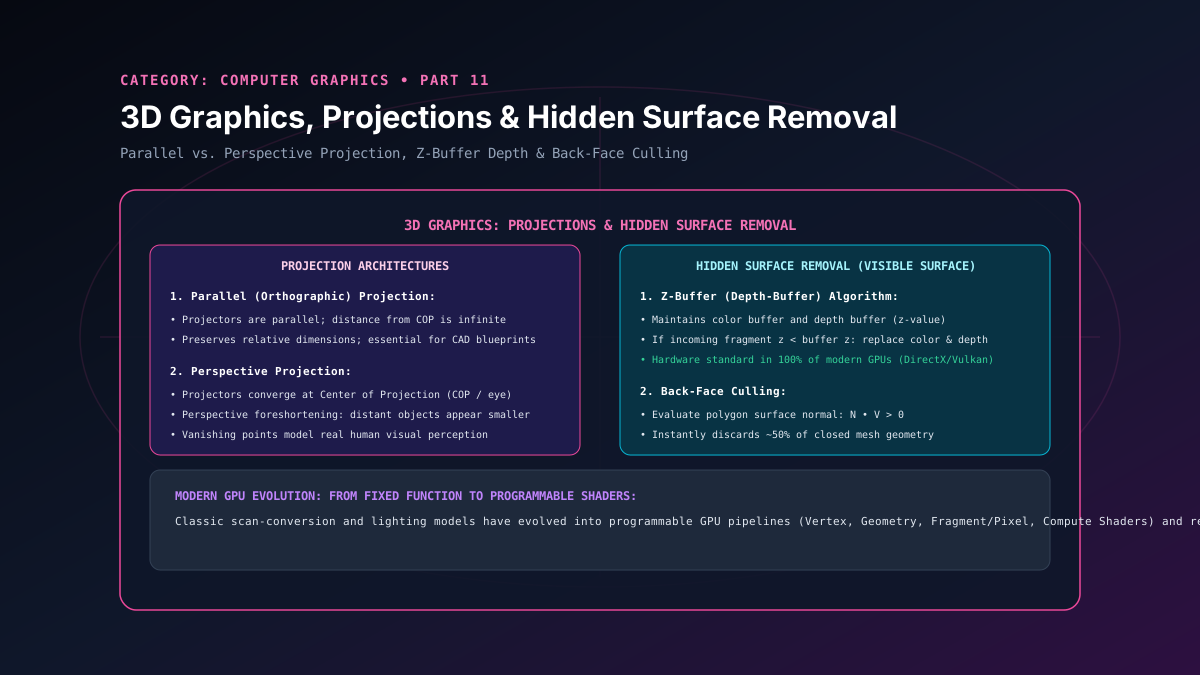
Part 11: 3D Graphics: Parallel & Perspective Projections & Hidden Surface Removal
A masterclass in 3D rendering pipelines, parallel and perspective projections, vanishing points, back-face culling, and GPU hardware Z-buffer depth testing.
By Md. Harun-Or-Roshid
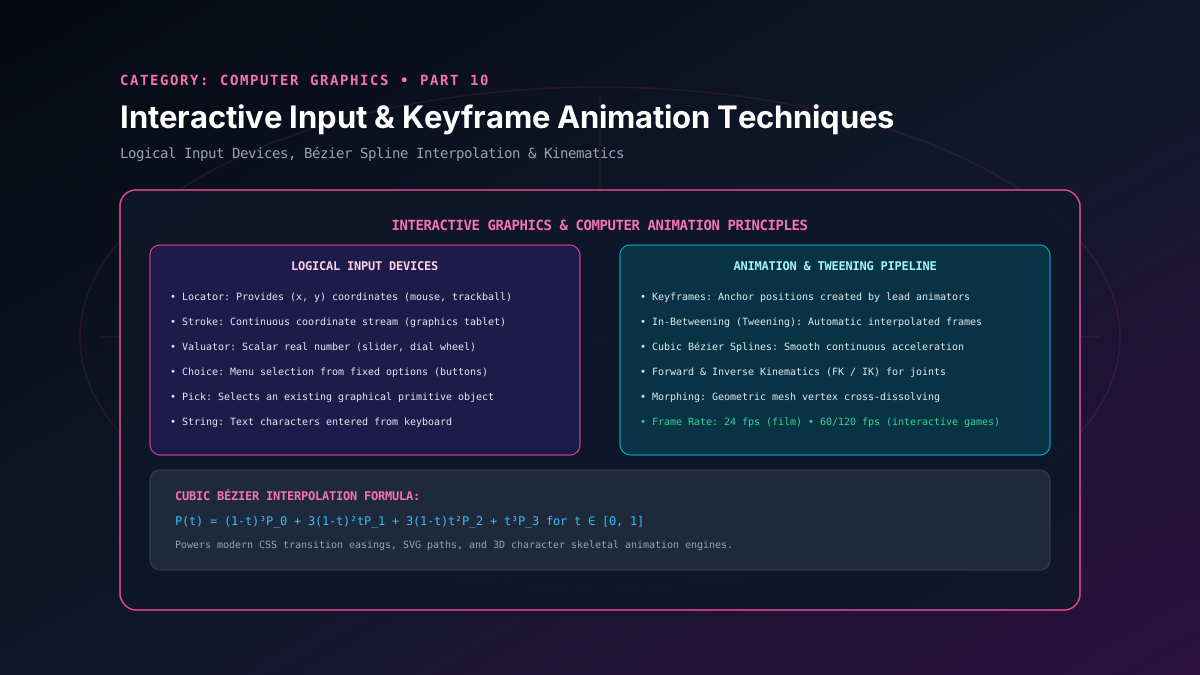
Part 10: Interactive Graphics & Computer Animation: Input Devices & Keyframes
A study of interactive input architectures and animation principles, covering logical input devices, keyframing, tweening, and cubic Bezier curve interpolation.
By Md. Harun-Or-Roshid
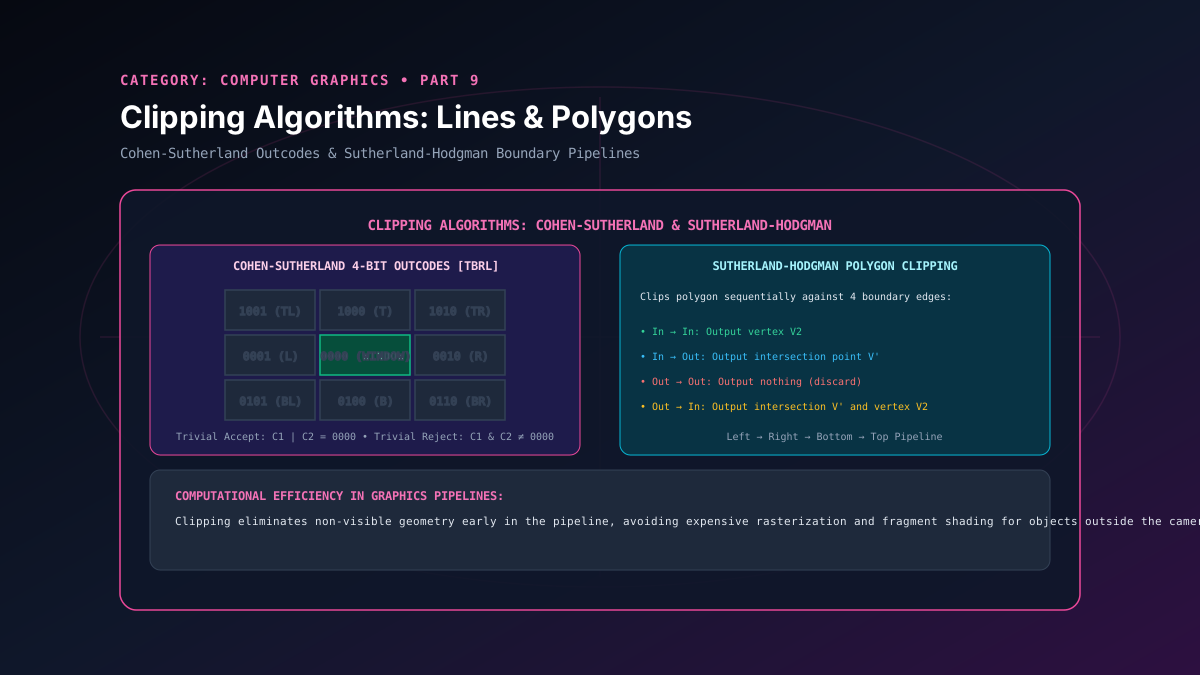
Part 9: Clipping Algorithms: Cohen-Sutherland Line & Sutherland-Hodgman Polygon
A deep analysis of 2D geometric clipping algorithms, detailing Cohen-Sutherland 4-bit region outcodes and Sutherland-Hodgman sequential polygon clipping.
By Md. Harun-Or-Roshid
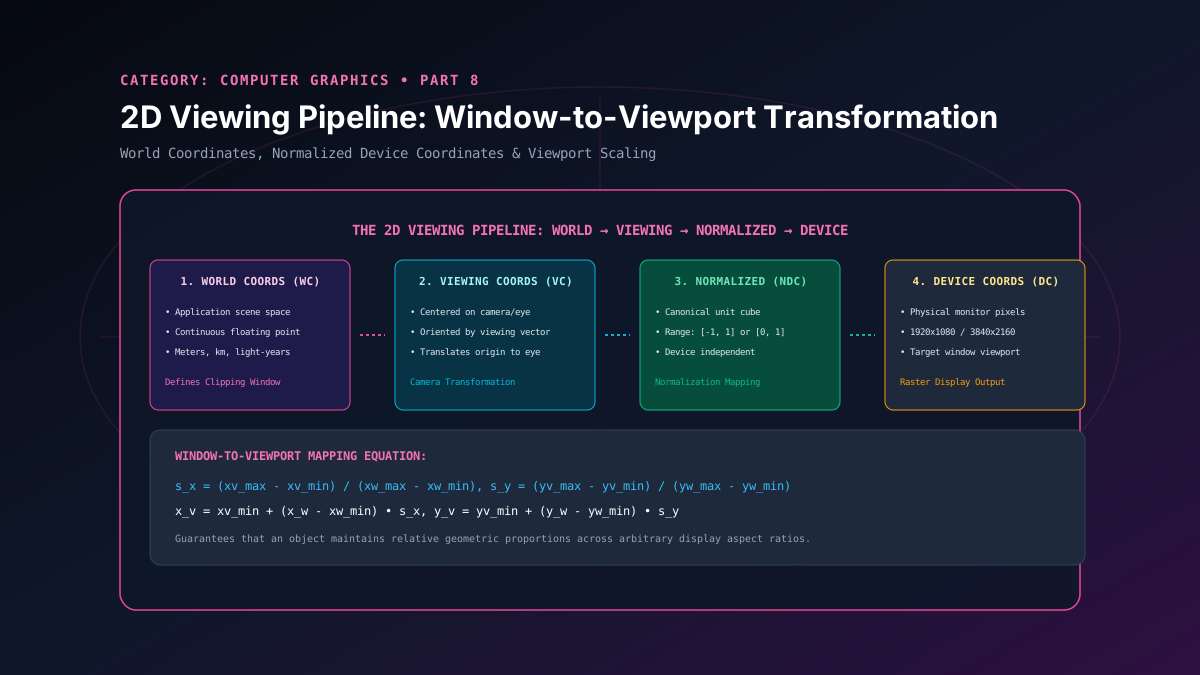
Part 8: 2D Viewing Pipeline: Window-to-Viewport Transformation Coordinates
A study of the 2D viewing transformation pipeline, detailing coordinate normalization, world window to viewport scaling derivation, and aspect ratio preservation.
By Md. Harun-Or-Roshid