Part 1: Cloud Computing Overview: Essential Characteristics & Key Risks
Series Overview & Learning Objectives
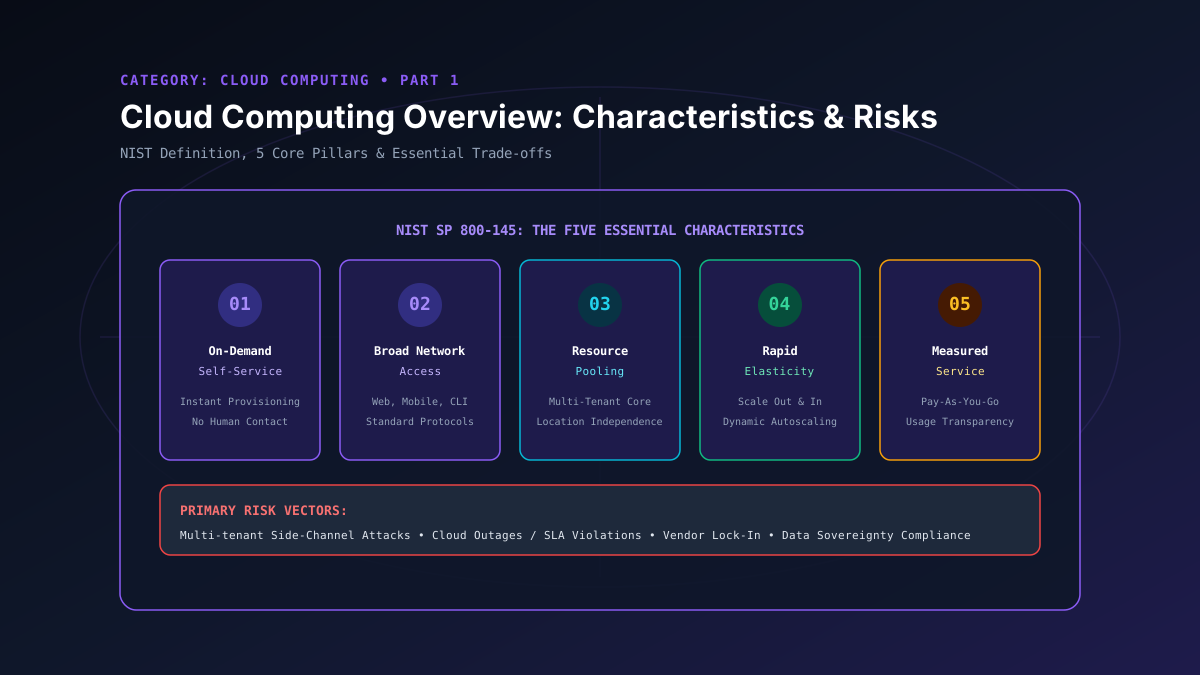
Welcome to Fundamentals of Cloud Computing, an exhaustive 10-part engineering curriculum covering the architectural, operational, and infrastructural foundations of distributed cloud platforms. Modern software engineering has shifted completely from capital-intensive physical data center colocation to on-demand programmable infrastructure. In this opening installment, we analyze the rigorous definition of cloud computing established by the National Institute of Standards and Technology (NIST SP 800-145), dissect the five essential cloud characteristics, evaluate the economic shift from CapEx to OpEx, and perform an objective risk assessment of multi-tenant cloud adoption.
1. Defining Cloud Computing: NIST SP 800-145
Historically, computer scientist John McCarthy predicted in 1961 that computation might one day be organized as a public utility—similar to electricity and municipal water supplies. Today, the globally accepted industry benchmark is the NIST SP 800-145 definition:
"Cloud computing is a model for enabling ubiquitous, convenient, on-demand network access to a shared pool of configurable computing resources (e.g., networks, servers, storage, applications, and services) that can be rapidly provisioned and released with minimal management effort or service provider interaction."
2. The Five Essential Characteristics of Cloud Computing
For an infrastructure or software service to qualify legitimately as cloud computing, it must demonstrate all five of the following technical attributes:
1. On-Demand Self-Service
A consumer can unilaterally provision computing capabilities, such as server time and network storage, as needed automatically without requiring human interaction with each service provider. Developers provision virtual machines or databases via CLI scripts, web portals, or Infrastructure-as-Code (IaC) tools within seconds.
2. Broad Network Access
Capabilities are available over the network and accessed through standard mechanisms that promote use by heterogeneous thin or thick client platforms (e.g., mobile phones, tablets, laptops, and workstations) using standard protocols like HTTPS, TLS, and gRPC.
3. Resource Pooling
The provider's computing resources are pooled to serve multiple consumers using a multi-tenant model, with different physical and virtual resources dynamically assigned and reassigned according to consumer demand. There is a sense of location independence where the client generally has no control or knowledge over the exact physical location of the provided resources.
4. Rapid Elasticity
Capabilities can be elastically provisioned and released, in some cases automatically, to scale rapidly outward and inward commensurate with demand. To the consumer, the capabilities available for provisioning often appear to be unlimited and can be appropriated in any quantity at any time.
5. Measured Service
Cloud systems automatically control and optimize resource use by leveraging a metering capability at some level of abstraction appropriate to the type of service (e.g., storage, processing, bandwidth, and active user accounts). Resource usage can be monitored, controlled, and reported, providing transparency for both the provider and consumer of the utilized service through pay-as-you-go financial models.
3. Cloud Economics: CapEx vs. OpEx Transformation
| Metric | Traditional On-Premises Data Center | Public Cloud Computing |
|---|---|---|
| Financial Classification | Capital Expenditures (CapEx) upfront | Operational Expenditures (OpEx) recurring |
| Hardware Procurement Time | Weeks to months (supply chain, racking, cabling) | Seconds to minutes via API calls |
| Capacity Planning | Must purchase for peak demand; idle waste 80% | Autoscales dynamically; zero idle capacity penalty |
| Maintenance Overhead | HVAC, backup generators, physical security, cabling | 100% offloaded to Cloud Service Provider (CSP) |
4. Architectural Risks & Real-World Trade-Offs
While cloud adoption unlocks rapid time-to-market and planetary scale, distributed multi-tenant environments introduce non-trivial vulnerabilities that senior engineers must account for:
- Multi-Tenant Isolation Leakage: Shared hardware introduces side-channel attacks (e.g., Spectre, Meltdown) and noisy-neighbor performance degradation.
- Data Sovereignty & Regulatory Penalties: Moving customer data across cloud regions can trigger severe regulatory violations under GDPR, HIPAA, and CCPA without strict data residency policies.
- SLA Failures & Cascade Outages: An outage in a single availability zone (AZ) or central identity provider (e.g., AWS IAM, Azure Entra ID) can paralyze global applications lacking cross-region multi-cloud failover.
- Uncontrolled Runaway Costs: Without automated FinOps alerting, leaky serverless functions or orphaned elastic IP addresses can generate massive unpredicted bills.
Related reading
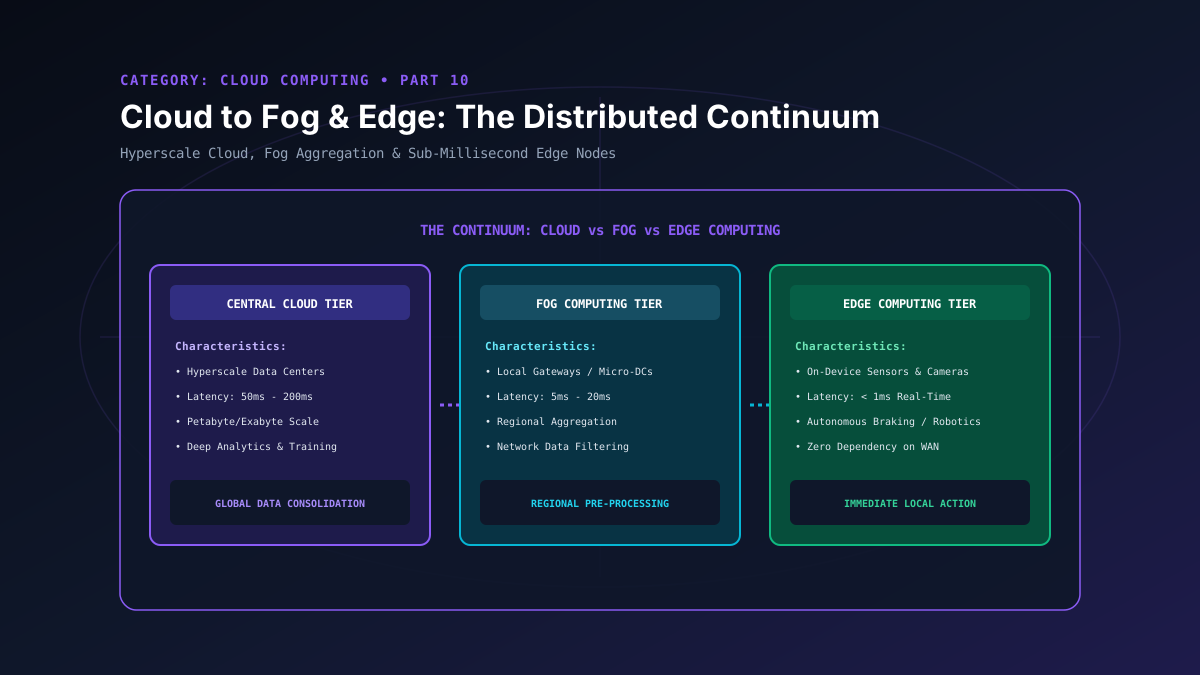
Part 10: Cloud to Fog & Edge: Architecting the Distributed Continuum
Explore the distributed computing continuum: compare centralized cloud, fog computing gateways, and real-time edge nodes for latency-critical IoT systems.
By Md. Harun-Or-Roshid
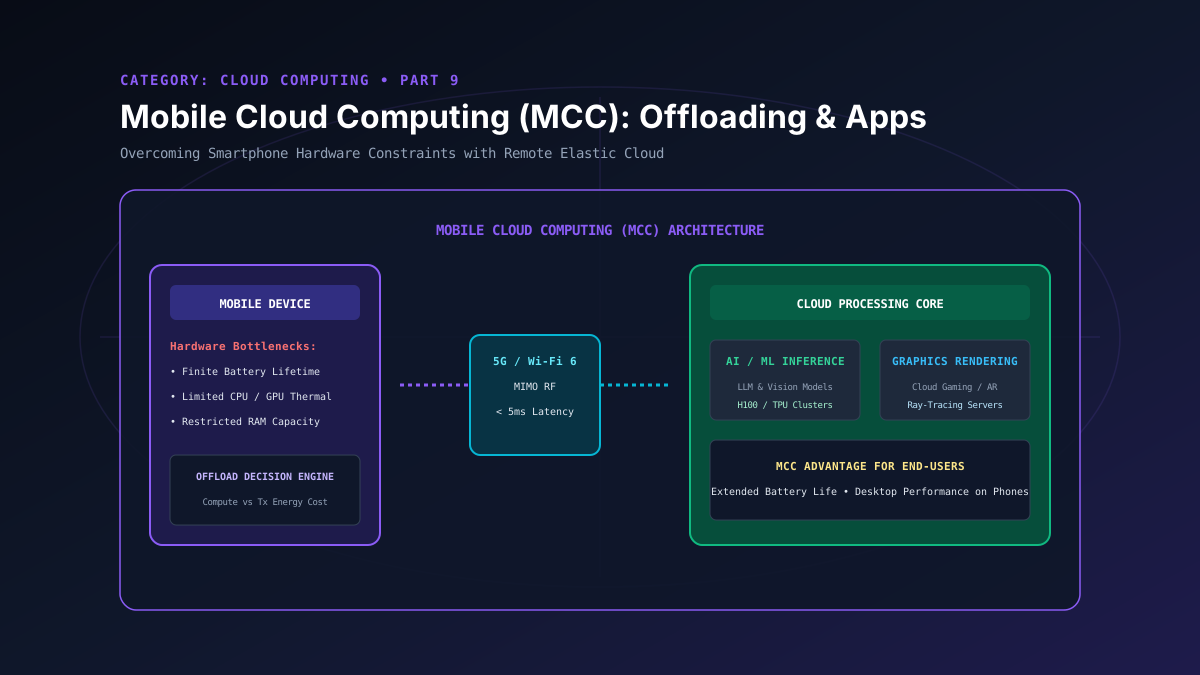
Part 9: Mobile Cloud Computing (MCC): Architecture, Offloading & Apps
Discover Mobile Cloud Computing (MCC): explore computation offloading algorithms, cloudlets, mobile edge nodes, 5G latency, and battery conservation.
By Md. Harun-Or-Roshid
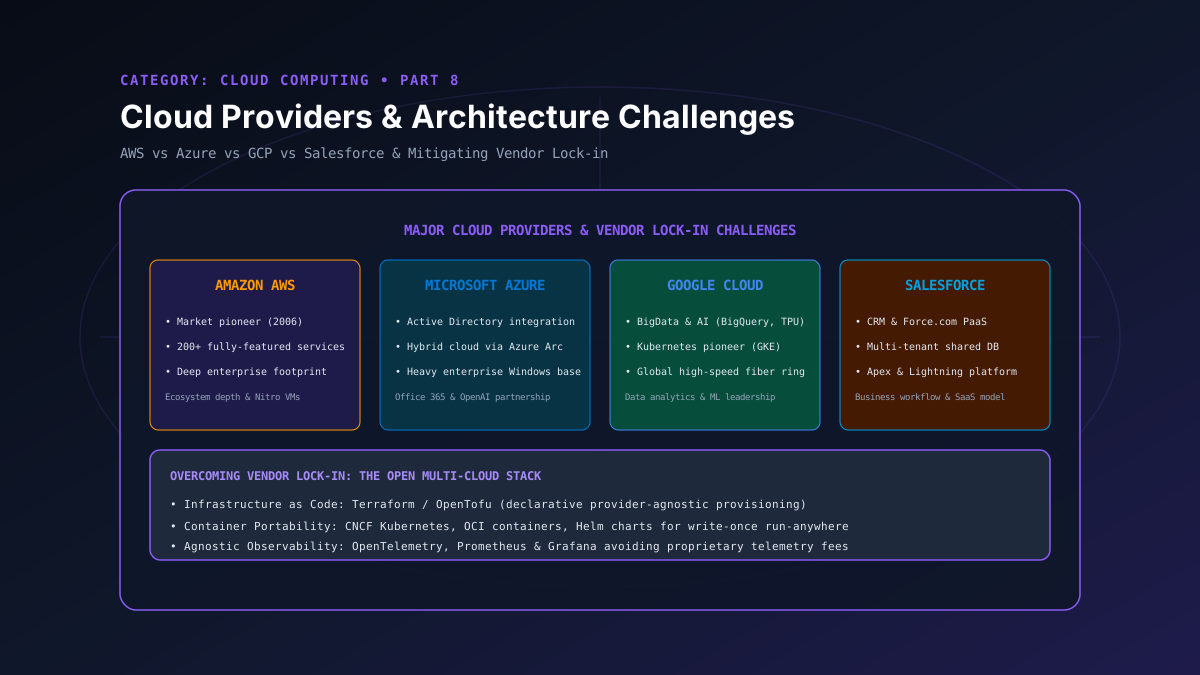
Part 8: Major Cloud Providers & Strategies to Mitigate Vendor Lock-In
Compare hyperscale cloud providers—AWS, Azure, GCP, Salesforce—and master open strategies to prevent vendor lock-in using Terraform and Kubernetes.
By Md. Harun-Or-Roshid
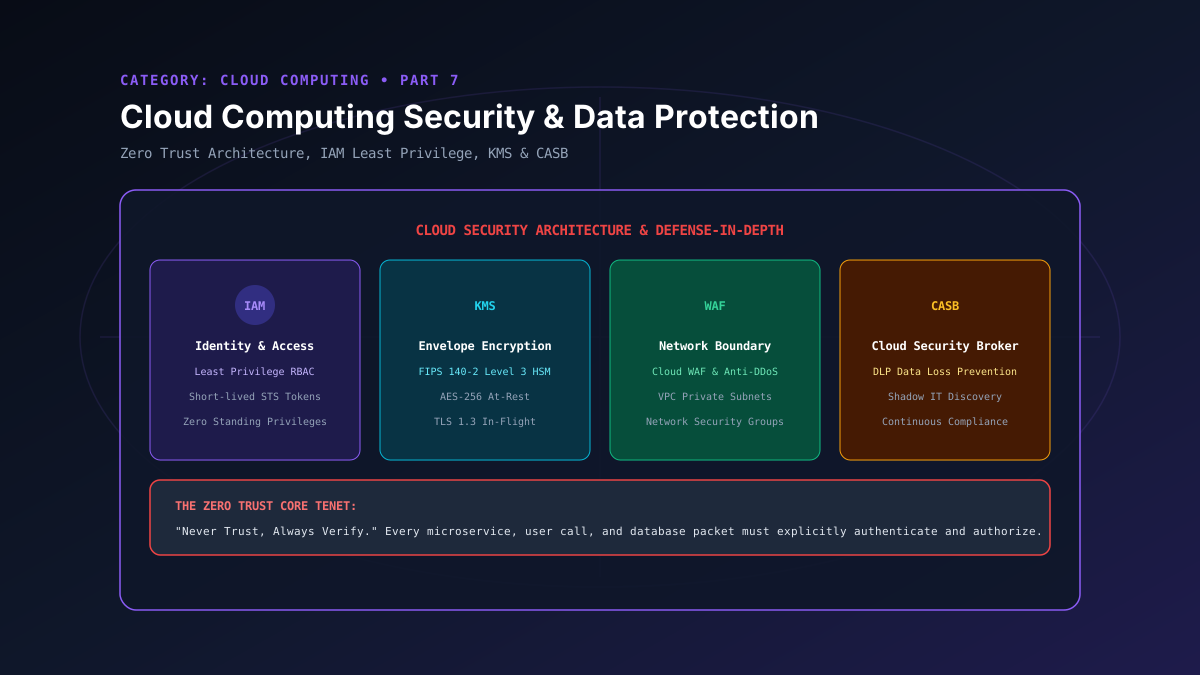
Part 7: Cloud Computing Security, Data Protection & CASB Architecture
A masterclass in cloud security: explore Zero Trust architecture, IAM least privilege, KMS envelope encryption, and Cloud Access Security Brokers (CASB).
By Md. Harun-Or-Roshid