Part 9: Mobile Cloud Computing (MCC): Architecture, Offloading & Apps
Lesson Focus & Objectives
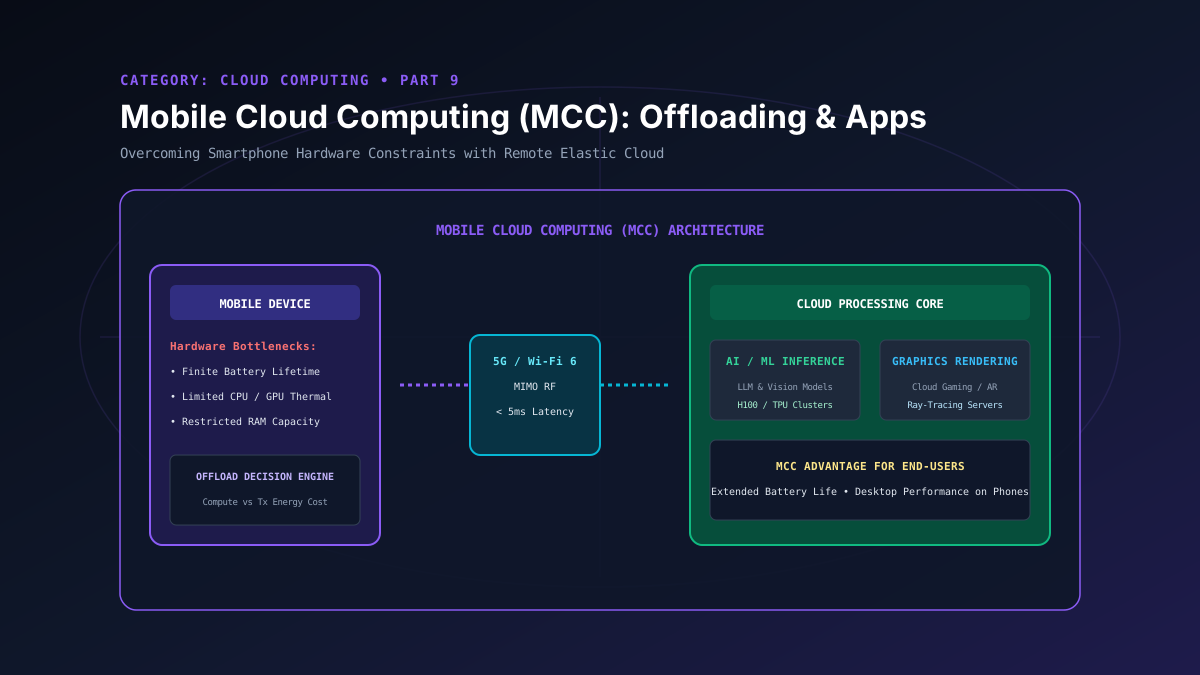
Smartphones, tablets, and wearable IoT devices have become the dominant computing endpoints for billions of users. However, mobile devices face inescapable physical bottlenecks: battery chemical capacity, restricted CPU/GPU thermal dissipation, and limited volatile RAM. Mobile Cloud Computing (MCC) integrates mobile computing, cloud elasticity, and wireless networks to break these hardware limits through remote computation offloading. In Part 9, we analyze MCC architecture, offloading decision engines, and real-world mobile cloud applications.
1. Why Mobile Cloud Computing?
While mobile System-on-Chips (SoCs) have grown remarkably capable, complex workloads like real-time large language model (LLM) inference, 3D photorealistic ray-tracing, and speech synthesis rapidly deplete mobile batteries and induce thermal throttling. MCC solves this challenge by shifting resource-heavy processing and persistent storage from the handheld device to remote elastic cloud data centers over high-speed 5G and Wi-Fi 6 wireless connections.
2. Computation Offloading Mechanics
The fundamental mathematical problem in MCC is determining when and what to offload. An offloading decision engine compares the energy cost of local execution against the energy required to transmit data over the wireless radio:
The Offloading Energy Trade-off Equation
Save Energy If: E_local > E_tx + E_rx + E_wait
- • E_local: Energy consumed by local mobile CPU/GPU executing the task ($P_{cpu} imes T_{local}$).
- • E_tx: Energy consumed by the 5G/Wi-Fi radio transmitter sending data payload ($P_{tx} imes (Data / Bandwidth)$).
- • E_rx: Energy consumed by radio receiver listening for the computed result.
- • E_wait: Energy consumed by the device in idle/standby while awaiting cloud response.
If a computation is computationally intensive but operates on small input data (e.g., calculating optimal chess moves or protein folding parameters), offloading yields massive battery savings. Conversely, if a task is computationally trivial but requires uploading a 500 MB video file, local execution is substantially more energy-efficient.
3. Key Architectural Models of MCC
Central Cloud MCC
Mobile devices connect directly to central hyperscale data centers (AWS, GCP). Offers virtually unlimited processing power and storage, but incurs 50–150ms round-trip propagation latency over the wide-area Internet.
Cloudlet / Edge MCC
Mobile devices offload tasks to localized, trusted clusters of multi-core computers co-located at cellular base stations or office Wi-Fi routers. Achieves single-digit millisecond latency (< 10ms) ideal for Augmented Reality (AR).
Ad-Hoc Mobile Cloud
A collective mesh of nearby mobile devices share spare CPU cycles via peer-to-peer Wi-Fi Direct or Bluetooth, creating a distributed computing cluster without relying on external Internet infrastructure.
4. Modern MCC Applications
- Cloud Gaming (GeForce Now, Xbox Cloud): Heavy Unreal Engine 5 graphics rendering and physics simulations occur on cloud GPUs; the smartphone merely decodes a 60 FPS H.265 video stream and transmits touchscreen inputs.
- Mobile Healthcare Telemetry: Wearable ECG/blood oxygen monitors stream telemetry to cloud ML pipelines for real-time arrhythmia prediction without burning wearable device battery.
- Computer Vision & Augmented Reality: Mobile cameras capture video frames, stream feature vectors to edge cloudlets, and receive 3D object rendering overlays in real time.
Related reading
Part 10: Cloud to Fog & Edge: Architecting the Distributed Continuum
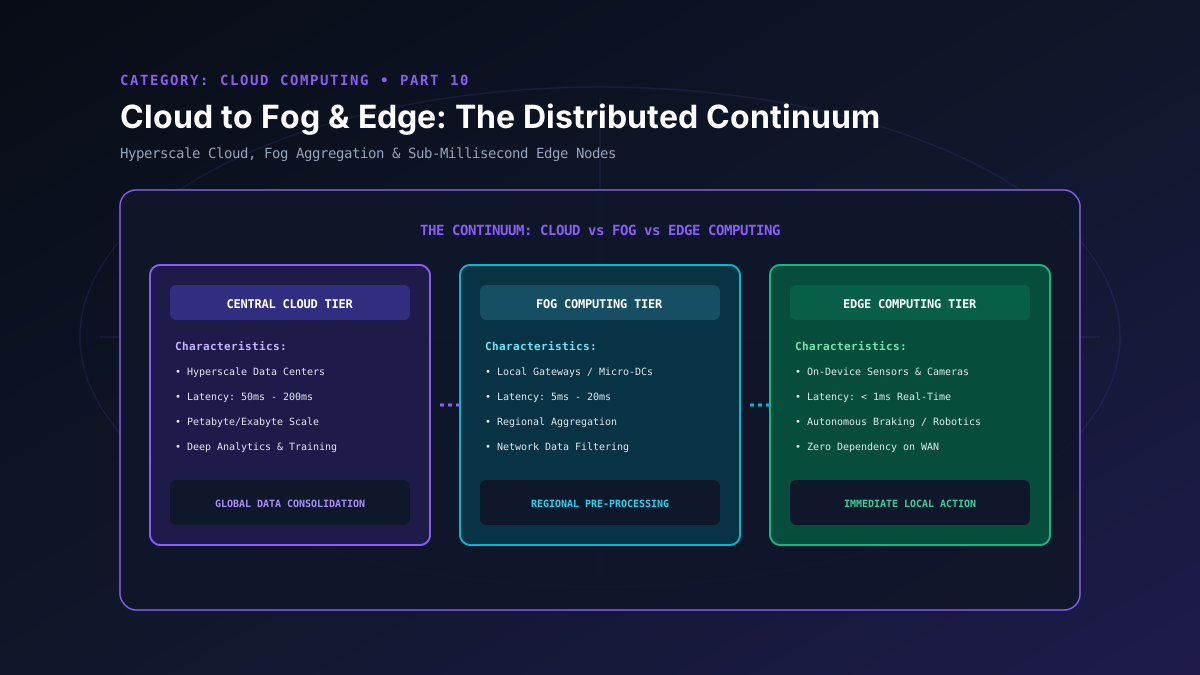
Explore the distributed computing continuum: compare centralized cloud, fog computing gateways, and real-time edge nodes for latency-critical IoT systems.
By Md. Harun-Or-Roshid
Part 8: Major Cloud Providers & Strategies to Mitigate Vendor Lock-In
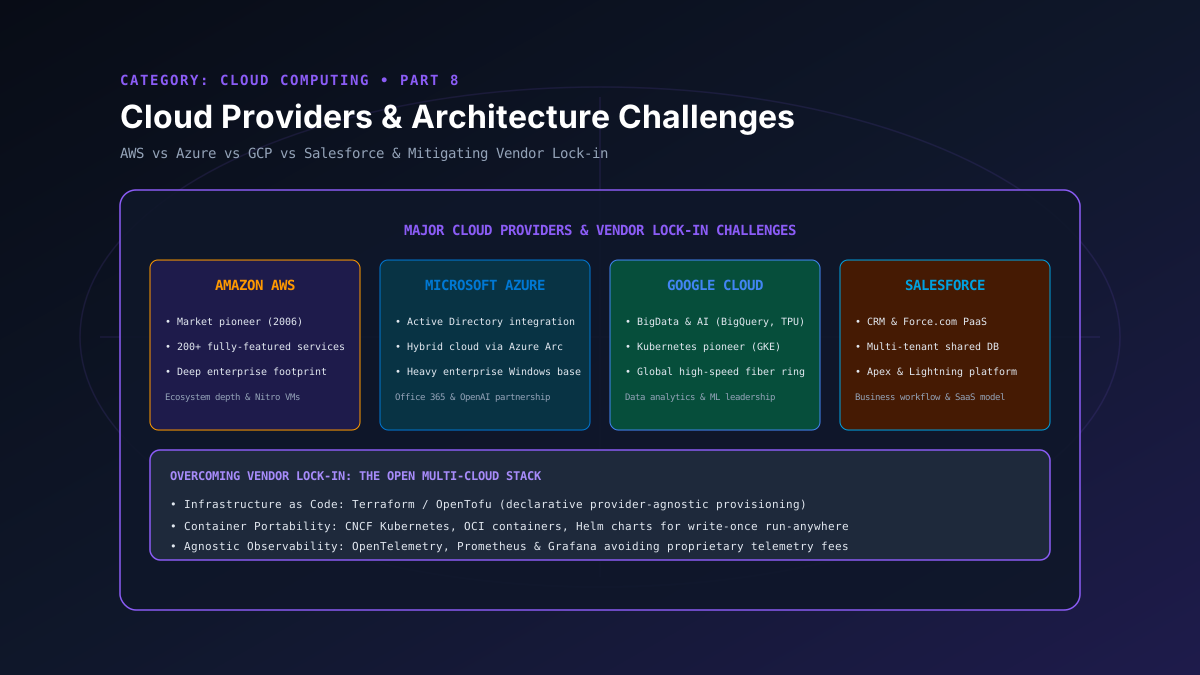
Compare hyperscale cloud providers—AWS, Azure, GCP, Salesforce—and master open strategies to prevent vendor lock-in using Terraform and Kubernetes.
By Md. Harun-Or-Roshid
Part 7: Cloud Computing Security, Data Protection & CASB Architecture
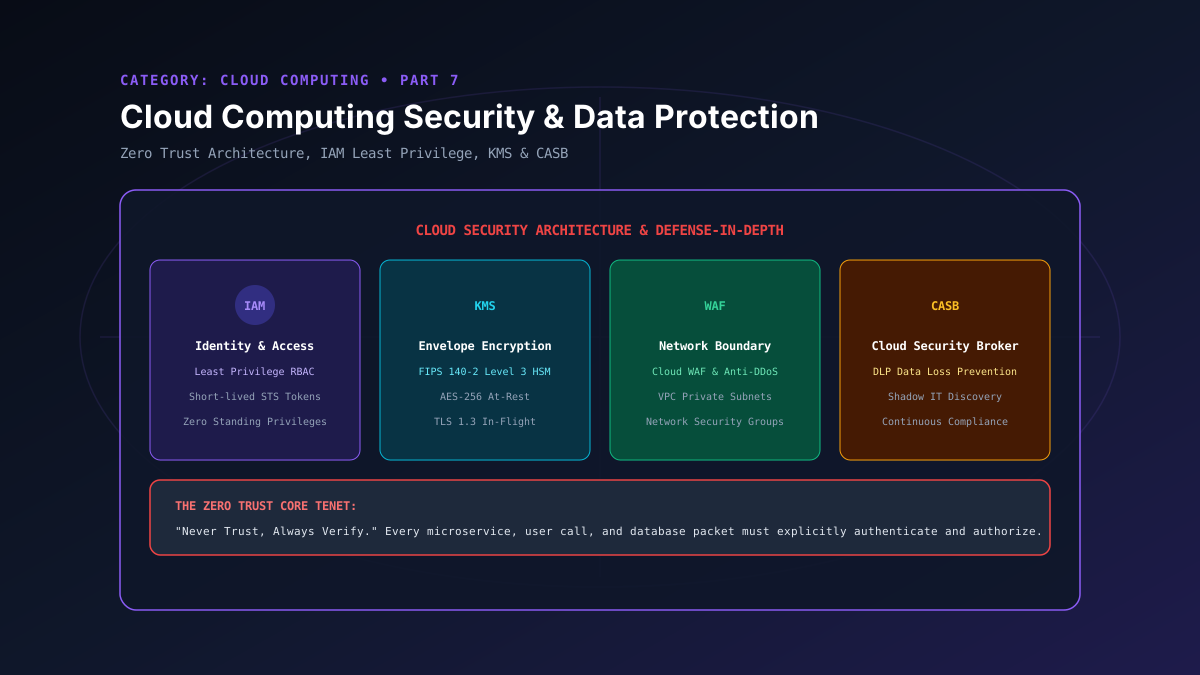
A masterclass in cloud security: explore Zero Trust architecture, IAM least privilege, KMS envelope encryption, and Cloud Access Security Brokers (CASB).
By Md. Harun-Or-Roshid
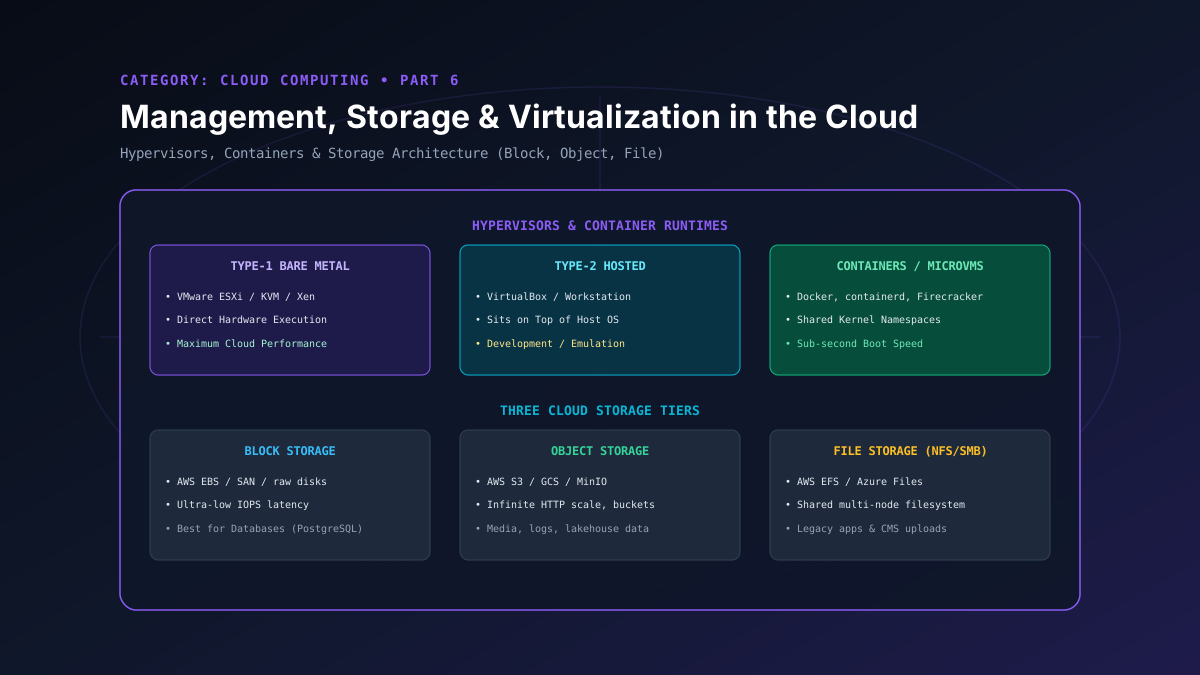
Part 6: Cloud Management, Storage, Virtualization & Resource Provisioning
A deep dive into cloud virtualization and storage: analyze Type-1 hypervisors, MicroVMs, and block (EBS), object (S3), and file (EFS) architectures.
By Md. Harun-Or-Roshid