Part 6: Memory Hierarchy & Cache Coherence: L1/L2/L3 & The MESI Protocol
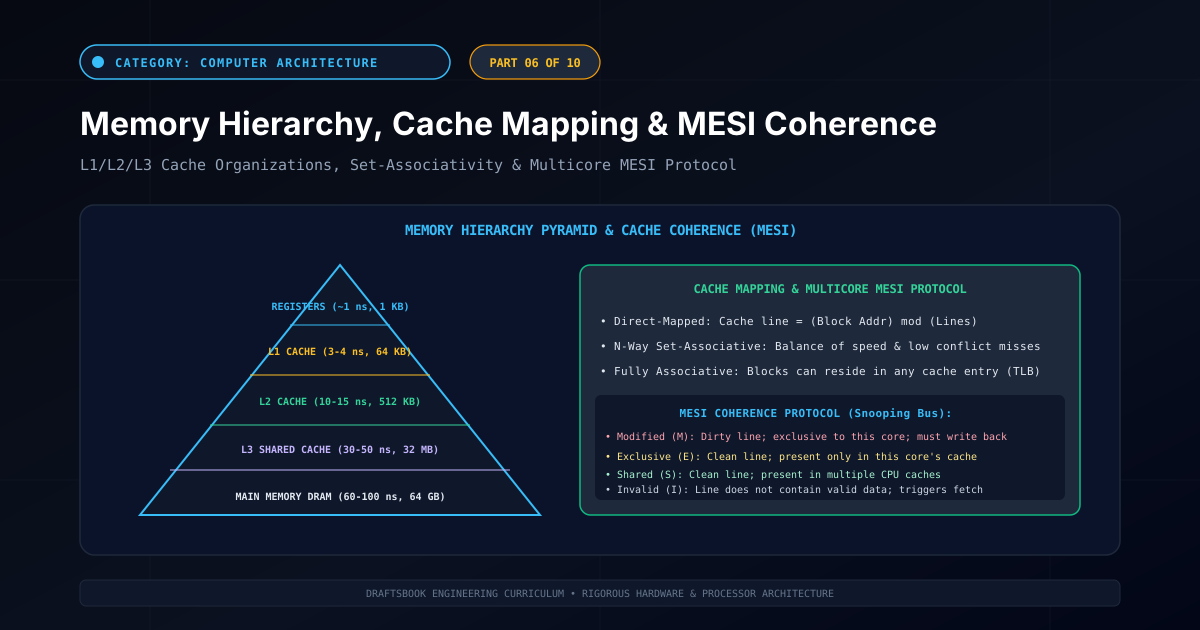
Memory Latency & Cache Hierarchies
While CPU clock frequencies have surged by orders of magnitude over the past four decades, dynamic random-access memory (DRAM) access latencies have improved at a drastically slower pace—a widening performance disparity known in computer architecture as the Memory Wall. To prevent gigahertz processor cores from stalling endlessly on main memory fetches, modern architectures deploy a multi-tiered Memory Hierarchy powered by SRAM caches (L1, L2, L3) governed by spatial and temporal locality. In this article, we analyze cache placement mappings, write policies, replacement heuristics, and the MESI Coherence Protocol in shared-memory multicore chips.
1. The Principle of Locality of Reference
Cache memory operates effectively due to the empirical property that computer programs do not access all code and data uniformly:
- Temporal Locality (Locality in Time): If a memory location is referenced at time $t$, it is highly probable to be referenced again in the immediate future (e.g., loop index counters, accumulator variables, inner loop code blocks).
- Spatial Locality (Locality in Space): If a memory location at address $A$ is referenced, locations physically adjacent to it ($A+1, A+2$) are highly probable to be referenced soon (e.g., contiguous array traversals, sequential instruction streams).
To exploit spatial locality, cache does not transfer isolated individual bytes from DRAM; it transfers contiguous multi-byte blocks termed Cache Lines (standardized at 64 bytes across modern x86 and ARM processors).
2. Cache Placement Policies & Address Partitioning
A physical memory address is mathematically dissected by cache controllers into three distinct bit fields: [Tag | Set Index | Block Offset].
Direct-Mapped Cache
Each memory block maps to exactly one cache line.
Fastest lookup, minimal silicon area; highly vulnerable to conflict misses when multiple addresses compete for the same slot.
N-Way Set-Associative Cache
The cache is partitioned into sets of $N$ lines.
A block can reside in any of the $N$ ways inside its designated set. Standard in modern L1 (8-way) and L2 (16-way) caches.
Fully Associative Cache
No set index; block can reside in any entry.
Requires expensive Content-Addressable Memory (CAM); reserved for small high-priority structures like TLBs.
3. Cache Write Policies: Write-Through vs. Write-Back
Write-Through with Write Buffer
Every write to cache immediately updates the underlying DRAM main memory simultaneously. Main memory is always pristine and coherent.
Trade-Off: Floods the memory bus with high write traffic on every store operation.
Write-Back with Dirty Bit
Writes update only the fast cache line and mark an internal Dirty Bit as active. The modified line is written back to main memory only when it is evicted by a newer block.
Trade-Off: Dramatically reduces bus bandwidth consumption; standard in modern L1/L2 caches.
4. Multicore Cache Coherence: The MESI Protocol
In modern multi-core processors, each CPU core possesses a private L1/L2 cache, while sharing a unified L3 cache and main memory. If Core 0 writes to variable $X$ in its private cache while Core 1 reads $X$ from its private cache, Core 1 risks observing stale data—the classic Cache Coherence Problem.
Hardware maintains coherence using bus-snooping state machines governed by the MESI Protocol. Every 64-byte cache line maintains two status bits representing four valid states:
| State | Line Valid? | Matches Memory? | Copies in Other Caches? | Write Permission? |
|---|---|---|---|---|
| Modified (M) | Yes | No (Dirty) | None (Exclusive) | Can write directly |
| Exclusive (E) | Yes | Yes (Clean) | None (Exclusive) | Can write (transitions to M) |
| Shared (S) | Yes | Yes (Clean) | May exist in other caches | Must broadcast invalidate first |
| Invalid (I) | No | N/A | N/A | Read triggers cache miss |
Related reading
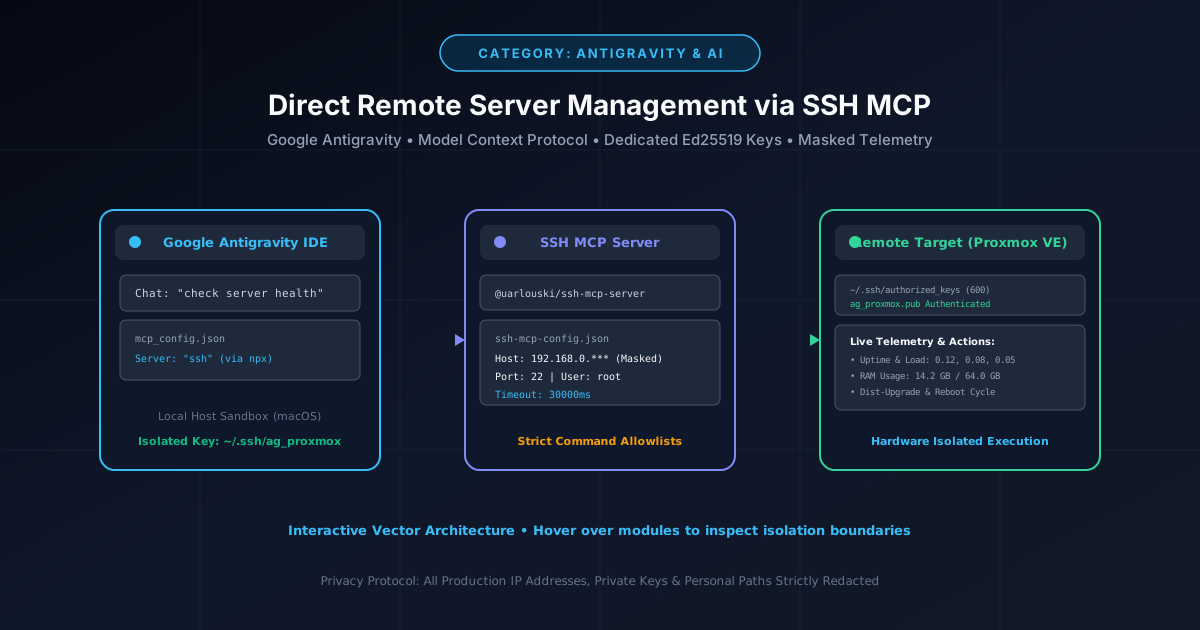
How to Give Google Antigravity Direct SSH Access to Remote Servers (Proxmox & Linux)
Connect Google Antigravity directly to Proxmox and Linux servers using the Model Context Protocol (MCP), dedicated Ed25519 keys, and automated updates.
By Md. Harun-Or-Roshid

Part 9: Load Balancing: Layer 4 vs Layer 7, Algorithms, Reverse Proxies & High Availability
Master high-availability load balancing, comparing Layer 4 transport vs Layer 7 application routing, consistent hashing rings, and health checks.
By Md. Harun-Or-Roshid
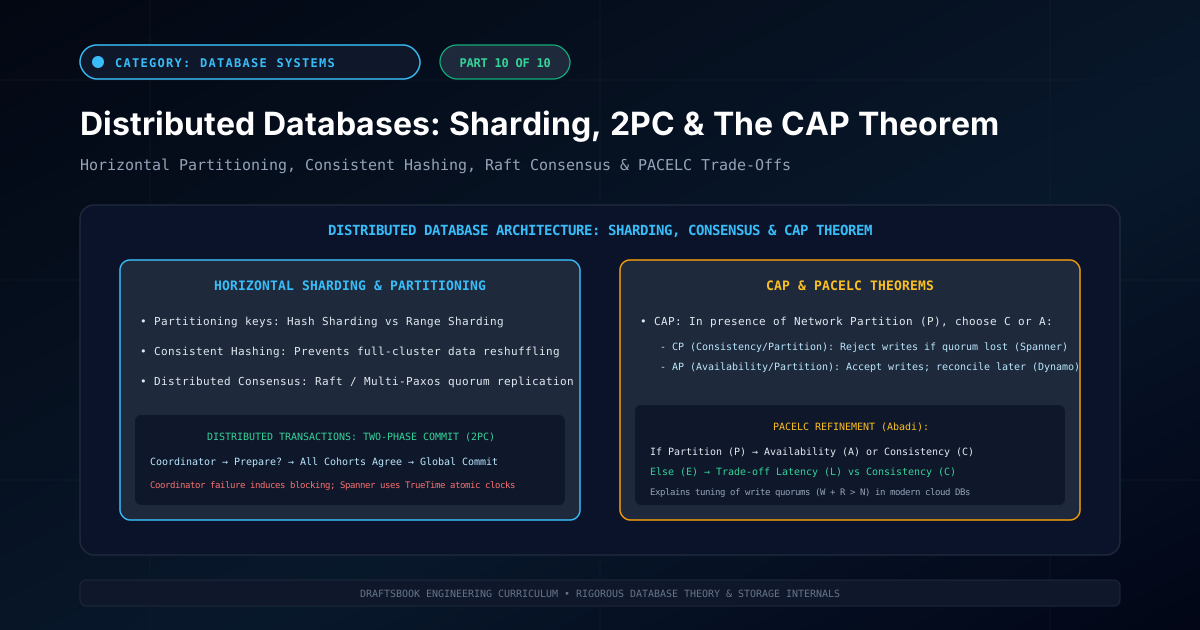
Part 10: Distributed Databases: Partitioning, Sharding, 2PC & CAP Theorem
Master distributed database architecture: horizontal sharding, consistent hashing, two-phase commit (2PC), CAP theorem trade-offs, and NewSQL engines.
By Md. Harun-Or-Roshid
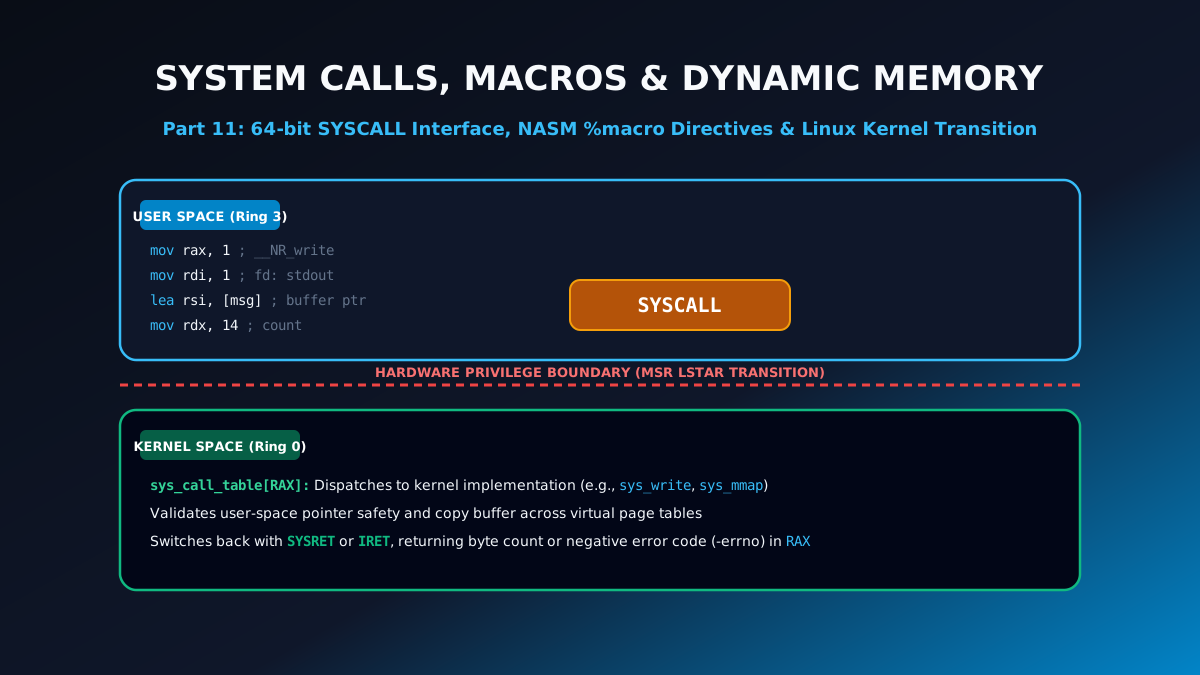
Part 11: Linux 64-Bit System Calls, NASM Macros & Dynamic Memory Allocation
Learn low-level systems programming: Linux 64-bit SYSCALL table, multi-argument NASM %macro directives, file I/O operations, and sys_mmap memory allocation.
By Md. Harun-Or-Roshid