Part 2: Network Models: OSI 7-Layer Reference Model & TCP/IP Architecture
Lesson Overview & Learning Objectives
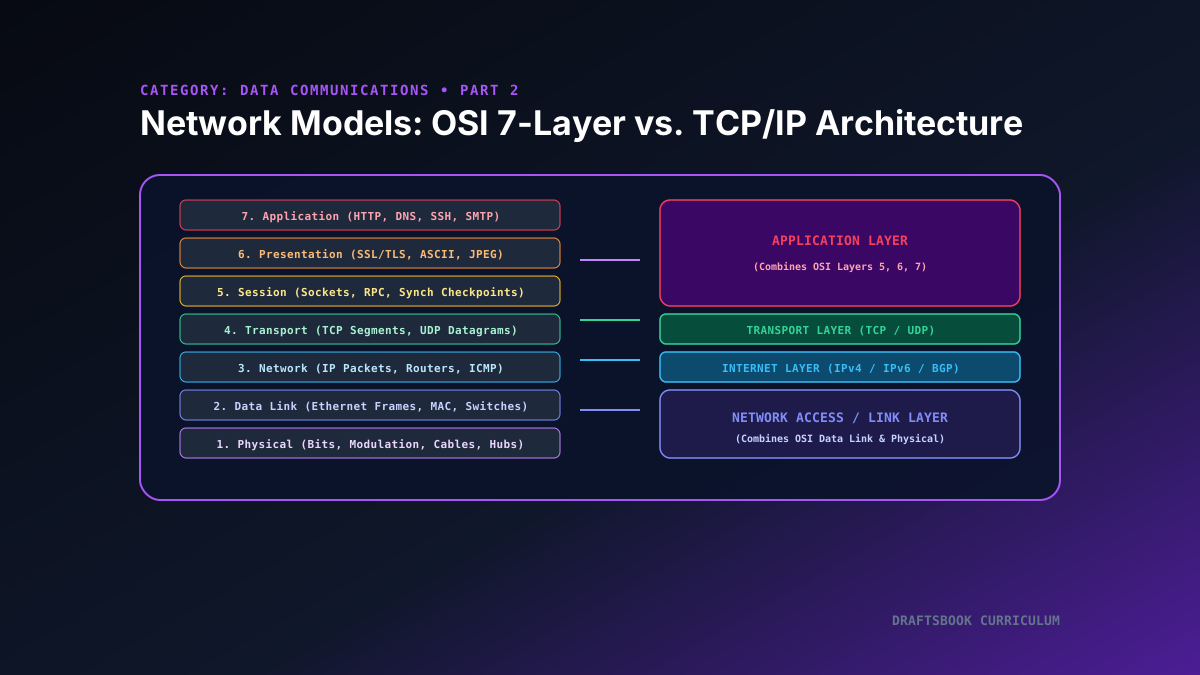
Modern computer networks are vastly complex systems comprising millions of heterogeneous devices running different operating systems and hardware architectures. To make networking manageable, standard organizations partitioned network functions into layered architectures. In this guide, we contrast the theoretical Open Systems Interconnection (OSI) 7-Layer Reference Model created by ISO with the practical, production-deployed TCP/IP Protocol Suite, exploring protocol data units (PDUs), headers, and layer encapsulation.
1. The 7 Layers of the OSI Reference Model
Provides user interfaces and network services to applications. Enables file transfers, email delivery, and directory services (HTTP, FTP, SMTP, DNS, SSH).
Handles data syntax and semantics: translation between character sets (EBCDIC to ASCII), compression (JPEG, MPEG), and cryptographic encryption/decryption (TLS/SSL).
Establishes, maintains, and synchronizes interactions between communicating systems. Inserts checkpoints into long data streams for recovery during connection failure.
Provides end-to-end process-to-process delivery of the entire message. Features port addressing, segmentation and reassembly, connection control, flow control, and error recovery (TCP / UDP).
Responsible for host-to-host delivery of individual packets across multiple networks. Provides logical IP addressing and path determination (Routing via OSPF, BGP).
Transforms a raw physical transmission facility into a reliable link. Organizes bits into frames, applies physical hardware MAC addressing, hop-to-hop flow control, and CRC error detection.
Coordinates the functions required to transmit a stream of raw bits over a physical medium. Defines line coding, pinouts, voltage levels, data rates, and transmission modes.
2. OSI vs. TCP/IP: The Architectural Contrast
| OSI Reference Layer | TCP/IP Architecture Layer | PDU Name | Representative Protocols |
|---|---|---|---|
| Application, Presentation, Session | Application Layer | Data / Message | HTTP, HTTPS, DNS, SSH, SMTP |
| Transport Layer | Transport Layer | Segment (TCP) / Datagram (UDP) | TCP, UDP, SCTP, QUIC |
| Network Layer | Internet Layer | Packet / Datagram | IPv4, IPv6, ICMP, IGMP, BGP |
| Data Link & Physical | Network Access / Link Layer | Frame (L2) & Bits (L1) | Ethernet (802.3), Wi-Fi (802.11), DOCSIS |
Related reading
Part 10: Cloud to Fog & Edge: Architecting the Distributed Continuum
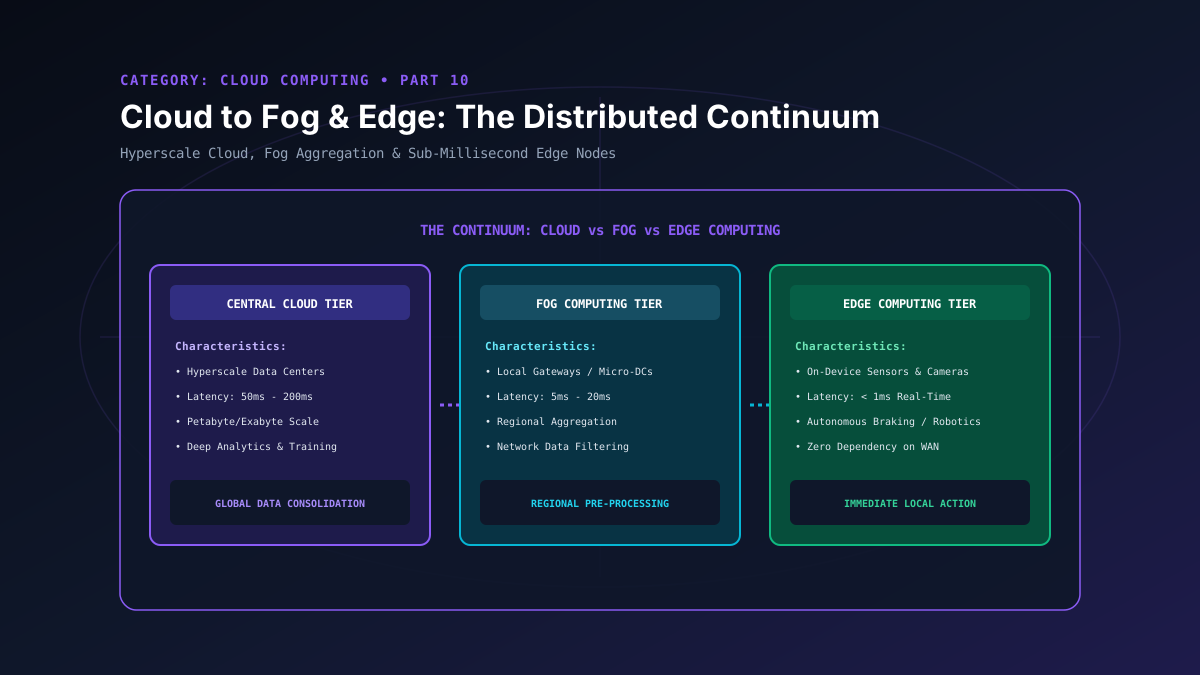
Explore the distributed computing continuum: compare centralized cloud, fog computing gateways, and real-time edge nodes for latency-critical IoT systems.
By Md. Harun-Or-Roshid
Part 10: Network Layer Addressing: IPv4 Subnetting, CIDR & IPv6 Architecture
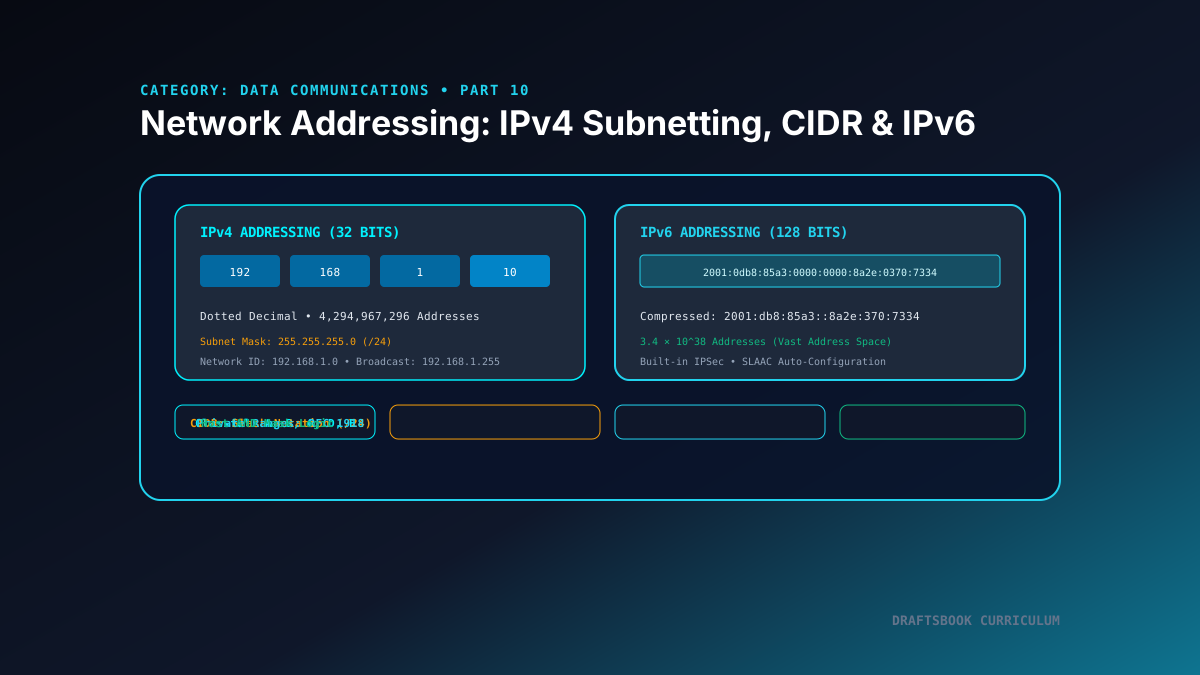
Master logical network addressing: explore IPv4 classful ranges, CIDR slash notation, subnet mask bitwise ANDing, and modern 128-bit IPv6 architecture.
By Md. Harun-Or-Roshid

Part 9: Load Balancing: Layer 4 vs Layer 7, Algorithms, Reverse Proxies & High Availability
Master high-availability load balancing, comparing Layer 4 transport vs Layer 7 application routing, consistent hashing rings, and health checks.
By Md. Harun-Or-Roshid
Part 8: VPN Explained: Cryptographic Tunnels, WireGuard, IPSec & Network Privacy
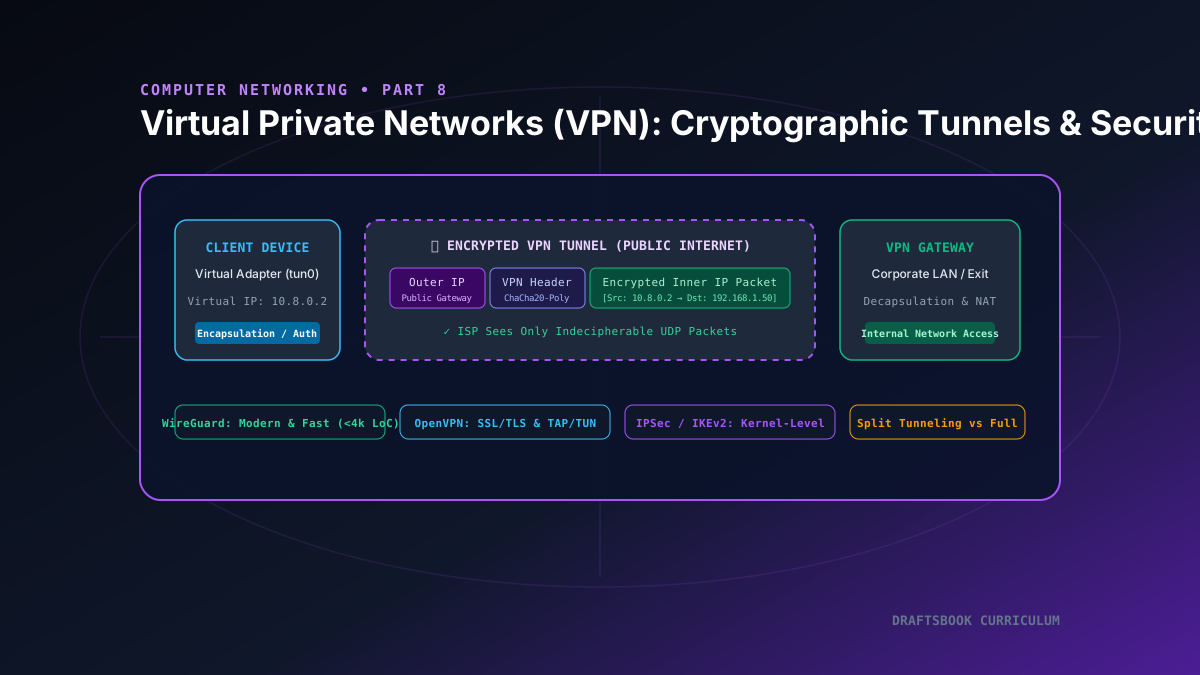
A deep dive into Virtual Private Networks, examining cryptographic packet encapsulation, virtual TUN/TAP adapters, WireGuard, and IPSec.
By Md. Harun-Or-Roshid