Part 1: Introduction to Data Communications: Five Key Elements & Transmission Modes
Series Overview & Learning Objectives
Welcome to Fundamentals of Data Communications, a comprehensive 10-part engineering curriculum covering the physical, electrical, and data-link foundations of modern telecommunication networks. While software developers routinely work at high levels of abstraction (REST APIs, WebSockets, JSON), all digital applications fundamentally rely on electromagnetic and optical signals traversing physical transmission media. In this opening installment, we establish the core definition of data communication, analyze the five indispensable components of every communication system, evaluate directional transmission modes (Simplex, Half-Duplex, Full-Duplex), and review international standards organizations.
1. What is Data Communication?
Data communication is the exchange of data between two devices via some form of transmission medium, such as a wire cable or radio frequency channel. For data communications to occur, the communicating devices must be part of a communication system made up of a combination of hardware (physical equipment) and software (programs and protocol drivers).
The effectiveness of any data communication system depends on four fundamental characteristics:
1. Delivery
The system must deliver data to the correct destination. Data must be received by the intended device or user and only by that device or user.
2. Accuracy
The system must deliver data accurately. Data that have been altered in transmission and left uncorrected are unusable.
3. Timeliness
The system must deliver data in a timely manner. Late-delivered data are often useless. In the case of video and audio, timely delivery means real-time transmission without jitter.
4. Jitter
Jitter refers to the variation in packet arrival time. It is the uneven delay in the delivery of audio or video packets that degrades multimedia quality.
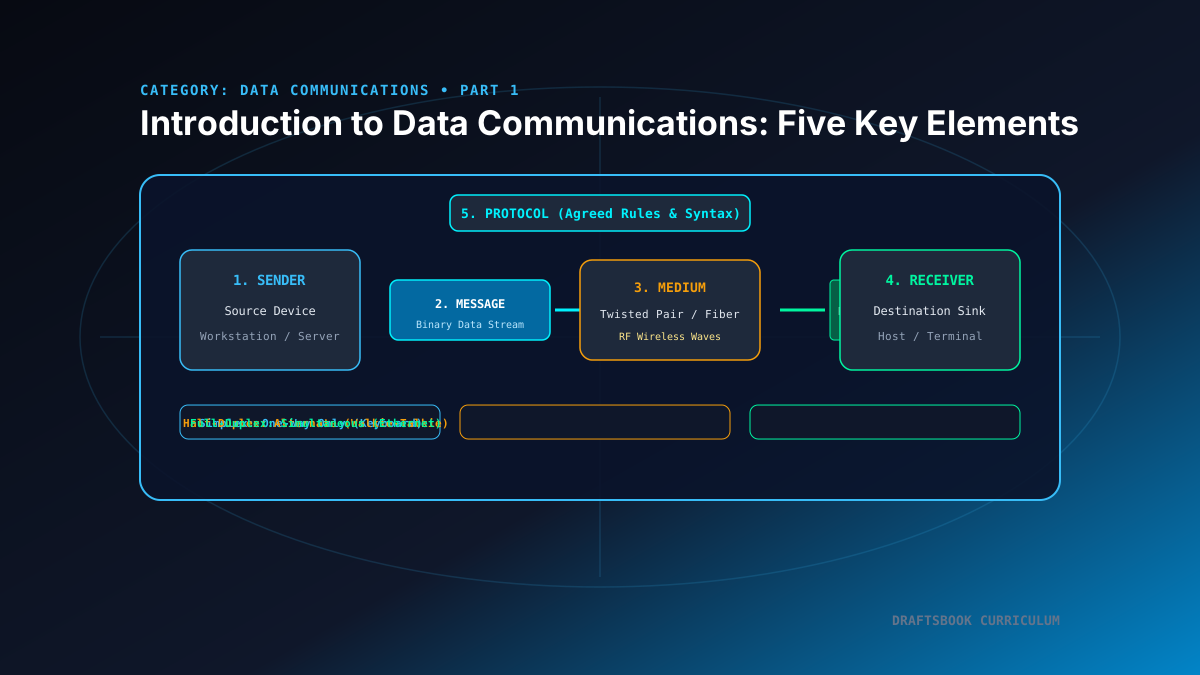
2. The Five Key Elements of a Communication System
Every data communication system, regardless of scale, comprises five core entities:
Message
The information (data) to be communicated. Popular forms of information include text, numbers, pictures, audio, and video, encoded into binary bits.
Sender (Transmitter)
The device that sends the data message. It can be a computer, workstation, telephone handset, video camera, or IoT sensor node.
Receiver
The device that receives the message. It can be a server, workstation, television receiver, printer, or mobile device.
Transmission Medium
The physical path by which a message travels from sender to receiver. Media are classified into Guided Media (twisted-pair wire, coaxial cable, fiber-optic cable) and Unguided Media (radio waves, microwaves, infrared).
Protocol
A protocol is a set of rules that govern data communications. It represents an agreement between communicating devices. Without a protocol, two devices may be connected, but not communicating—just as a person speaking French cannot be understood by a person who speaks only Japanese.
3. Data Flow Modes: Simplex, Half-Duplex, and Full-Duplex
| Mode | Directionality | Channel Capacity Usage | Real-World Examples |
|---|---|---|---|
| Simplex | Strictly unidirectional (One-way only) | Entire channel capacity used by one direction | Keyboard to CPU, traditional broadcast television, GPS satellites |
| Half-Duplex | Bidirectional, but only one party at a time | Entire capacity shared alternately | Walkie-talkies (push-to-talk), legacy 10BASE-T half-duplex CSMA/CD hubs |
| Full-Duplex | Simultaneous bidirectional transmission | Capacity divided between directions or separate physical channels | Modern switched Ethernet (1000BASE-T), cellular phone calls, optical links |
Related reading
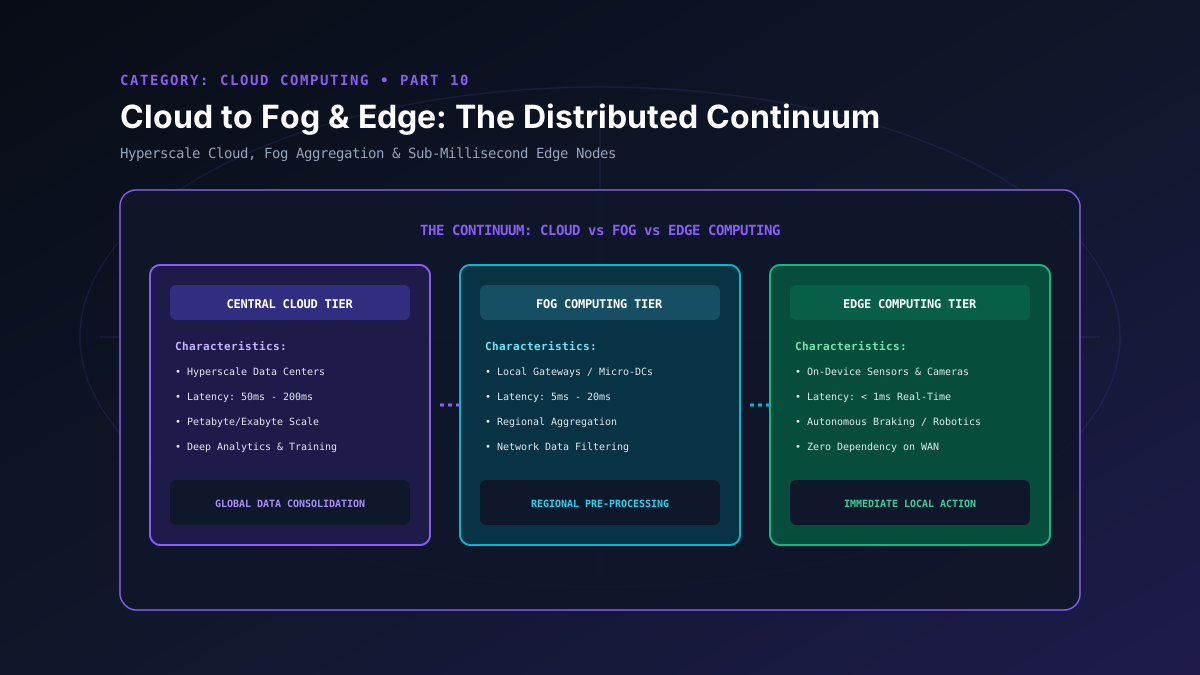
Part 10: Cloud to Fog & Edge: Architecting the Distributed Continuum
Explore the distributed computing continuum: compare centralized cloud, fog computing gateways, and real-time edge nodes for latency-critical IoT systems.
By Md. Harun-Or-Roshid
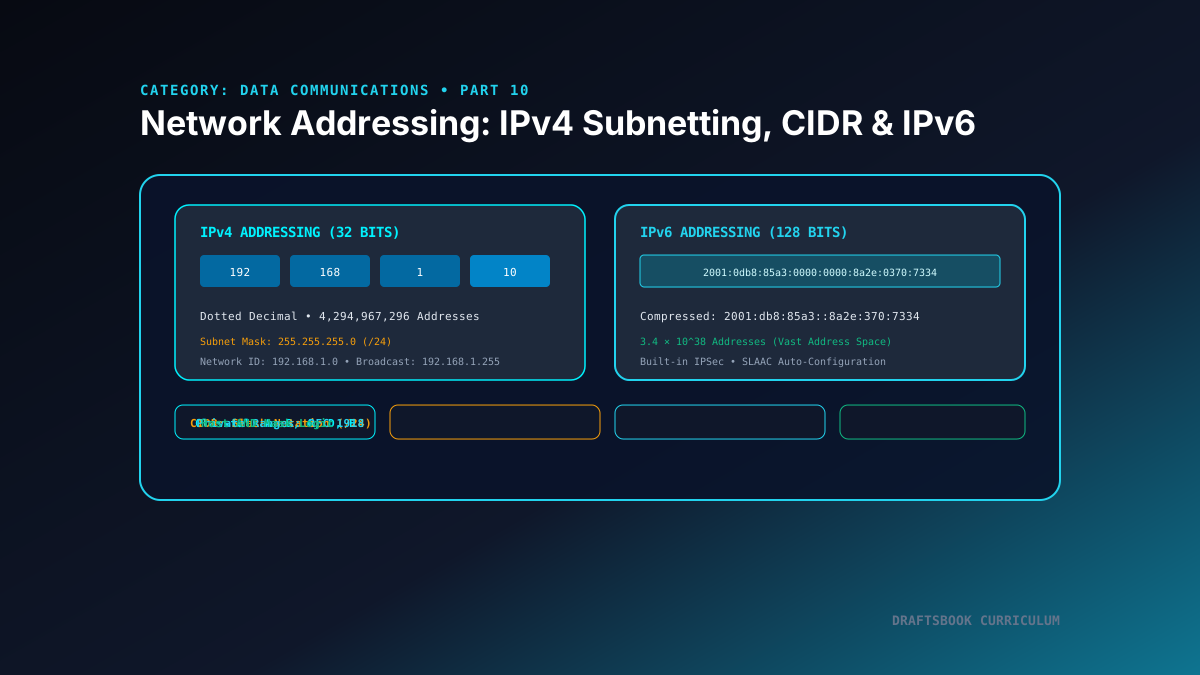
Part 10: Network Layer Addressing: IPv4 Subnetting, CIDR & IPv6 Architecture
Master logical network addressing: explore IPv4 classful ranges, CIDR slash notation, subnet mask bitwise ANDing, and modern 128-bit IPv6 architecture.
By Md. Harun-Or-Roshid
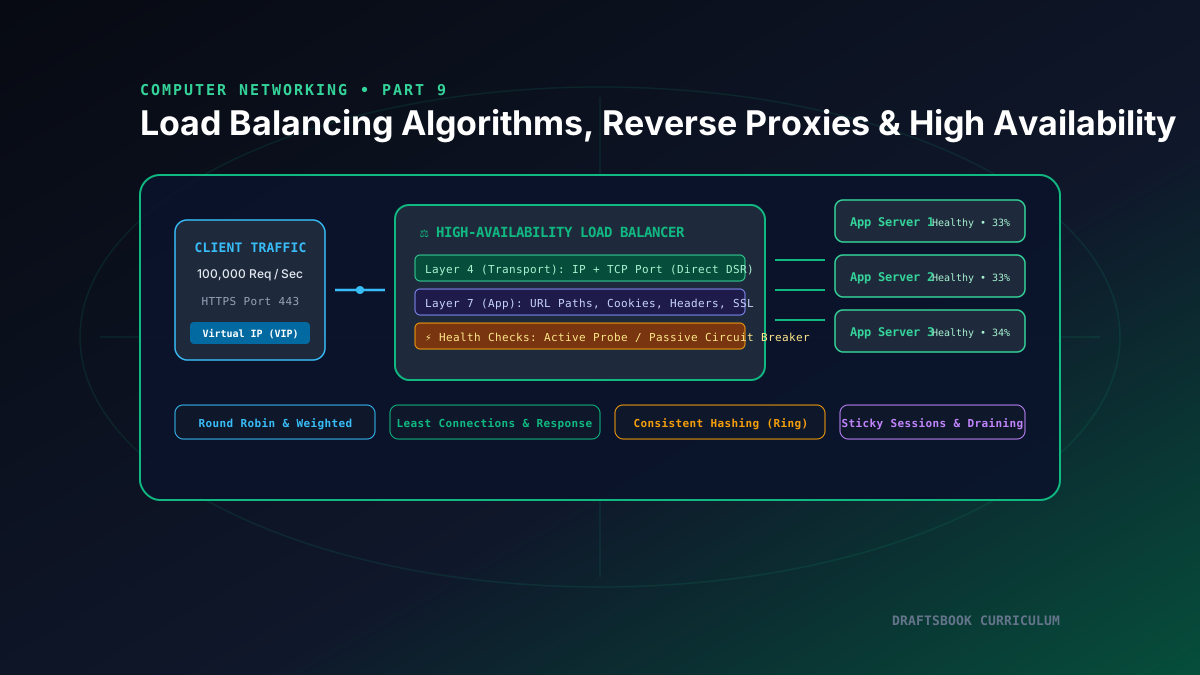
Part 9: Load Balancing: Layer 4 vs Layer 7, Algorithms, Reverse Proxies & High Availability
Master high-availability load balancing, comparing Layer 4 transport vs Layer 7 application routing, consistent hashing rings, and health checks.
By Md. Harun-Or-Roshid
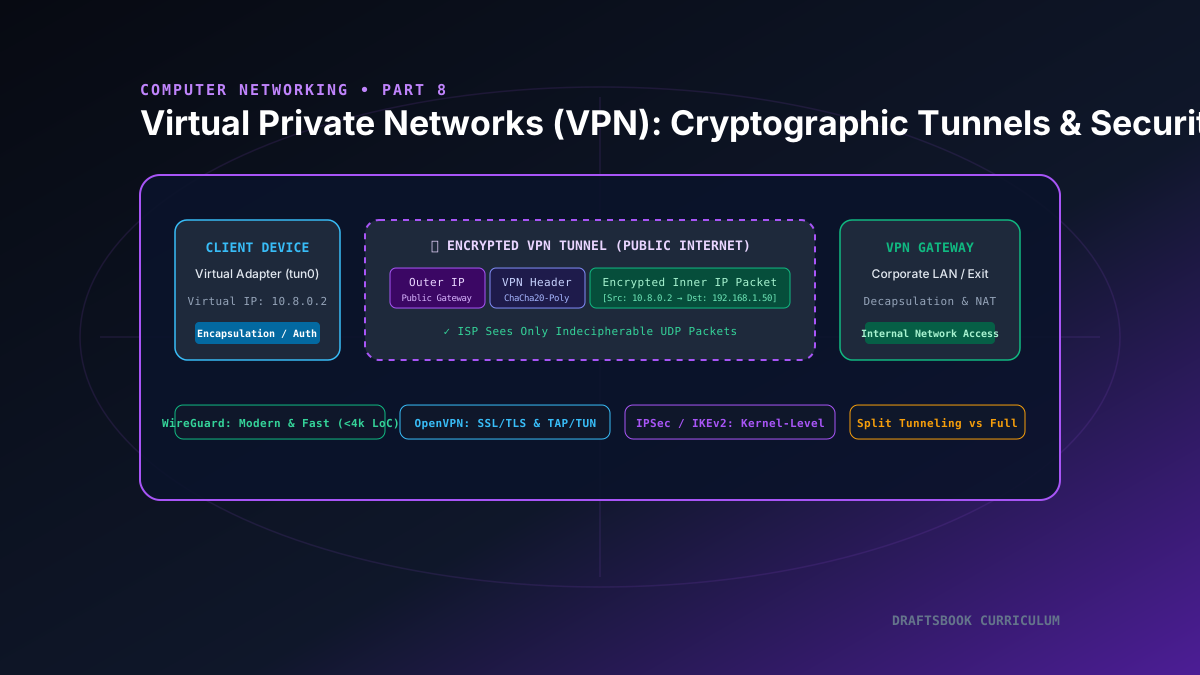
Part 8: VPN Explained: Cryptographic Tunnels, WireGuard, IPSec & Network Privacy
A deep dive into Virtual Private Networks, examining cryptographic packet encapsulation, virtual TUN/TAP adapters, WireGuard, and IPSec.
By Md. Harun-Or-Roshid