Part 5: Packet Switching vs Circuit Switching: Bandwidth, Latency & Queueing Delays
Lesson Overview & Learning Objectives
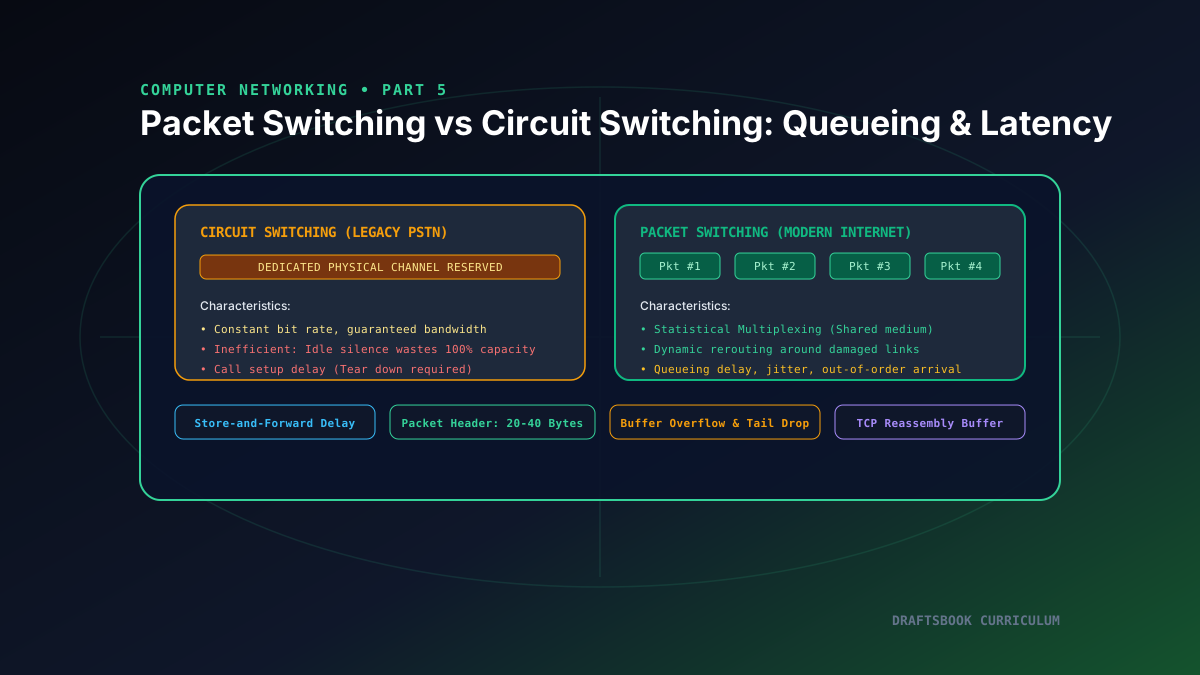
The fundamental design choice that made the global internet possible was the departure from traditional telephone networks: replacing Circuit Switching with Packet Switching. While telephone networks physically lock dedicated transmission capacity for the duration of a call, the internet breaks data into independent chunks called packets, dynamically sharing transmission lines across millions of concurrent users. In this article, we contrast these two foundational architectures, explore the power of statistical multiplexing, analyze the four components of network delay, and inspect queueing bufferbloat.
1. Architectural Comparison: Dedicated Pipes vs. Shared Chunks
| Dimension | Circuit Switching (Legacy Telecom) | Packet Switching (The Modern Internet) |
|---|---|---|
| Channel Allocation | Dedicated physical circuit reserved for session duration | Shared transmission medium (Statistical Multiplexing) |
| Bandwidth Utilization | Inefficient: silence and idle gaps waste reserved capacity | Highly efficient: line is utilized whenever any user sends data |
| Call Setup Latency | Mandatory end-to-end circuit setup delay before data transfer | Immediate packet dispatch without path reservation |
| Failure Resilience | Vulnerable: if any switch along circuit fails, call drops | Self-healing: subsequent packets dynamically route around failed nodes |
| Congestion Behavior | Call blocking (busy tone if circuits are full) | Increased queueing delay, jitter, and potential packet drop |
2. The Power of Statistical Multiplexing
Imagine a 1 Gbps fiber link. Suppose typical web users generate traffic in bursty patterns—actively transmitting data only 10% of the time, remaining idle 90% of the time.
Under Circuit Switching
If each user requires 100 Mbps, the circuit-switched network can support exactly 10 users (10 × 100 Mbps = 1 Gbps), regardless of whether those users are actively talking or silent.
Under Packet Switching
Because the probability of all users transmitting simultaneously is negligible, the packet-switched network can comfortably support 50 to 100 users with indistinguishable performance! This multiplicative efficiency enabled the economic scaling of the global web.
3. The Four Pillars of Total Network Latency
Whenever an engineer benchmarks API latency, total delay is the exact sum of four physical and computational delays:
1. Nodal Processing Delay (d_proc)
The time router silicon takes to inspect the packet header, verify the IP checksum, evaluate firewall ACLs, and query the Forwarding Information Base (FIB). Typically under microseconds in modern hardware.
2. Queueing Delay (d_queue)
The time a packet sits in the router's memory buffer waiting for preceding packets to be transmitted onto the physical link. If inbound traffic exceeds outbound line capacity, queueing delay spikes and excess packets are dropped (Tail Drop).
3. Transmission Delay (d_trans = Length / Rate)
The time required to push all packet bits onto the physical medium. For a 1500-byte packet on a 1 Gbps link, transmission delay is 12 microseconds; on an old 10 Mbps link, it is 1.2 milliseconds.
4. Propagation Delay (d_prop = Distance / Speed)
The time a photon takes to travel the physical distance through silica fiber optics (approximately 5 microseconds per kilometer). Between New York and London (~5,500 km), pure propagation delay is roughly 28 milliseconds.
Related reading
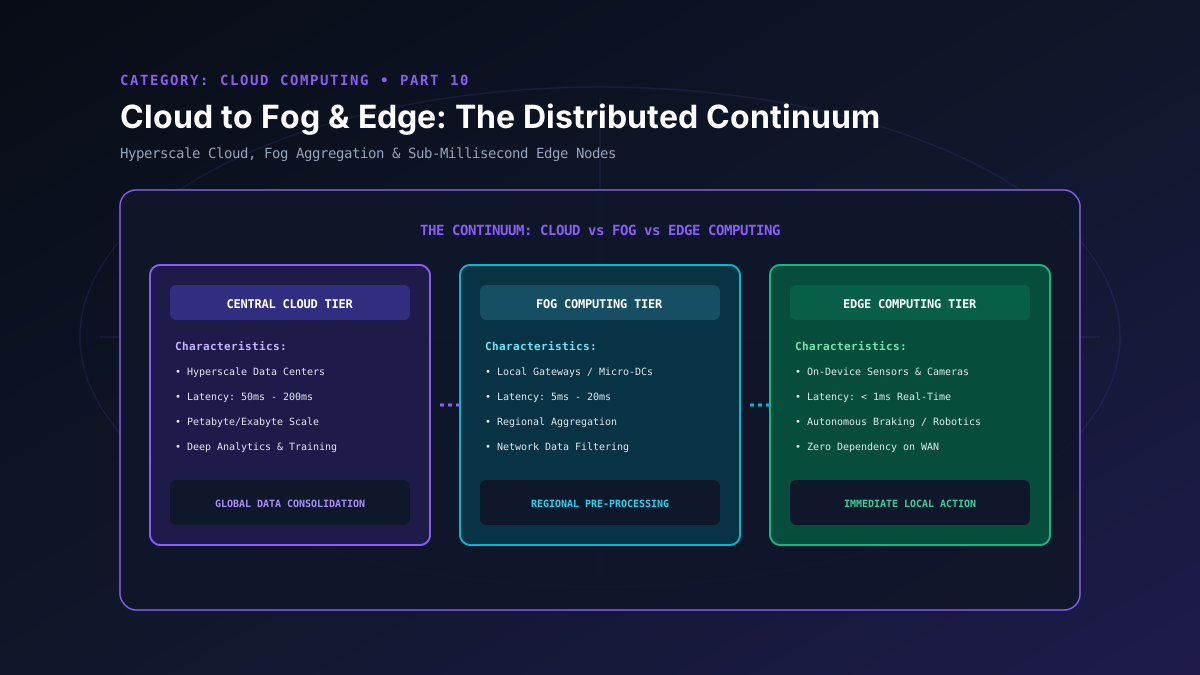
Part 10: Cloud to Fog & Edge: Architecting the Distributed Continuum
Explore the distributed computing continuum: compare centralized cloud, fog computing gateways, and real-time edge nodes for latency-critical IoT systems.
By Md. Harun-Or-Roshid
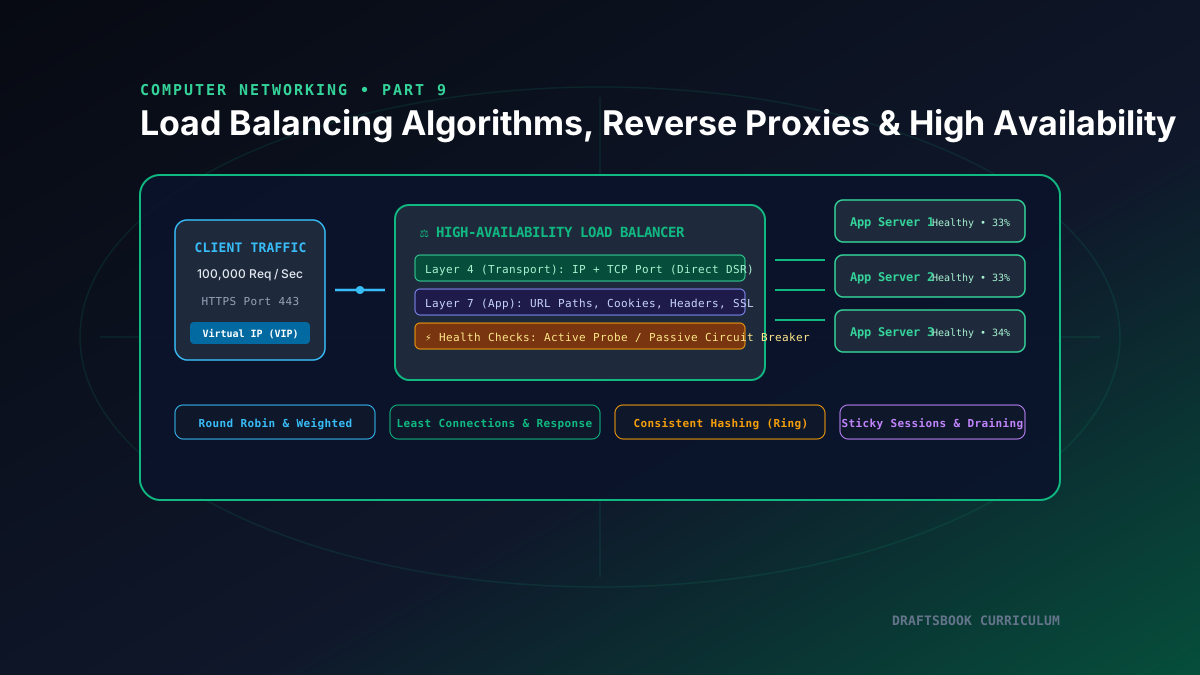
Part 9: Load Balancing: Layer 4 vs Layer 7, Algorithms, Reverse Proxies & High Availability
Master high-availability load balancing, comparing Layer 4 transport vs Layer 7 application routing, consistent hashing rings, and health checks.
By Md. Harun-Or-Roshid
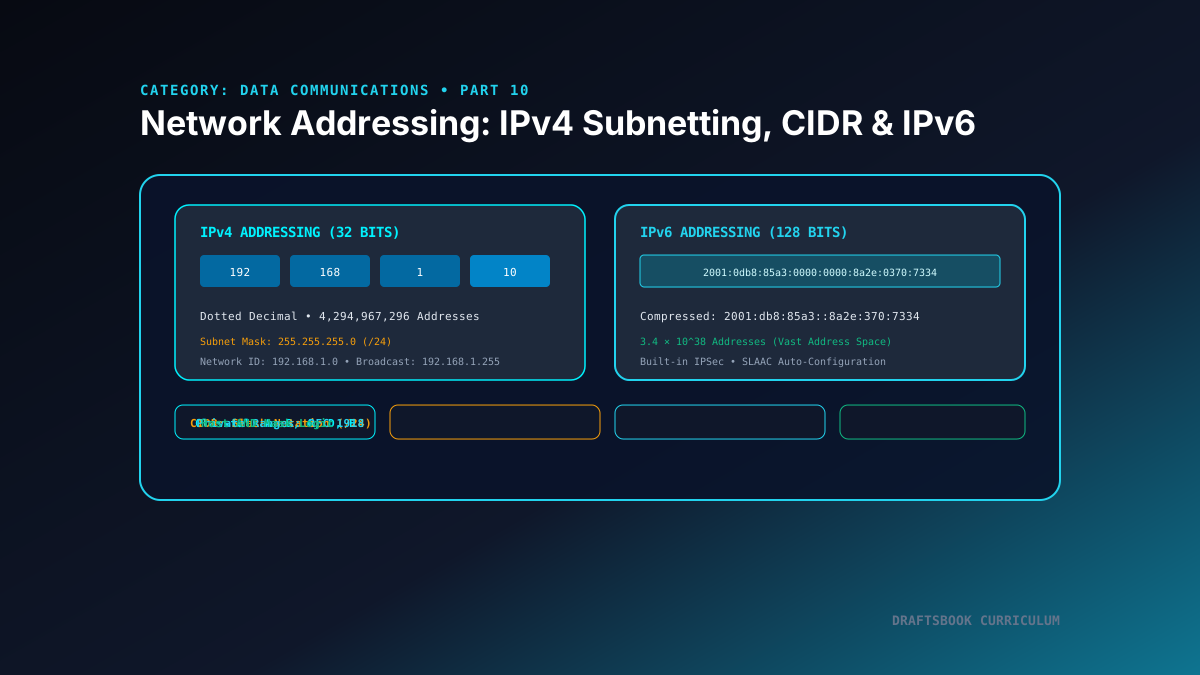
Part 10: Network Layer Addressing: IPv4 Subnetting, CIDR & IPv6 Architecture
Master logical network addressing: explore IPv4 classful ranges, CIDR slash notation, subnet mask bitwise ANDing, and modern 128-bit IPv6 architecture.
By Md. Harun-Or-Roshid
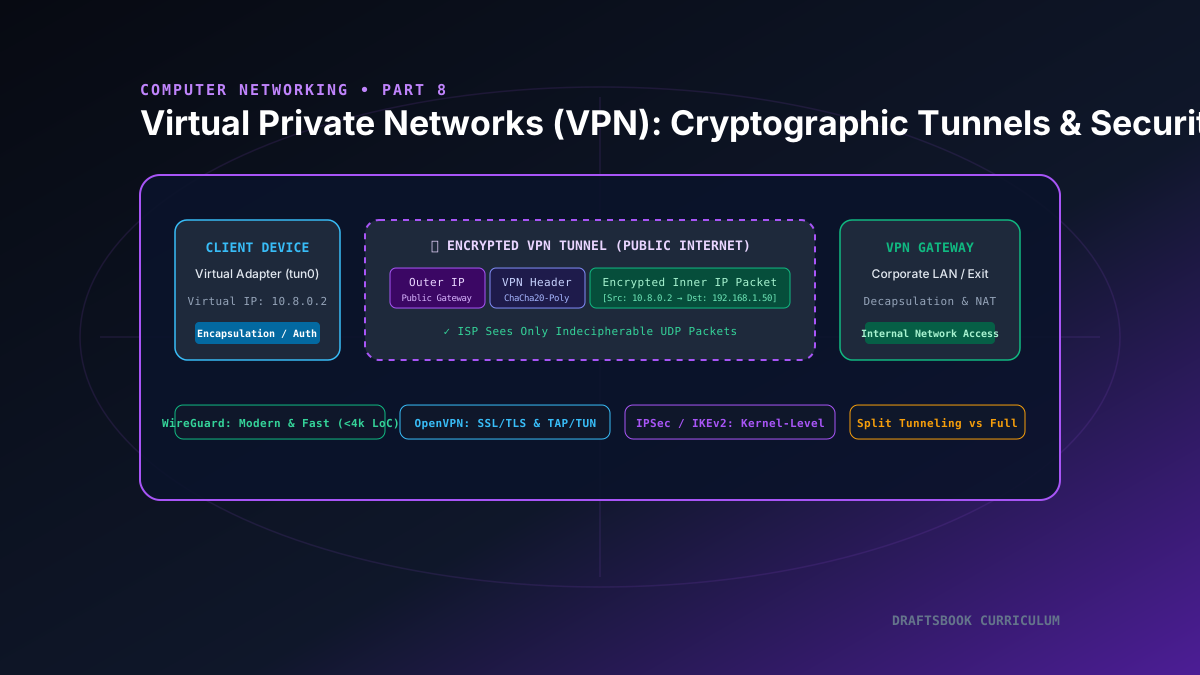
Part 8: VPN Explained: Cryptographic Tunnels, WireGuard, IPSec & Network Privacy
A deep dive into Virtual Private Networks, examining cryptographic packet encapsulation, virtual TUN/TAP adapters, WireGuard, and IPSec.
By Md. Harun-Or-Roshid