Part 2: Scan Conversion & Line Generation: DDA vs Bresenham's Integer Algorithm
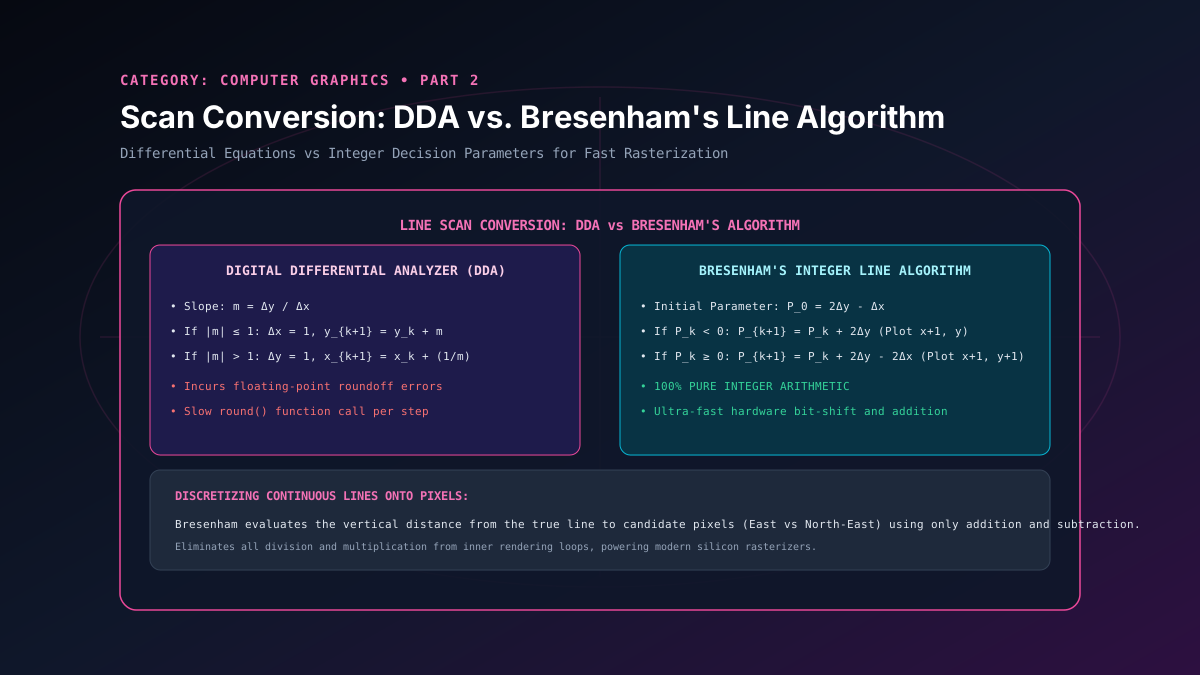
Mathematical Foundations of Rasterization
In computer graphics, scan conversion is the algorithmic process of digitizing continuous mathematical primitives (lines, curves, and polygons) into a discrete grid of integer pixel coordinates $(x, y)$ in the framebuffer. A straight line segment between endpoints $(x_0, y_0)$ and $(x_1, y_1)$ represents an infinite set of real numbers; rasterization must approximate this continuum using a finite lattice of pixels while preserving uniform brightness, minimal aliasing, and maximum throughput. In this article, we rigorously analyze and implement the two cornerstone line algorithms: the Digital Differential Analyzer (DDA) and Bresenham's Integer Line Algorithm.
1. The Differential Equation of a Line & Slope Dynamics
In Cartesian geometry, the slope-intercept form of a straight line is:
Where the slope $m$ and y-intercept $c$ are determined by the delta differentials $\Delta x = x_1 - x_0$ and $\Delta y = y_1 - y_0$:
Directly evaluating $y = m \cdot x + c$ for every integer $x$ requires floating-point multiplication and addition per step. More critically, when $|m| > 1$, incrementing $x$ by 1 produces $\Delta y > 1$, causing gaps and disconnected pixel holes along steep lines. Robust rasterization algorithms must dynamically adapt step increments according to the line's slope magnitude.
2. Digital Differential Analyzer (DDA) Algorithm
The DDA Algorithm is an incremental scan-conversion method based on calculating differential increments $\Delta x$ and $\Delta y$. Instead of computing full multiplications at each coordinate, DDA samples the line at unit intervals along the coordinate axis with the largest differential.
Case 1: Shallow Slope ($|m| \le 1$)
Step along $x$ in unit intervals: $\Delta x = 1$. The next y-coordinate is incremented incrementally by the slope:
The plotted pixel is $(x_{k+1}, \text{round}(y_{k+1}))$.
Case 2: Steep Slope ($|m| > 1$)
Step along $y$ in unit intervals: $\Delta y = 1$. The next x-coordinate is incremented incrementally by the inverse slope:
The plotted pixel is $(\text{round}(x_{k+1}), y_{k+1})$.
Weakness of DDA: Although DDA eliminates multiplication, it still relies on floating-point arithmetic and explicit rounding functions (round() or floor()) at every single step. In hardware graphics pipelines, floating-point roundoff errors accumulate over long lines, causing the line trajectory to drift away from the true mathematical path.
3. Bresenham's Integer Line Algorithm
In 1962, Jack Elton Bresenham developed an optimal scan-conversion algorithm that utilizes pure integer addition, subtraction, and bitwise arithmetic—completely eliminating floating-point math and division.
Consider a line in the first octant where $0 \le m \le 1$ with $x_0 < x_1$. At step $k$, having plotted $(x_k, y_k)$, the next candidate pixel must be either:
- East (E): $(x_k + 1, y_k)$
- North-East (NE): $(x_k + 1, y_k + 1)$
The true mathematical line at $x = x_k + 1$ has vertical coordinate $y = m(x_k + 1) + c$. The vertical distances from the true line to the lower candidate pixel ($d_1$) and upper candidate pixel ($d_2$) are:
d_2 = (y_k + 1) - y = y_k + 1 - [m(x_k + 1) + c]
d_1 - d_2 = 2m(x_k + 1) - 2y_k + 2c - 1
Substituting $m = \Delta y / \Delta x$ and multiplying throughout by $\Delta x$ (which is strictly positive) produces the integer decision parameter $P_k$:
Initial Parameter & Incremental Recurrence
Evaluating at the origin endpoint $(x_0, y_0)$ yields the initial decision parameter $P_0$:
At each subsequent step $k$, the next parameter $P_{k+1}$ is computed incrementally from $P_k$:
- If $P_k < 0$: The true line is closer to pixel $E$ $(x_k + 1, y_k)$. Plot $(x_k + 1, y_k)$, and update:
P_{k+1} = P_k + 2 \Delta y
- If $P_k \ge 0$: The true line is closer to pixel $NE$ $(x_k + 1, y_k + 1)$. Plot $(x_k + 1, y_k + 1)$, and update:
P_{k+1} = P_k + 2 \Delta y - 2 \Delta x
4. C++ Reference Implementation
void drawLineBresenham(int x0, int y0, int x1, int y1) {
    int dx = std::abs(x1 - x0);
    int dy = std::abs(y1 - y0);
    int sx = (x0 < x1) ? 1 : -1;
    int sy = (y0 < y1) ? 1 : -1;
    int err = dx - dy;

    while (true) {
        setPixel(x0, y0);
        if (x0 == x1 && y0 == y1) break;
        int e2 = 2 * err;
        if (e2 > -dy) {
            err -= dy;
            x0 += sx;
        }
        if (e2 < dx) {
            err += dx;
            y0 += sy;
        }
    }
}
5. Performance & Hardware Efficiency Comparison
| Metric | Direct Equation ($y = mx + c$) | DDA Algorithm | Bresenham's Algorithm |
|---|---|---|---|
| Arithmetic Operations | Float multiplication & addition | Float addition & rounding | Integer addition, subtraction, bit-shift ($2x$) |
| Accumulative Error | None (calculated from scratch) | Drifts due to floating-point truncation | Zero error drift; exact integer precision |
| Hardware Complexity | High (FPU multiplier required) | Moderate (FPU adder required) | Extremely low (pure ALU adder/shifter) |
Related reading

How to Give Google Antigravity Direct SSH Access to Remote Servers (Proxmox & Linux)
Connect Google Antigravity directly to Proxmox and Linux servers using the Model Context Protocol (MCP), dedicated Ed25519 keys, and automated updates.
By Md. Harun-Or-Roshid

Part 9: Load Balancing: Layer 4 vs Layer 7, Algorithms, Reverse Proxies & High Availability
Master high-availability load balancing, comparing Layer 4 transport vs Layer 7 application routing, consistent hashing rings, and health checks.
By Md. Harun-Or-Roshid
Part 10: Distributed Databases: Partitioning, Sharding, 2PC & CAP Theorem
Master distributed database architecture: horizontal sharding, consistent hashing, two-phase commit (2PC), CAP theorem trade-offs, and NewSQL engines.
By Md. Harun-Or-Roshid
Part 11: 3D Graphics: Parallel & Perspective Projections & Hidden Surface Removal
A masterclass in 3D rendering pipelines, parallel and perspective projections, vanishing points, back-face culling, and GPU hardware Z-buffer depth testing.
By Md. Harun-Or-Roshid