Cambridge IELTS 17 Test 4 Reading Answers & Step-by-Step Explanations
Cambridge IELTS 17 Academic Reading Test 4: Complete Explanations
Master Cambridge IELTS 17 Reading Test 4 with our verified walkthrough. Comprehensive answer keys, paragraph citations, and keyword bridges for Bats to the Rescue (biological pest suppression in Madagascar), economic history analysis on Does Education Fuel Economic Growth?, and cognitive neuroimaging of Timur Gareyev - Blindfold Chess Champion.
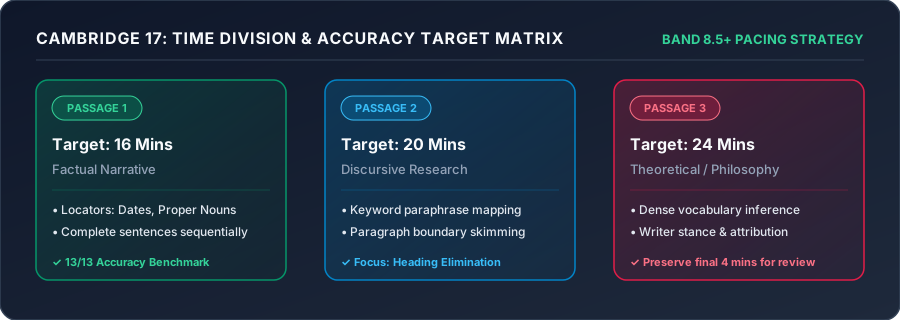
Master Quick-Reference Answer Key (Questions 1–40)
Cross-check your exam answers across all 40 questions with this master key.
| Q# | Answer Key | Q# | Answer Key | Q# | Answer Key | Q# | Answer Key |
|---|---|---|---|---|---|---|---|
| 1 | FALSE | 11 | unclean | 21 | fine | 31 | D |
| 2 | FALSE | 12 | culture | 22 | skills | 32 | G |
| 3 | NOT GIVEN | 13 | houses | 23 | B | 33 | FALSE |
| 4 | TRUE | 14 | B | 24 | E | 34 | NOT GIVEN |
| 5 | NOT GIVEN | 15 | F | 25 | B | 35 | NOT GIVEN |
| 6 | TRUE | 16 | D | 26 | D | 36 | TRUE |
| 7 | droppings | 17 | A | 27 | C | 37 | memory |
| 8 | coffee | 18 | E | 28 | E | 38 | numbers |
| 9 | mosquitoes | 19 | descendants | 29 | A | 39 | communication |
| 10 | protein | 20 | sermon | 30 | B | 40 | visual |
Reading Passage 1: Bats to the Rescue
Topic: Tropical Ecology, Biological Pest Control & Madagascar Agriculture • Questions 1–13
Questions 1–6: True / False / Not Given Breakdown
Questions 7–13: Agro-Ecological Relations Summary Completion
| Q# | Summary Blank Concept | Correct Term | Context Rationale |
|---|---|---|---|
| 7 | DNA barcode sample source | droppings | Researchers collected bat fecal droppings underneath roosting trees. |
| 8 | Pest control in other cash crops | coffee | Bats safeguard lucrative coffee shrubs from wood borer beetles. |
| 9 | Disease vector consumption | mosquitoes | Bats voraciously consume mosquitoes carrying malaria and elephantiasis. |
| 10 | Dietary supplement during famine | protein | During lean seasons, fruit bats serve as an emergency dietary protein source. |
| 11 | Roosting building stigma | unclean | Residents resent attic roosts because guano makes ceiling timbers unclean. |
| 12 | Ancestral spiritual reverence | culture | Bats occupying sacred ancestral caves occupy a revered niche in local culture. |
| 13 | Ecological coexistence initiative | houses | Conservationists encourage farmers to erect dedicated artificial bat houses. |
Reading Passage 2: Does Education Fuel Economic Growth?
Topic: Economic History, Early Modern Literacy & Trade Guilds • Questions 14–26
Questions 14–18: Information Matching (Sections A–F)
Explains that research must examine ordinary artisans rather than exceptional polymath geniuses.
Lists historical archival sources: parish baptismal registries, probate inventories, court records.
Narrates a shepherd defying a local magistrate's decree to surrender an unapproved Bible.
Highlights Württemberg in southwest Germany as a pristine test case due to comprehensive archives.
Itemizes estate possessions: spinning wheels, pewter spoons, bedding, prayer books.
Questions 19–22: Sentence Completion
| 19 | descendants | Genealogists traced family lineages to determine whether literacy enriched descendants. |
| 20 | sermon | Parishioners who missed the mandatory Sunday sermon faced church court censure. |
| 21 | fine | Parents failing to send children to village catechism classes incurred a stiff financial fine. |
| 22 | skills | Craft guilds prioritized practical mechanical skills over abstract academic reading. |
Questions 23–26: Multiple Selection Findings
Questions 23 & 24: Historical Literacy Rates (Choose TWO)
Answers: B, EGermany enjoyed exceptional early modern literacy rates (B), while historical data suggests wealth creation ultimately drove education expansion, rather than vice versa (E).
Questions 25 & 26: Craft Guild Policies in Central Europe (Choose TWO)
Answers: B, DGuilds vigorously blocked external labour migration (B) and aggressively suppressed unlicensed manufacturing practices that threatened their local cartels (D).
Reading Passage 3: Timur Gareyev - Blindfold Chess Champion
Topic: Cognitive Neuroscience, Working Memory & Blindfold Chess Grandmasters • Questions 27–40
Questions 27–32: Paragraph Matching (Paragraphs A–H)
| 27 | C | References historic blindfold displays in 13th-century Florence. |
| 28 | E | Outlines cognitive mechanics: visualizing changing mental boards without physical sight. |
| 29 | A | Claims Gareyev's genius is domain-specific rather than a generalized super-intellect. |
| 30 | B | Explains why UCLA cognitive neuroscientists jumped at the opportunity to scan his brain. |
| 31 | D | Outlines Gareyev's personal priorities: setting world records while exercising on a stationary bike. |
| 32 | G | Explains endgame vulnerability: fatigue eroding visual distinction after 16 hours of continuous play. |
Questions 33–36: True / False / Not Given
Questions 37–40: Neurological Scan Summary
UCLA researchers began by evaluating standard short-term Working Memory capacity.
Gareyev was tasked with recalling arbitrary strings of pseudo-random numbers.
fMRI scans revealed heightened neural communication between the frontal and parietal lobes.
Gareyev relied on intense visual network recruitment to anchor dynamic spatial positions.
Band 8.5+ Strategy: Mastering Information Matching & Summary
- Matching Information to Paragraphs: Notice that questions ask for an outline (Q28), a reason (Q32), or a claim (Q29). Classify the rhetorical function of the target text before matching.
- Multiple Selection Questions: In questions like 23–24, options are credited as 1 mark each. You can write them in either order (B, E or E, B) on your official Cambridge answer sheet.
Related reading
IELTS Writing Task 2 Part 5: Direct Questions & Band 9 Models
Master IELTS Writing Task 2 two-part direct questions, complex grammatical subordination, and analyze a complete Band 9.0 model essay with examiner marks.
By Super Admin
IELTS Writing Task 2 Part 4: Problem-Solution & Causes
Master IELTS Writing Task 2 problem-solution and cause-effect essays with symmetrical causal chains, practical interventions, and Band 8.5+ templates.
By Super Admin
IELTS Writing Task 2 Part 3: Discussion Essays (Both Views)
Master IELTS Writing Task 2 discussion essays (discuss both views and give your opinion) with balanced argumentation, objective framing, and clear stances.
By Super Admin
IELTS Writing Task 2 Part 2: Opinion Essays (Agree/Disagree)
Master IELTS Writing Task 2 opinion essays (agree or disagree) with unambiguous thesis statements, persuasive argumentation, and Band 9 model essays.
By Super Admin