Cambridge IELTS 17 Test 3 Reading Answers & Step-by-Step Explanations
Cambridge IELTS 17 Academic Reading Test 3: Complete Explanations
In-depth solutions and tactical breakdown for Cambridge IELTS 17 Reading Test 3. Complete answers for The Thylacine (extinction of the Tasmanian tiger), the global ecological and economic debates surrounding Palm Oil, and Jason M. Barr's urban economics in Building the Skyline: The Birth and Growth of Manhattan's Skyscrapers.
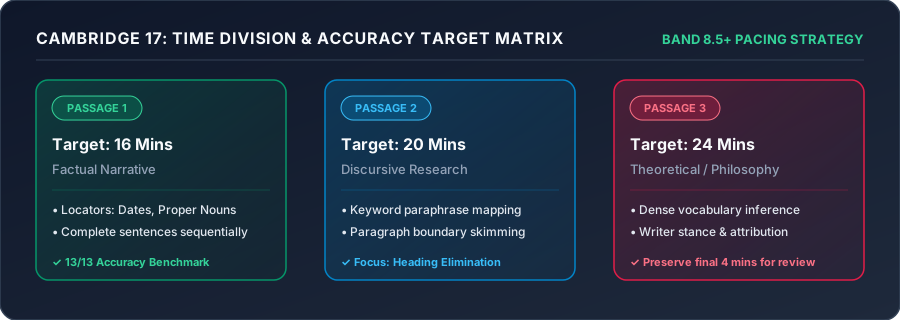
Master Quick-Reference Answer Key (Questions 1–40)
Cross-check your results across all three reading passages with this master answer table.
| Q# | Answer Key | Q# | Answer Key | Q# | Answer Key | Q# | Answer Key |
|---|---|---|---|---|---|---|---|
| 1 | carnivorous | 11 | FALSE | 21 | C | 31 | C |
| 2 | scent | 12 | TRUE | 22 | E | 32 | NO |
| 3 | pouch | 13 | NOT GIVEN | 23 | solid | 33 | YES |
| 4 | fossil | 14 | G | 24 | Sumatran orangutan | 34 | NOT GIVEN |
| 5 | habitat | 15 | E | 25 | carbon stocks | 35 | NO |
| 6 | TRUE | 16 | A | 26 | biodiversity | 36 | H |
| 7 | FALSE | 17 | F | 27 | D | 37 | D |
| 8 | NOT GIVEN | 18 | B | 28 | B | 38 | I |
| 9 | FALSE | 19 | C | 29 | C | 39 | B |
| 10 | NOT GIVEN | 20 | D | 30 | D | 40 | F |
Reading Passage 1: The Thylacine
Topic: Marsupial Zoology, Extinction & Historical Conservation • Questions 1–13
Questions 1–5: Morphological & Behavioral Notes
| Q# | Feature / Category | Correct Term | Passage Citation |
|---|---|---|---|
| 1 | Feeding classification | carnivorous | As the largest known carnivorous marsupial of modern times... |
| 2 | Prey tracking sense | scent | Relied on keen scent rather than burst velocity to track wallabies... |
| 3 | Maternal anatomy | pouch | Females carried joeys in a backward-facing rear abdominal pouch... |
| 4 | Prehistoric evidence | fossil | Fossil records indicate widespread dispersal across the Australian mainland... |
| 5 | Ecological retreat | habitat | Dingo competition and human hunting restricted its habitat exclusively to Tasmania... |
Questions 6–13: True / False / Not Given Breakdown
Reading Passage 2: An Insight into Palm Oil
Topic: Tropical Agro-Industry, RSPO Certification & Deforestation • Questions 14–26
Questions 14–20: Information Matching (Paragraphs A–G)
Details high land efficiency: oil palm produces up to 10 times more oil per hectare than soy or sunflower.
Profiles the Roundtable on Sustainable Palm Oil (RSPO) regulatory oversight body.
Lists common consumer items: shampoo, detergents, lipstick, packaged baked goods.
Highlights barn owls introduced as natural pest predators in plantation canopy ecosystems.
Provides production metrics: global supply quadrupling to over 70 million tonnes annually.
Explains economic livelihood: supporting millions of smallholder farming families in Indonesia and Malaysia.
Documents critically endangered fauna: Sumatran tigers, pygmy elephants, and orangutans.
Questions 21–22: RSPO Policy (Choose TWO Letters)
Which TWO claims are made regarding the RSPO?
Answers: C, EThe RSPO established mandatory standards prohibiting clearing primary rainforest (C) but suffers from monitoring loopholes where uncertified oil blends into supply chains (E).
Questions 23–26: Summary Completion
| 23 | solid | Chemical attribute: remains solid at room temperature without hydrogenation. |
| 24 | Sumatran orangutan | Flagship primate whose peat forest habitat is severely fragmented. |
| 25 | carbon stocks | Draining peat swamp forests releases centuries of stored carbon stocks into the atmosphere. |
| 26 | biodiversity | Monoculture plantations lead to a catastrophic crash in overall tropical biodiversity. |
Reading Passage 3: Building the Skyline
Topic: Urban Economics, Bedrock Geology & Skyscraper History • Questions 27–40
Questions 27–31: Multiple Choice Review
Q27: Shester's assessment of Barr's book in Paragraph 1:
Ans: DThe book synthesizes diverse interdisciplinary fields—geology, demographics, financial history, and econometric modeling.
Q28: Tenement housing analysis in Chapter 4:
Ans: BShester points out a methodological weakness: Barr relies heavily on aggregate rent averages, obscuring acute immigrant overcrowding.
Q29: Critique of Chapter 6:
Ans: CThe heavy regression equations and mathematical proofs will prove too specialized and impenetrable for casual general readers.
Q30: Commentary on the 1920s skyscraper boom chapters:
Ans: DLengthy mathematical models evaluating speculative developer psychology may deter readers interested purely in architecture.
Q31: What impresses Shester most about the land values chapter?
Ans: CThe rigorous archival research required to reconstruct 150 years of Manhattan property sales transactions.
Questions 32–35: Yes / No / Not Given
Questions 36–40: Demystifying the Bedrock Myth (Summary with Letters)
| 36 | H | Absence of bedrock close to surface does not explain why towers were missing from two specific areas (Downtown & Midtown). |
| 37 | D | Deeper foundation excavation costs cannot be viewed as prohibitively high. |
| 38 | I | Extra foundation outlay accounted for only a minuscule fraction of total development expenditure. |
| 39 | B | Skyscrapers clustered where commercial demand for centralized office space was highest. |
| 40 | F | Proximity to rapid transit hubs allowed workers to arrive from distant suburbs. |
Band 8.5+ Strategy: Academic Book Review Analysis
- Reviewer Stance vs Author Claims: In academic book review passages like Passage 3, questions test the reviewer's appraisal (Shester) rather than the original author's assertions (Barr). Distinguish between praise, reservations, and neutral summary.
- Summary Completion with Distractors (Questions 36–40): Pre-determine the syntactic role of the gap. For Question 37, the gap following "regarded as" requires an evaluative adjective phrase (prohibitively high).
Related reading
IELTS Writing Task 2 Part 5: Direct Questions & Band 9 Models
Master IELTS Writing Task 2 two-part direct questions, complex grammatical subordination, and analyze a complete Band 9.0 model essay with examiner marks.
By Super Admin
IELTS Writing Task 2 Part 4: Problem-Solution & Causes
Master IELTS Writing Task 2 problem-solution and cause-effect essays with symmetrical causal chains, practical interventions, and Band 8.5+ templates.
By Super Admin
IELTS Writing Task 2 Part 3: Discussion Essays (Both Views)
Master IELTS Writing Task 2 discussion essays (discuss both views and give your opinion) with balanced argumentation, objective framing, and clear stances.
By Super Admin
IELTS Writing Task 2 Part 2: Opinion Essays (Agree/Disagree)
Master IELTS Writing Task 2 opinion essays (agree or disagree) with unambiguous thesis statements, persuasive argumentation, and Band 9 model essays.
By Super Admin