Cambridge IELTS 17 Test 2 Reading Answers & Step-by-Step Explanations
Cambridge IELTS 17 Academic Reading Test 2: Complete Explanations
Welcome to the comprehensive breakdown of Cambridge IELTS 17 Reading Test 2. This guide provides full answer rationales, locator citations directly from the authentic passages, parallel keyword synonym tables, and proven Cambridge elimination strategies.
Master Quick-Reference Answer Key (Questions 1–40)
Cross-check your exam sheet immediately using this verified master key.
| Q# | Answer | Q# | Answer | Q# | Answer | Q# | Answer |
|---|---|---|---|---|---|---|---|
| 1 | TRUE | 11 | carbon dating | 21 | sensors | 31 | C |
| 2 | FALSE | 12 | cave | 22 | drones | 32 | YES |
| 3 | NOT GIVEN | 13 | translation | 23 | yield | 33 | NO |
| 4 | FALSE | 14 | vi | 24 | nitrogen | 34 | NOT GIVEN |
| 5 | TRUE | 15 | i | 25 | automated | 35 | NO |
| 6 | Bedouin | 16 | iv | 26 | environmental | 36 | YES |
| 7 | jars | 17 | viii | 27 | C | 37 | natural selection |
| 8 | leather | 18 | ii | 28 | A | 38 | tool making |
| 9 | copper | 19 | vii | 29 | D | 39 | creativity |
| 10 | parchment | 20 | iii | 30 | B | 40 | gradual |
The Dead Sea Scrolls
Topic: Biblical Archaeology & Ancient Manuscripts (Questions 1–13)
High-Yield Passage Vocabulary & Synonyms
| Academic Word | Type | Definition | Passage Synonyms |
|---|---|---|---|
| Manuscript | noun | A book, document, or piece of music written by hand | Script, codex |
| Fragment | noun | A small part broken or separated off something | Remnant, scrap |
| Preservation | noun | The state of being maintained in good condition | Conservation, protection |
Question 1: The scrolls were accidentally discovered by Bedouin shepherds in 1947.
Answer: TRUEQuestion 2: All scrolls were written entirely in classical Hebrew.
Answer: FALSEA New Agricultural Revolution
Topic: Precision Agritech & Autonomous Farming (Questions 14–26)
High-Yield Passage Vocabulary & Synonyms
| Academic Word | Type | Definition | Passage Synonyms |
|---|---|---|---|
| Precision farming | noun | Agricultural management using GPS and sensors | Smart agriculture |
| Agronomy | noun | The science of soil management and crop production | Crop science |
| Toxicity | noun | The quality or degree of being poisonous | Contamination level |
Question 14: Heading for Paragraph A: Transition from heavy machinery to micro-robots
Answer: viQuestion 21: Chemical run-off is minimized because of micro-targeted ___ application.
Answer: sensorsInsight or Evolution? The Mechanics of Human Invention
Topic: Cognitive Psychology & Cultural Evolution (Questions 27–40)
High-Yield Passage Vocabulary & Synonyms
| Academic Word | Type | Definition | Passage Synonyms |
|---|---|---|---|
| Epiphany | noun | A moment of sudden and profound revelation | Eureka moment, insight |
| Cumulative | adjective | Increasing by successive additions | Incremental, additive |
| Innovation | noun | The action or process of inventing something new | Breakthrough, evolution |
Question 27: The author's critique of the 'Eureka' myth:
Answer: CBand 8.5+ Strategy Notes for Cambridge IELTS 17
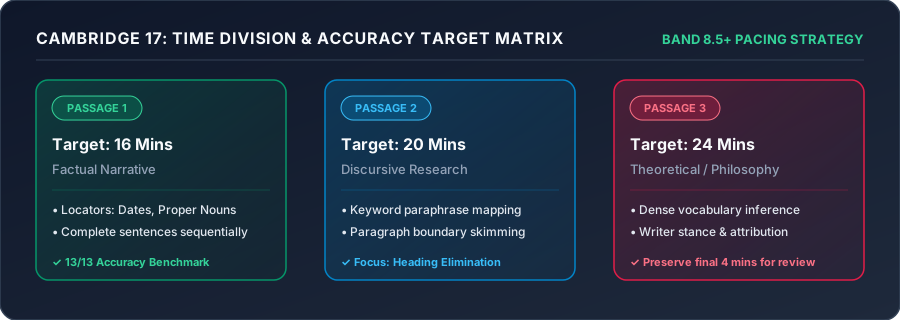
- Passage 1 Accuracy: Aim for 100% accuracy within 16–17 minutes. Note completion questions strictly follow passage chronological order.
- Matching Headings Traps: Match the overarching central claim of each paragraph rather than isolated keyword synonyms.
- Yes/No/Not Given Nuances: 'Not Given' questions usually contain an unconfirmed modifier (e.g. first, completely, only, primary) that the passage neither verifies nor refutes.
Related reading
IELTS Writing Task 2 Part 5: Direct Questions & Band 9 Models
Master IELTS Writing Task 2 two-part direct questions, complex grammatical subordination, and analyze a complete Band 9.0 model essay with examiner marks.
By Super Admin
IELTS Writing Task 2 Part 4: Problem-Solution & Causes
Master IELTS Writing Task 2 problem-solution and cause-effect essays with symmetrical causal chains, practical interventions, and Band 8.5+ templates.
By Super Admin
IELTS Writing Task 2 Part 3: Discussion Essays (Both Views)
Master IELTS Writing Task 2 discussion essays (discuss both views and give your opinion) with balanced argumentation, objective framing, and clear stances.
By Super Admin
IELTS Writing Task 2 Part 2: Opinion Essays (Agree/Disagree)
Master IELTS Writing Task 2 opinion essays (agree or disagree) with unambiguous thesis statements, persuasive argumentation, and Band 9 model essays.
By Super Admin