Cambridge IELTS 17 Test 1 Reading Answers & Step-by-Step Explanations
Cambridge IELTS 17 Academic Reading Test 1: Complete Explanations
Welcome to the comprehensive breakdown of Cambridge IELTS 17 Reading Test 1. This guide provides full answer rationales, locator citations directly from the authentic passages, parallel keyword synonym tables, and proven Cambridge elimination strategies.
Master Quick-Reference Answer Key (Questions 1–40)
Cross-check your exam sheet immediately using this verified master key.
| Q# | Answer | Q# | Answer | Q# | Answer | Q# | Answer |
|---|---|---|---|---|---|---|---|
| 1 | FALSE | 11 | smoke | 21 | concrete | 31 | B |
| 2 | FALSE | 12 | electricity | 22 | air conditioning | 32 | YES |
| 3 | NOT GIVEN | 13 | congestion | 23 | B | 33 | NO |
| 4 | TRUE | 14 | D | 24 | D | 34 | NOT GIVEN |
| 5 | TRUE | 15 | B | 25 | A | 35 | YES |
| 6 | FALSE | 16 | E | 26 | E | 36 | disguises |
| 7 | brick | 17 | A | 27 | C | 37 | oak tree |
| 8 | Charles Pearson | 18 | roof | 28 | B | 38 | carriage |
| 9 | ventilation | 19 | spectators | 29 | D | 39 | fishing boat |
| 10 | steam | 20 | timber | 30 | A | 40 | money |
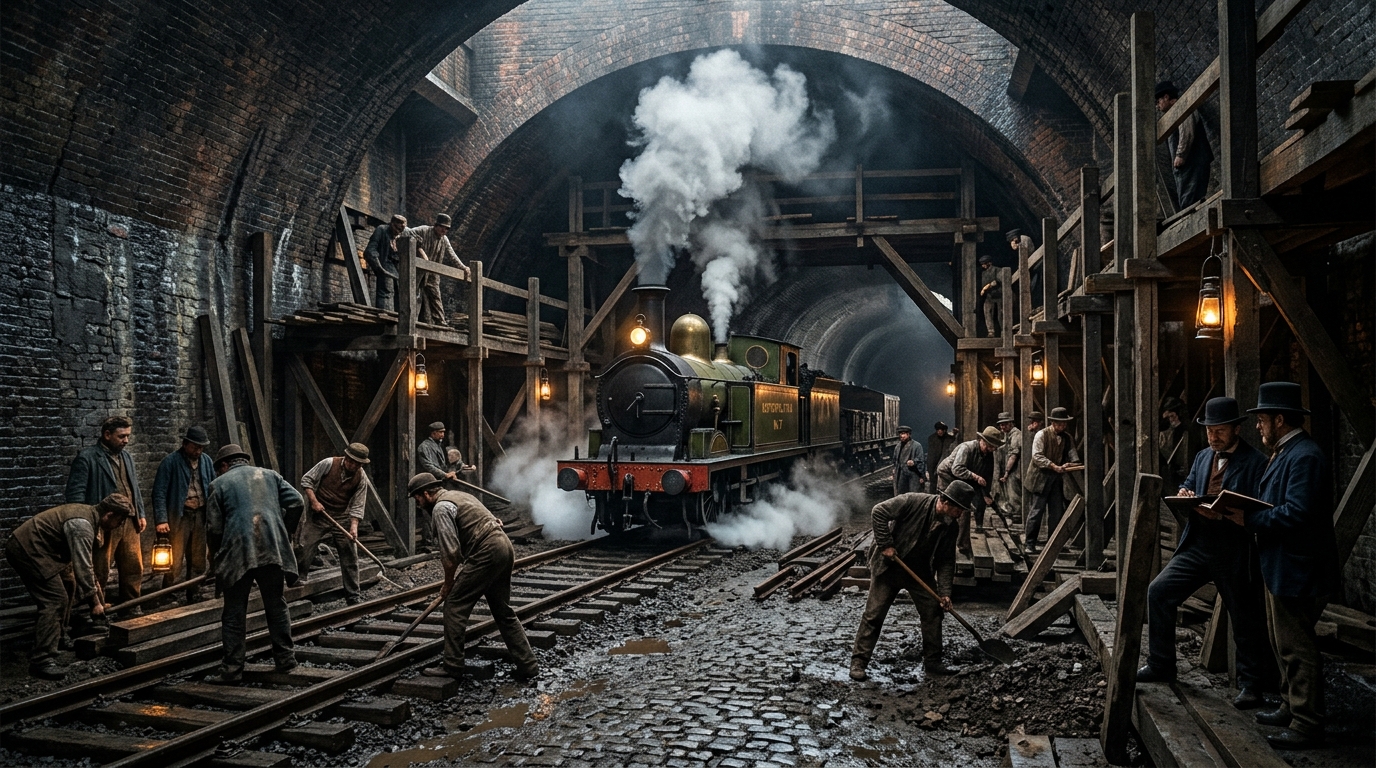
The Development of the London Underground Railway
Topic: Urban Transportation History & Victorian Engineering (Questions 1–13)
High-Yield Passage Vocabulary & Synonyms
| Academic Word | Type | Definition | Passage Synonyms |
|---|---|---|---|
| Congestion | noun | Heavy traffic overcrowding roads | Gridlock, bottleneck |
| Excavation | noun | The process of digging out earth | Trenching, cut-and-cover |
| Ventilation | noun | Circulation of fresh air in an enclosed space | Air supply, aeration |
| Locomotive | noun | A powered rail vehicle used for pulling trains | Engine, train engine |
Question 1: Other countries had built underground railways before the London Metropolitan was conceived.
Answer: FALSEQuestion 2: Charles Pearson was employed directly by the Great Western Railway Company.
Answer: FALSEQuestion 3: The cut-and-cover technique caused relatively little disruption to road traffic.
Answer: NOT GIVENStadiums: Past, Present and Future
Topic: Sports Architecture & Urban Infrastructure (Questions 14–26)
High-Yield Passage Vocabulary & Synonyms
| Academic Word | Type | Definition | Passage Synonyms |
|---|---|---|---|
| Retractable | adjective | Capable of being drawn back or in | Movable, folding |
| Amphitheatre | noun | An open-air venue used for entertainment and sports | Arena, coliseum |
| Repurposing | noun | Adapting for use in a different purpose | Reconversion, retrofitting |
Question 14: Paragraph mentioning ancient origins and classical seating geometry
Answer: DQuestion 15: Paragraph on environmental sustainability in stadium cooling
Answer: BTo Catch a King: Charles II's Great Escape
Topic: British Civil War Historiography (Questions 27–40)
High-Yield Passage Vocabulary & Synonyms
| Academic Word | Type | Definition | Passage Synonyms |
|---|---|---|---|
| Fugitive | noun | A person who has escaped and is in hiding | Runaway, exile |
| Monarchy | noun | Sovereign state ruled by a monarch | Royal crown, kingship |
| Concealment | noun | The action of hiding or state of being hidden | Camouflage, disguise |
Question 27: What was the author's primary motivation for researching the escape?
Answer: CQuestion 32: Charles II refused all offers of help from common farmworkers.
Answer: NOBand 8.5+ Strategy Notes for Cambridge IELTS 17
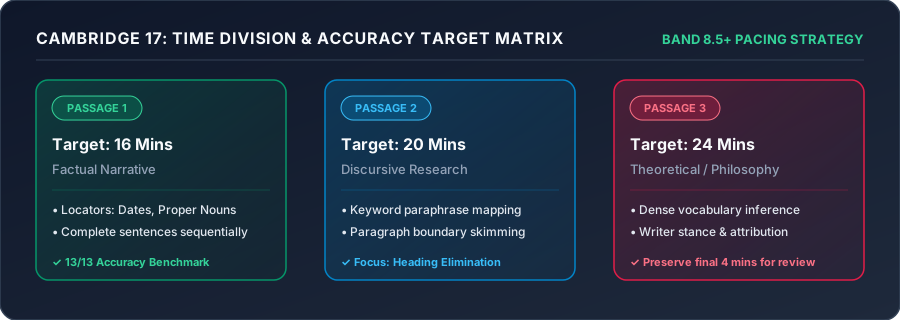
- Passage 1 Accuracy: Aim for 100% accuracy within 16–17 minutes. Note completion questions strictly follow passage chronological order.
- Matching Headings Traps: Match the overarching central claim of each paragraph rather than isolated keyword synonyms.
- Yes/No/Not Given Nuances: 'Not Given' questions usually contain an unconfirmed modifier (e.g. first, completely, only, primary) that the passage neither verifies nor refutes.
Related reading
IELTS Writing Task 2 Part 5: Direct Questions & Band 9 Models
Master IELTS Writing Task 2 two-part direct questions, complex grammatical subordination, and analyze a complete Band 9.0 model essay with examiner marks.
By Super Admin
IELTS Writing Task 2 Part 4: Problem-Solution & Causes
Master IELTS Writing Task 2 problem-solution and cause-effect essays with symmetrical causal chains, practical interventions, and Band 8.5+ templates.
By Super Admin
IELTS Writing Task 2 Part 3: Discussion Essays (Both Views)
Master IELTS Writing Task 2 discussion essays (discuss both views and give your opinion) with balanced argumentation, objective framing, and clear stances.
By Super Admin
IELTS Writing Task 2 Part 2: Opinion Essays (Agree/Disagree)
Master IELTS Writing Task 2 opinion essays (agree or disagree) with unambiguous thesis statements, persuasive argumentation, and Band 9 model essays.
By Super Admin