Cambridge IELTS 16 Test 4 Reading Answers & Step-by-Step Explanations
Cambridge IELTS 16 Academic Reading Test 4: Complete Explanations
Comprehensive walkthrough and verified solutions for Cambridge IELTS 16 Reading Test 4. Detailed analysis of Roman Tunnels (qanat and counter-excavation surveying), cognitive neuroscience on Changes in Reading Habits, and societal perceptions in Attitudes Towards Artificial Intelligence.
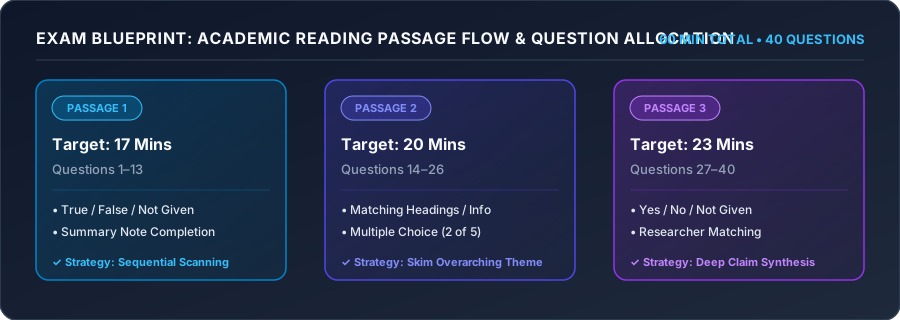
Master Quick-Reference Answer Key (Questions 1–40)
Cross-check all 40 answers instantly with this verified master table.
| Q# | Answer Key | Q# | Answer Key | Q# | Answer Key | Q# | Answer Key |
|---|---|---|---|---|---|---|---|
| 1 | posts | 11 | gold | 21 | B (isolated) | 31 | vii |
| 2 | canal | 12 | architect's name | 22 | C (emotional) | 32 | v |
| 3 | ventilation | 13 | harbour | 23 | YES | 33 | C |
| 4 | lid | 14 | A | 24 | NO | 34 | B |
| 5 | weight | 15 | B | 25 | NOT GIVEN | 35 | A |
| 6 | climbing | 16 | D | 26 | YES | 36 | NO |
| 7 | FALSE | 17 | B | 27 | iii | 37 | NOT GIVEN |
| 8 | NOT GIVEN | 18 | D (worrying) | 28 | vi | 38 | YES |
| 9 | FALSE | 19 | H (thorough) | 29 | ii | 39 | NO |
| 10 | TRUE | 20 | F (hard) | 30 | i | 40 | YES |
Reading Passage 1: Roman Tunnels
Topic: Classical Civil Engineering & Subterranean Aqueducts • Questions 1–13
Questions 1–6: Diagram & Shaft Labeling
| Q# | Diagram Element | Correct Term | Engineering Function |
|---|---|---|---|
| 1 | Alignment markers along surface | posts | Wooden sighting posts aligned to chart straight subterranean trajectories |
| 2 | Surface waterway destination | canal | Channel supplying urban districts and communal public baths |
| 3 | Vertical shaft purpose | ventilation | Supplied fresh air to miners and evacuated hazardous subterranean gases |
| 4 | Shaft surface seal | lid | Removable stone lid preventing debris and animal contamination |
| 5 | Plumb-line component | weight | Lead weight suspended to verify absolute vertical orientation |
| 6 | Shaft wall foothold notches | climbing | Notches carved into shaft sides to permit climbing access for miners |
Questions 7–10: True / False / Not Given
Questions 11–13: Short Answer Words
Dolaucothi mines in Wales were constructed by the Roman military to extract precious gold.
Inscriptions frequently preserved the patron and the architect's name for posterity.
The massive Cevlik diversion tunnel in Turkey diverted floodwaters away from the city's vital harbour.
Reading Passage 2: Changes in Reading Habits
Topic: Neuroplasticity, Bi-Literate Brains & Digital Skimming • Questions 14–26
Questions 14–17: Multiple Choice Overview
Q14: Writer's primary thesis in the opening paragraph:
Ans: ADigital skimming accelerates information gathering but imperils contemplative deep-reading circuits developed over centuries.
Q15: Sherry Turkle's insight on technological innovation:
Ans: BSociety must proactively assess what cognitive capabilities are eroded when adopting new communication tools.
Q16: Neural plasticity in Paragraph 4:
Ans: DThe brain re-wires its circuits according to whichever medium (print vs digital screen) commands daily cognitive attention.
Q17: Mark Edmundson's observations on undergraduates:
Ans: BStudents increasingly avoid long 19th-century novels due to an acquired intolerance for dense syntactical complexity.
Questions 18–22: Summary Matching (Consequences of Skimming)
| Q# | Cognitive Effect | Code | Description |
|---|---|---|---|
| 18 | Speed reading trend is | D | Deeply worrying for intellectual development |
| 19 | Print reading encourages | H | Thorough analytical comprehension |
| 20 | Sustained attention becomes | F | Hard to maintain for digital natives |
| 21 | Readers encounter ideas in | B | Isolated fragments rather than continuous narratives |
| 22 | Weakened capacity for deep | C | Emotional empathy with fictional characters |
Questions 23–26: Yes / No / Not Given
Reading Passage 3: Attitudes Towards Artificial Intelligence
Topic: Algorithm Aversion, Transparency & Human-Computer Interaction • Questions 27–40
Questions 27–32: Section Headings (Sections A–F)
| Section | Heading | Theme |
|---|---|---|
| A | iii | The superiority of AI projections over human intuition |
| B | vi | Widespread distrust of an AI innovation |
| C | ii | Reasons why we have more faith in human judgment |
| D | i | An increasing divergence of attitudes towards AI |
| E | vii | Encouraging openness about how AI functions |
| F | v | The advantages of involving users in decision-making |
Questions 33–35: Multiple Choice
Author highlights the stubborn paradox of humans rejecting statistically superior machine models.
Opaque black-box models cause users to feel alienated and stripped of personal agency.
Sensationalist news headlines disproportionately amplify rare algorithmic glitches, stoking public dread.
Questions 36–40: Yes / No / Not Given
Band 8.5+ Strategy: Conquering Algorithm & Engineering Passages
- Diagram Labeling (Questions 1–6): Notice the spatial progression. Scan the diagram labels in the direction of the water flow or vertical axis (surface to underground bedrock). Maintain strict noun forms without articles when word limits specify "NO MORE THAN ONE WORD".
- Matching Headings Strategy (Questions 27–32): Focus on the transition and concluding sentences of each paragraph. Section F emphasizes user agency and tweaking algorithms (Heading v: involving users).
Related reading
IELTS Writing Task 2 Part 5: Direct Questions & Band 9 Models
Master IELTS Writing Task 2 two-part direct questions, complex grammatical subordination, and analyze a complete Band 9.0 model essay with examiner marks.
By Super Admin
IELTS Writing Task 2 Part 4: Problem-Solution & Causes
Master IELTS Writing Task 2 problem-solution and cause-effect essays with symmetrical causal chains, practical interventions, and Band 8.5+ templates.
By Super Admin
IELTS Writing Task 2 Part 3: Discussion Essays (Both Views)
Master IELTS Writing Task 2 discussion essays (discuss both views and give your opinion) with balanced argumentation, objective framing, and clear stances.
By Super Admin
IELTS Writing Task 2 Part 2: Opinion Essays (Agree/Disagree)
Master IELTS Writing Task 2 opinion essays (agree or disagree) with unambiguous thesis statements, persuasive argumentation, and Band 9 model essays.
By Super Admin