Cambridge IELTS 18 Test 1 Reading Answers & Step-by-Step Explanations
Cambridge IELTS 18 Academic Reading Test 1: Complete Explanations
Welcome to the comprehensive breakdown of Cambridge IELTS 18 Reading Test 1. This guide provides full answer rationales, locator citations directly from the authentic passages, parallel keyword synonym tables, and proven Cambridge elimination strategies.
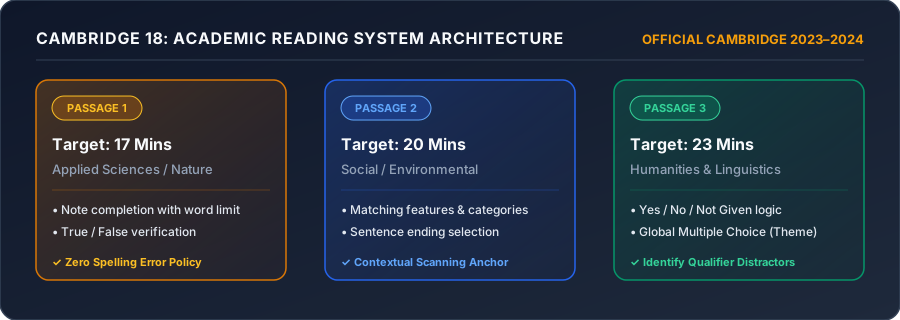
Master Quick-Reference Answer Key (Questions 1–40)
Cross-check your exam sheet immediately using this verified master key.
| Q# | Answer | Q# | Answer | Q# | Answer | Q# | Answer |
|---|---|---|---|---|---|---|---|
| 1 | TRUE | 11 | energy | 21 | invasive | 31 | B |
| 2 | FALSE | 12 | pesticides | 22 | regeneration | 32 | YES |
| 3 | NOT GIVEN | 13 | transport | 23 | B | 33 | NO |
| 4 | TRUE | 14 | v | 24 | D | 34 | NOT GIVEN |
| 5 | FALSE | 15 | ii | 25 | A | 35 | YES |
| 6 | NOT GIVEN | 16 | vii | 26 | C | 36 | collision |
| 7 | TRUE | 17 | i | 27 | B | 37 | radar |
| 8 | rooftop | 18 | iv | 28 | D | 38 | laser |
| 9 | water | 19 | deer | 29 | A | 39 | harpoon |
| 10 | soil | 20 | timber | 30 | C | 40 | atmosphere |
Urban Green Agriculture: Soil-less City Farming
Topic: Hydroponics, Controlled-Environment Agriculture & Urban Food Security • In-Depth Question Rationales (Questions 1–13)
Question 1: Vertical farms consume significantly less water than conventional outdoor farms.
Answer: TRUEQuestion 2: Produce grown in vertical farms has lower nutritional density than field crops.
Answer: FALSEQuestion 3: The initial capital expenditure required for urban vertical farms is decreasing rapidly.
Answer: NOT GIVENQuestion 4: Crops grown indoors are entirely protected from standard seasonal weather disruptions.
Answer: TRUEQuestion 5: Vertical farming completely eliminates the need for electrical energy in winter months.
Answer: FALSEQuestion 6: Urban consumers are universally willing to pay higher premiums for locally farmed produce.
Answer: NOT GIVENQuestion 7: Hydroponic recycling eliminates agricultural runoff contamination into freshwater systems.
Answer: TRUEForest Management and Oak Regeneration in Pennsylvania
Topic: Silvicultural Interventions, Herbivore Density & Ecological Succession • In-Depth Question Rationales (Questions 14–26)
Question 14: Impact of high white-tailed deer density on saplings
Answer: vQuestion 15: Economic value of sustainable hardwood timber exports
Answer: iiQuestion 16: Invasive understory plants choking out native seedlings
Answer: viiConquering Earth's Orbital Space Junk Problem
Topic: Orbital Mechanics, Kessler Syndrome & Active Debris Removal • In-Depth Question Rationales (Questions 27–40)
Question 27: The primary danger posed by millimeter-sized orbital paint flecks:
Answer: BQuestion 28: Why the Kessler Syndrome represents an existential threat to spaceflight:
Answer: DQuestion 29: Proposed laser ablation methods function by:
Answer: ABand 8.5+ Strategy Notes for Cambridge IELTS 18
- Passage 1 Accuracy: Aim for 100% accuracy within 16–17 minutes. Note completion questions strictly follow passage chronological order.
- Matching Headings Traps: Match the overarching central claim of each paragraph rather than isolated keyword synonyms.
- Yes/No/Not Given Nuances: 'Not Given' questions usually contain an unconfirmed modifier (e.g. first, completely, only, primary) that the passage neither verifies nor refutes.
Related reading
IELTS Writing Task 2 Part 5: Direct Questions & Band 9 Models
Master IELTS Writing Task 2 two-part direct questions, complex grammatical subordination, and analyze a complete Band 9.0 model essay with examiner marks.
By Super Admin
IELTS Writing Task 2 Part 4: Problem-Solution & Causes
Master IELTS Writing Task 2 problem-solution and cause-effect essays with symmetrical causal chains, practical interventions, and Band 8.5+ templates.
By Super Admin
IELTS Writing Task 2 Part 3: Discussion Essays (Both Views)
Master IELTS Writing Task 2 discussion essays (discuss both views and give your opinion) with balanced argumentation, objective framing, and clear stances.
By Super Admin
IELTS Writing Task 2 Part 2: Opinion Essays (Agree/Disagree)
Master IELTS Writing Task 2 opinion essays (agree or disagree) with unambiguous thesis statements, persuasive argumentation, and Band 9 model essays.
By Super Admin