Cambridge IELTS 16 Test 2 Reading Answers & Step-by-Step Explanations
Cambridge IELTS 16 Academic Reading Test 2: Complete Explanations
Master Cambridge IELTS 16 Reading Test 2 with our exhaustive analysis. This walkthrough details passage locators, keyword synonym bridges, and step-by-step logic for The White Horse of Uffington, Ed Yong's I Contain Multitudes (Microbiome Science), and psychological research on How to Make Wise Decisions.
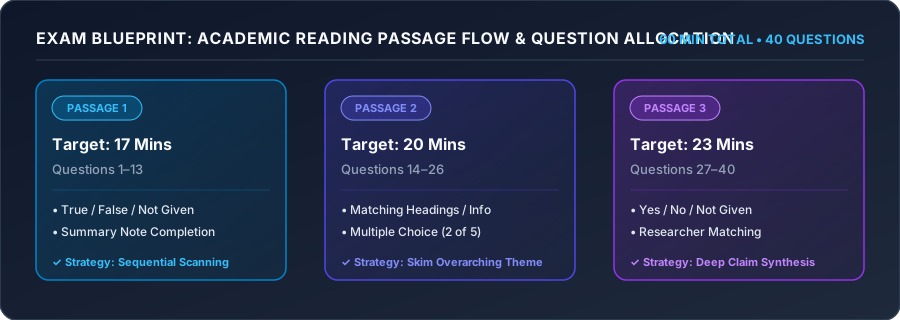
Master Quick-Reference Answer Key (Questions 1–40)
Verify your answers across all 40 questions before examining the passage-by-passage breakdown.
| Q# | Answer Key | Q# | Answer Key | Q# | Answer Key | Q# | Answer Key |
|---|---|---|---|---|---|---|---|
| 1 | TRUE | 11 | soil | 21 | YES | 31 | D (modesty) |
| 2 | NOT GIVEN | 12 | fertility | 22 | NO | 32 | A (opinion) |
| 3 | TRUE | 13 | Rhiannon | 23 | NOT GIVEN | 33 | C (view) |
| 4 | FALSE | 14 | D | 24 | YES | 34 | F (objectivity) |
| 5 | FALSE | 15 | C | 25 | NOT GIVEN | 35 | G (fairness) |
| 6 | TRUE | 16 | A | 26 | NO | 36 | FALSE |
| 7 | TRUE | 17 | G | 27 | B | 37 | NOT GIVEN |
| 8 | NOT GIVEN | 18 | B | 28 | C | 38 | NOT GIVEN |
| 9 | Ridgeway | 19 | H | 29 | B | 39 | TRUE |
| 10 | documents | 20 | E | 30 | D | 40 | TRUE |
Reading Passage 1: The White Horse of Uffington
Topic: Landscape Archaeology & Geoglyphs • Questions 1–13 (True/False/Not Given & Sentence Completion)
High-Yield Vocabulary Glossary
| Academic Word | Part of Speech | Contextual Definition | Synonyms |
|---|---|---|---|
| Geoglyph | noun | A large visual design or motif produced on the ground surface | Hill figure, earthwork, turf carving |
| Optically Stimulated Luminescence (OSL) | noun | Dating technique measuring when sediment was last exposed to sunlight | Luminescence dating, chronometric testing |
| Scouring | noun/verb | Periodic clearing of weeds and renewing chalk trenches | Restoration, weeding, re-chalking |
Questions 1–8: True / False / Not Given Breakdown
Q1: Most geoglyphs in England are located in a particular area of the country.
Ans: TRUELocator: "The vast majority of hill figures are found on the downlands of southern England..." (Paragraph 1)
"Vast majority" directly matches "most", and "downlands of southern England" specifies a distinct geographic region. Hence, TRUE.
Q2: There are more geoglyphs in the shape of a horse than any other creature.
Ans: NOT GIVENLocator: Paragraph 1 discusses horses and giants, noting horses are prominent, but never compares animal proportions statistically.
Because the passage offers no numerical ranking of creature shapes, this claim cannot be confirmed: NOT GIVEN.
Q3: A recent dating of the Uffington White Horse indicates that people were mistaken about its age.
Ans: TRUELocator: "The results pushed the creation back to the Bronze Age... overturning the earlier consensus that it was Iron Age or Anglo-Saxon." (Paragraph 2)
Overturning earlier beliefs about the period proves previous historical assumptions were mistaken. Statement is TRUE.
Q4: Historians have come to an agreement about the origins of the Long Man of Wilmington.
Ans: FALSELocator: "Meanwhile, the date and origins of the Long Man of Wilmington remain intensely debated, with theories ranging from prehistoric to 16th-century origins." (Paragraph 2)
Ongoing debate and lack of consensus directly contradict "have come to an agreement". Result: FALSE.
Q5: Geoglyphs were created by people placing white chalk on the hillside.
Ans: FALSELocator: "Builders excavated trenches into the turf to expose the stark white chalk bedrock beneath." (Paragraph 3)
They removed grass to reveal underlying rock rather than bringing and placing loose chalk. Direct contradiction: FALSE.
Q6: Many geoglyphs in England are no longer visible.
Ans: TRUELocator: "...scores of figures have succumbed to the elements, overgrowth, and neglect, disappearing entirely from the landscape." (Paragraph 3)
Scores disappearing entirely confirms that many are no longer visible today. Statement is TRUE.
Q7: The shape of some geoglyphs has been altered over time.
Ans: TRUELocator: "Repeated scouring ceremonies over hundreds of years altered the original outline of the figures." (Paragraph 4)
The physical outline was modified over centuries through scouring. Statement is TRUE.
Q8: The fame of the Uffington White Horse is due to its size.
Ans: NOT GIVENLocator: Paragraph 5 mentions its large scale (110 metres) and wide notoriety, but does not identify size as the primary causal reason for its fame.
A correlation does not establish causation in Cambridge IELTS. Verdict: NOT GIVEN.
Questions 9–13: Sentence Completion
| Q# | Answer | Passage Sentence Locator | Context Rationale |
|---|---|---|---|
| 9 | Ridgeway | Near the prehistoric trackway known as the Ridgeway... | The ancient trail adjoining the monument. |
| 10 | documents | First explicitly mentioned in medieval documents from the 1070s... | Written historical records referencing the site. |
| 11 | soil | Optically stimulated luminescence was applied to soil sediments... | The material analyzed by modern OSL chronometry. |
| 12 | fertility | Associated with a Celtic fertility goddess cult... | Ritual purpose associated with agricultural and life fertility. |
| 13 | Rhiannon | Echoes the Celtic equestrian deity Rhiannon... | Specific Welsh mythological figure associated with white horses. |
Reading Passage 2: I Contain Multitudes
Topic: Microbiology, Microbiome Symbiosis & Public Health • Questions 14–26
Questions 14–16: Multiple Choice
The writer emphasizes that microbes are universal, residing in every environmental niche and numbering trillions in our physiology.
Yong is awed by how deeply bacterial biochemistry shapes immune education, digestion, and neurochemistry.
The author critiques extreme modern hygiene, illustrating how eliminating harmless microbes triggers immune dysfunction.
Questions 17–20: Summary Matching (Our Microbial Equilibrium)
| Q# | Summary Statement | Letter | Matched Concept |
|---|---|---|---|
| 17 | Only a tiny fraction of bacteria cause | G | Pathogenic illness / disease |
| 18 | Human-microbe relations are characterized by | B | Mutual co-evolution and symbiosis |
| 19 | Equilibrium is disrupted by our poor | H | Nutritional diet (low in complex plant fiber) |
| 20 | Along with an obsessive fixation on | E | Excessive domestic cleanliness and sterilization |
Questions 21–26: Yes / No / Not Given Claims
Reading Passage 3: How to Make Wise Decisions
Topic: Cognitive Psychology, Contextual Reasoning & Solomon's Paradox • Questions 27–40
Questions 27–30: Multiple Choice Analysis
Q27: Key point established in the opening paragraph:
Ans: BWisdom is not a permanent personality trait; it fluctuates significantly depending on the immediate emotional context of the situation.
Q28: What does Igor Grossmann propose regarding wise reasoning?
Ans: CCultivating psychological distance from personal dilemmas unlocks greater philosophical insight and cognitive balance.
Q29: Explanations regarding the third-person vantage point:
Ans: BReferring to oneself by name or in the third person dampens visceral ego-defense mechanisms, facilitating impartial evaluation.
Q30: Description in Paragraph 5:
Ans: DDetails an experiment where couples engaged in discussions about recurring conflict scenarios from an observer's perspective.
Questions 31–35: Characteristics of Wise Reasoning (Summary Box)
| Q# | Cognitive Facet | Answer Code | Operational Definition in Research |
|---|---|---|---|
| 31 | Intellectual humility | D (modesty) | Acknowledging the boundaries and gaps in one's personal knowledge. |
| 32 | Appreciating opposing views | A (opinion) | Recognizing valid perspectives beyond one's immediate convictions. |
| 33 | Broadening situational scope | C (view) | Seeing events within their larger social and longitudinal context. |
| 34 | Emotional detachment | F (objectivity) | Evaluating scenarios without egocentric bias or defensive distortion. |
| 35 | Seeking compromise | G (fairness) | Balancing divergent interests to achieve harmonious resolution. |
Questions 36–40: Experimental Findings (True / False / Not Given)
Band 8.5+ Strategy: Mastering Yes / No / Not Given
- Claims vs. Facts: True/False/Not Given tests factual information against the passage; Yes/No/Not Given tests whether a statement matches the author's personal claims or opinions. Follow the exact wording requested on your answer sheet.
- Negative Phrasing Traps: Watch out for double negatives in Question 22 ("children should come into contact with as few bacteria as possible" -> passage argues exposure is beneficial -> NO).
- Summary Completion with Options: In Questions 31–35, always identify the grammatical form required. If the blank is preceded by "a sense of", look for abstract nouns like modesty or fairness.
Related reading
IELTS Writing Task 2 Part 5: Direct Questions & Band 9 Models
Master IELTS Writing Task 2 two-part direct questions, complex grammatical subordination, and analyze a complete Band 9.0 model essay with examiner marks.
By Super Admin
IELTS Writing Task 2 Part 4: Problem-Solution & Causes
Master IELTS Writing Task 2 problem-solution and cause-effect essays with symmetrical causal chains, practical interventions, and Band 8.5+ templates.
By Super Admin
IELTS Writing Task 2 Part 3: Discussion Essays (Both Views)
Master IELTS Writing Task 2 discussion essays (discuss both views and give your opinion) with balanced argumentation, objective framing, and clear stances.
By Super Admin
IELTS Writing Task 2 Part 2: Opinion Essays (Agree/Disagree)
Master IELTS Writing Task 2 opinion essays (agree or disagree) with unambiguous thesis statements, persuasive argumentation, and Band 9 model essays.
By Super Admin