Cambridge IELTS 16 Test 1 Reading Answers & Step-by-Step Explanations

Cambridge IELTS 16 Academic Reading Test 1: Complete Explanations
This guide provides an exhaustive question-by-question breakdown of Cambridge IELTS 16 Reading Test 1. Each answer includes exact paragraph locators, parallel keyword vocabulary tables, and detailed logical reasoning to help you eliminate distractors and master Cambridge exam patterns.
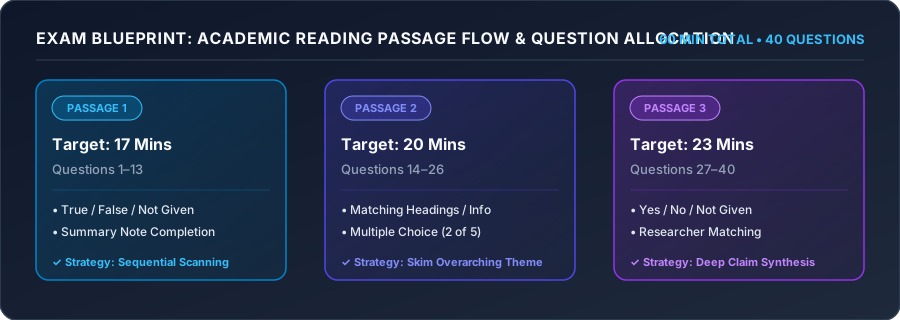
Master Quick-Reference Answer Key (Questions 1–40)
Cross-check your test responses immediately using this verified master key before reading the deep rationales.
| Q# | Answer Key | Q# | Answer Key | Q# | Answer Key | Q# | Answer Key |
|---|---|---|---|---|---|---|---|
| 1 | FALSE | 11 | photographer | 21 | city | 31 | G |
| 2 | FALSE | 12 | game | 22 | priests | 32 | E |
| 3 | NOT GIVEN | 13 | frustration | 23 | trench | 33 | C |
| 4 | FALSE | 14 | iv | 24 | location | 34 | F |
| 5 | TRUE | 15 | vii | 25 | B | 35 | B |
| 6 | FALSE | 16 | ii | 26 | D | 36 | A |
| 7 | TRUE | 17 | v | 27 | B | 37 | C |
| 8 | violent | 18 | i | 28 | D | 38 | A |
| 9 | tool | 19 | viii | 29 | C | 39 | B |
| 10 | meat | 20 | vi | 30 | D | 40 | C |
Reading Passage 1: Why Polar Bears Should Be Treated with Respect
Topic: Arctic Biology & Comparative Genetics • Questions 1–13 (True/False/Not Given & Summary Completion)
High-Yield Passage Vocabulary & Collocations
| Academic Word | Part of Speech | Contextual Definition | Cambridge Synonyms |
|---|---|---|---|
| Adipose tissue | noun | Fat tissue stored beneath the skin of mammals | Fat reserves, lipid layer |
| Genetic mutation | noun | Permanent alteration in DNA sequence providing evolutionary advantage | Gene variant, adaptation |
| Osteoporosis | noun | Bone density reduction leading to brittle, fragile bones | Bone loss, bone degradation |
| Tenacity | noun | Persistent determination and endurance under adverse conditions | Perseverance, persistence |
Questions 1–7: True / False / Not Given Detailed Explanations
Question 1: Polar bears suffer from various health problems due to the build-up of fat under their skin.
Answer: FALSEQuestion 2: The study done by Liu and his colleagues compared different groups of polar bears.
Answer: FALSEQuestion 3: Liu and colleagues were the first researchers to compare polar bears and brown bears genetically.
Answer: NOT GIVENQuestion 4: Polar bears are able to control their levels of 'bad' cholesterol by cutting down on their intake of food.
Answer: FALSEQuestion 5: Female polar bears are able to survive for about six months without food.
Answer: TRUEQuestion 6: It was found that the bones of female polar bears were very weak when they came out of their dens in spring.
Answer: FALSEQuestion 7: The polar bears' mechanism for increasing bone density could also be used by people one day.
Answer: TRUEQuestions 8–13: Summary Completion (Polar Bear Intelligence & Behaviour)
| Q# | Correct Answer | Passage Keyword Locator | Grammatical & Contextual Rationale |
|---|---|---|---|
| 8 | violent | Paragraph 5: "Traditionally perceived as dim-witted and violent beasts..." | The summary requires an adjective pairing with "unintelligent". The text provides "dim-witted and violent". |
| 9 | tool | Paragraph 5: "...using a tree branch as a tool to dislodge a piece of meat..." | A tree branch was utilized as a functional tool to retrieve food suspended overhead. |
| 10 | meat | Paragraph 5: "...knock down a piece of meat that was hanging out of reach." | The target item the bear sought to obtain with the branch was a piece of meat. |
| 11 | photographer | Paragraph 5: "...a wild bear calculated how to move towards a platform where a photographer was positioned." | The person occupying the observation platform was a professional wildlife photographer. |
| 12 | game | Paragraph 6: "...deliberate manipulation of objects resembling a game or play." | Bears demonstrated creative play behaviours resembling structured games. |
| 13 | frustration | Paragraph 6: "...kicking snow and thrashing about in an apparent display of frustration after a failed hunt." | The emotional movement displayed after a missed catch corresponds to emotional frustration. |
Reading Passage 2: The Step Pyramid of Djoser
Topic: Ancient Egyptian Architecture & Archaeology • Questions 14–26 (Matching Headings, Summary & Multiple Choice)
Questions 14–20: Matching Headings to Paragraphs A–G
| Para | Heading | Heading Title | Core Theme in Paragraph |
|---|---|---|---|
| A | iv | A single certainty among less definite facts | Historical records differ on Djoser's reign dates, but one unquestioned fact is his monumental pyramid. |
| B | vii | An overview of the external buildings and areas | Details the surrounding complex: temples, courtyard, outer perimeter wall, and false entrances. |
| C | ii | A difficult task for those involved | Emphasizes the unprecedented logistical challenge of quarrying, cutting, and hauling stone. |
| D | v | A king who saved his people | Recounts the legend of Djoser ending a devastating seven-year famine by appealing to Khnum. |
| E | i | The areas and artefacts within the pyramid itself | Explores the subterranean burial chambers, stone vessels, and alabaster treasures beneath. |
| F | viii | An idea for changing the design of burial structures | Imhotep's revolution: stacking successively smaller mastabas to produce a step pyramid. |
| G | vi | A pyramid design that was copied elsewhere | The revolutionary step design influenced subsequent pharaohs and culminated in the Great Pyramids of Giza. |
Questions 21–24: Summary Completion
Answer: city
The complex was designed to resemble a royal city, complete with government structures, shrines, and plazas representing the unified kingdom.
Answer: priests
Daily offerings and sacred rituals were maintained by hereditary priests dedicated to the posthumous cult of the pharaoh.
Answer: trench
Surrounding the monumental perimeter wall was an extensive dry trench carved directly into the bedrock to deter grave robbers.
Answer: location
The prominent location on the Saqqara plateau overlooked the ancient capital of Memphis, asserting divine authority.
Questions 25–26: Multiple Choice
Questions 25 & 26: Which TWO achievements are attributed to Imhotep?
Answers: B, D (in any order)The text credits Imhotep with introducing dressed stone architecture on a monumental scale (B) and serving as the mastermind who completely overhauled tomb geometry from a flat mastaba to a multi-tiered step pyramid (D).
Reading Passage 3: The Future of Work
Topic: Artificial Intelligence, Labor Economics & Knowledge Workers • Questions 27–40
Questions 27–30: Multiple Choice Rationale
Q27: What is the main thesis of the opening paragraph?
Ans: BThe author explains that automation is no longer confined to manual or routine mechanical tasks; it is rapidly encroaching upon high-skill cognitive professions.
Q28: Stella Pachidi's view of the 'knowledge economy':
Ans: DPachidi cautions that algorithmic automation challenges the fundamental assumption that specialized analytical knowledge guarantees permanent career security.
Q29: Observation at the telecommunications firm:
Ans: CSales analysts felt disempowered when AI predictive models replaced their personal judgment and contextual customer rapport with automated scores.
Q30: Corporate executives' adoption of AI software:
Ans: DLeaders frequently misunderstand the operational realities of machine learning, expecting instantaneous perfection while neglecting data governance.
Questions 31–34: Summary Completion (Algorithmic Governance)
| Q# | Key Concept | Matched Letter | Passage Parallel |
|---|---|---|---|
| 31 | Decisions once made by experienced managers | G | Automated software algorithms determining resource allocation |
| 32 | Loss of tacit professional expertise | E | Erosion of human intuition and experiential mastery |
| 33 | Resentment among staff | C | Friction arising from rigid quantitative surveillance |
| 34 | Need for human oversight | F | Crucial requirement for ethical intervention and contextual audits |
Questions 35–40: Researcher Matching & Claims
| Q# | Statement / Researcher Opinion | Answer | Logical Verification |
|---|---|---|---|
| 35 | Greater levels of automation will not result in lower employment. | B | Matches researcher B's empirical finding on job redeployment rather than net loss. |
| 36 | There are several reasons why AI is appealing to businesses. | A | Aligns with scholar A's breakdown of efficiency, throughput, and error elimination. |
| 37 | AI's potential to transform people's lives has parallels with historical shifts. | C | Directly corresponds to comparison with the Industrial Revolution. |
| 38 | It is important to be aware of the range of problems that AI causes. | A | Warning regarding algorithm bias, transparency deficits, and deskilling. |
| 39 | People are going to follow a less conventional career path than in the past. | B | Transition towards portfolio careers, continuous retraining, and gig contracts. |
| 40 | Authorities should take measures to ensure adequate remuneration for everyone. | C | Policy proposals advocating universal basic guarantees and transition subsidies. |
Band 8.5+ Strategy: How to Avoid Cambridge 16 Pitfalls
- Distinguishing False vs. Not Given: Notice in Question 3, researchers conducted the study, but the word first was unconfirmed in the passage. In Cambridge reading, an unverified extreme qualifier is always NOT GIVEN, whereas a direct contradiction (Question 1) is FALSE.
- Summary Word Restraints: Always check the instructions (e.g., ONE WORD ONLY). Hyphenated words count as single words, while numbers and articles must adhere strictly to word boundaries.
- Matching Headings Traps: Do not simply match keywords between the heading and the paragraph. In Passage 2, Paragraph D mentions famines, but the heading centers on the king's salvific role (Heading v). Read for the overarching paragraph argument.
Related reading

IELTS Writing Task 2 Part 5: Direct Questions & Band 9 Models
Master IELTS Writing Task 2 two-part direct questions, complex grammatical subordination, and analyze a complete Band 9.0 model essay with examiner marks.
By Super Admin

IELTS Writing Task 2 Part 4: Problem-Solution & Causes
Master IELTS Writing Task 2 problem-solution and cause-effect essays with symmetrical causal chains, practical interventions, and Band 8.5+ templates.
By Super Admin

IELTS Writing Task 2 Part 3: Discussion Essays (Both Views)
Master IELTS Writing Task 2 discussion essays (discuss both views and give your opinion) with balanced argumentation, objective framing, and clear stances.
By Super Admin
IELTS Writing Task 2 Part 2: Opinion Essays (Agree/Disagree)
Master IELTS Writing Task 2 opinion essays (agree or disagree) with unambiguous thesis statements, persuasive argumentation, and Band 9 model essays.
By Super Admin