Weak Heap Sort: Mechanism, Complexity Analysis & Interactive Visualizer
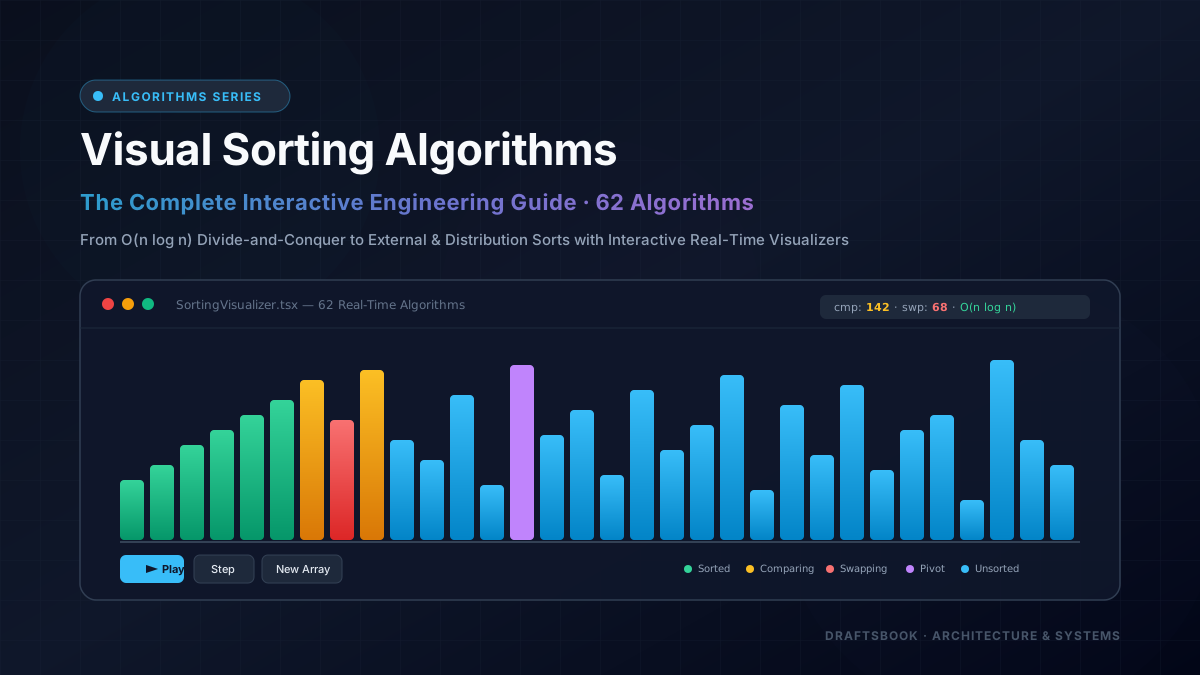
Weak Heap Sort
A clever sorting algorithm that relaxes the structure of binary heaps to minimize element comparisons, achieving performance extremely close to the information-theoretic lower bound.
How it works
In a standard binary heap, each parent node must be greater than or equal to **both** of its children. Weak Heap Sort relaxes this requirement: each parent node is only required to be greater than or equal to **one** of its children (typically the right child/first child). An auxiliary bit-array of "reverse bits" (denoted as r) tracks whether the left and right children have been swapped. This relaxation makes heap construction incredibly fast (taking exactly n − 1 comparisons) and speeds up extraction significantly.
- Transform the array into a weak heap bottom-up. Each node is merged with its **distinguished ancestor** (the closest parent reached via a right branch).
- During a merge, if the child is larger than the ancestor, swap them and toggle the child's reverse bit.
- To sort, repeatedly swap the root (index 0) with the last element of the heap.
- Find the leaf along the path of first children starting at index 1.
- Traverse up from this leaf to the root, merging each node with the root to restore the weak heap property.
- Swap indices 0 and 1 at the very end to complete the sort.
Complexity
Interactive visualization
Pseudocode
procedure weakHeapSort(A):
  n ← length(A)
  r ← array of size n initialized to 0

  for i from n − 1 down to 1:
    j ← i
    while (j & 1) = r[j >> 1]: j ← j >> 1
    parent ← j >> 1
    weakHeapMerge(r, parent, i)

  for i from n − 1 down to 2:
    swap A[0], A[i]
    x ← 1
    while (2x + r[x]) < i: x ← 2x + r[x]
    while x > 0:
      weakHeapMerge(r, 0, x)
      x ← x >> 1
  swap A[0], A[1]

procedure weakHeapMerge(r, i, j):
  if A[i] < A[j]:
    swap A[i], A[j]
    r[j] ← r[j] ⊕ 1
JavaScript implementation
function weakHeapSort(arr) {
  const n = arr.length;
  if (n <= 1) return arr;

  const r = new Uint8Array(n);

  for (let i = n - 1; i > 0; i--) {
    let j = i;
    while ((j & 1) === r[j >> 1]) {
      j = j >> 1;
    }
    const parent = j >> 1;
    merge(arr, r, parent, i);
  }

  for (let i = n - 1; i >= 2; i--) {
    [arr[0], arr[i]] = [arr[i], arr[0]];
    let x = 1;
    let y;
    while ((y = 2 * x + r[x]) < i) {
      x = y;
    }
    while (x > 0) {
      merge(arr, r, 0, x);
      x = x >> 1;
    }
  }
  [arr[0], arr[1]] = [arr[1], arr[0]];
  return arr;
}

function merge(arr, r, i, j) {
  if (arr[i] < arr[j]) {
    [arr[i], arr[j]] = [arr[j], arr[i]];
    r[j] ^= 1;
  }
}
Pros and cons
Pros
- Comparison count is strictly limited, matching theory bounds.
- Extremely fast heap construction in just n − 1 comparisons.
- Highly effective when sorting items with expensive comparators (like locale strings).
- Performs much fewer swaps and comparisons than traditional Heapsort.
Cons
- Requires O(n) auxiliary bits of memory (a flag array).
- Not stable (duplicates might be reordered).
- Poor cache locality compared to Quicksort.
- Marginally more complex to understand than simple binary heap sort.
When to use it
- Expensive comparisons: sorting large strings or records where comparison key computation dominates execution time.
- Worst-case guarantees needed with minimal comparator overhead: in library structures where standard Heapsort was previously used.
Related reading
Sleep Sort: Mechanism, Complexity Analysis & Interactive Visualizer
A unique concurrency-based sorting algorithm: spawns a separate thread for each element, sleeping for a duration proportional to the element value before writing it to the output.
By Md. Harun-Or-Roshid
Cube Sort: Mechanism, Complexity Analysis & Interactive Visualizer
A parallel dimension sorting algorithm: organizes elements in a 3D coordinate cube and sorts vectors along the height, width, and depth axes sequentially to achieve sorted order.
By Md. Harun-Or-Roshid
Patience Sort: Mechanism, Complexity Analysis & Interactive Visualizer
A card-game inspired sorting algorithm: distributes elements onto a series of piles such that each pile's top is \(\ge\) the incoming value, then performs a multi-way merge across pile tops.
By Md. Harun-Or-Roshid
Library Sort: Mechanism, Complexity Analysis & Interactive Visualizer
A gapped variation of Insertion Sort: leaves empty slots (gaps) in the array, allowing elements to be inserted in \(O(1)\) shift time on average by avoiding massive shifts.
By Md. Harun-Or-Roshid