Strand Sort: Mechanism, Complexity Analysis & Interactive Visualizer
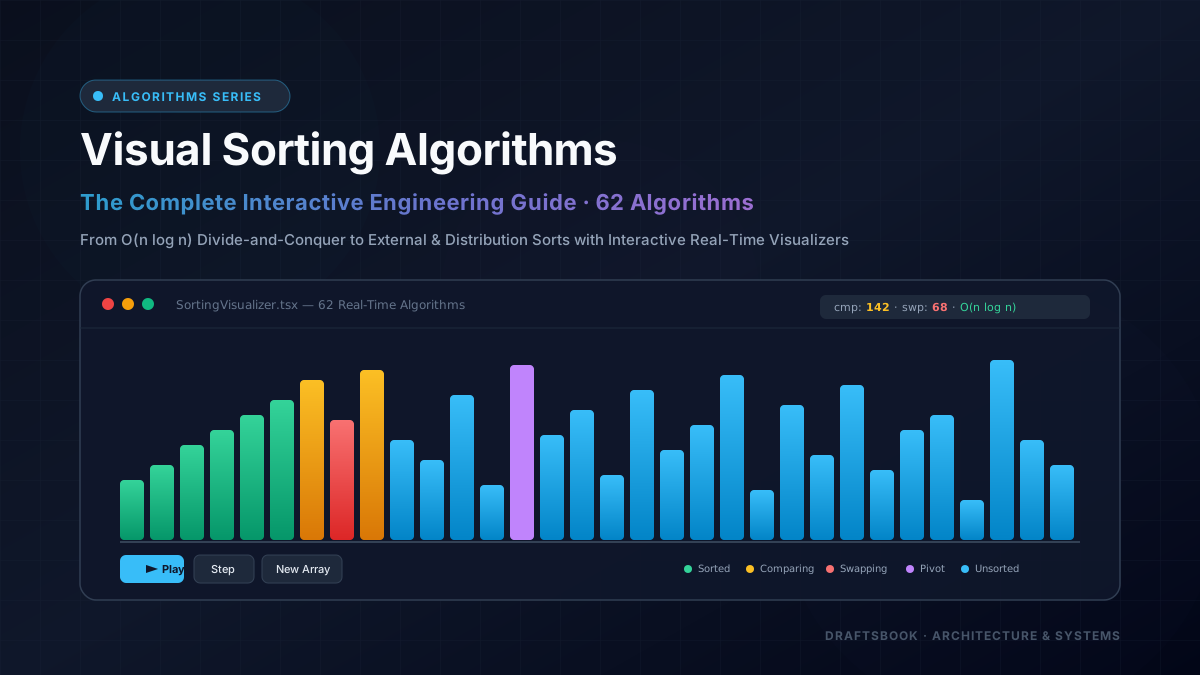
Strand Sort
A unique list-extraction sorting algorithm: repeatedly pulls out sorted ascending chains (strands) from the unsorted data, merging them step-by-step into a growing sorted list.
How it works
Strand Sort is an elegant comparison-based algorithm. Instead of swapping individual elements or dividing them into binary partitions, it extracts whole sorted chains (strands) from the unsorted items and merges them together:
- **First Strand Selection:** Take the first element of the unsorted list as the start of a new sorted list (strand).
- **Scan and Extract:** Scan the remaining unsorted elements from left to right. For each element:
- Compare it to the last element added to the current strand.
- If the element is greater than or equal to the last element of the strand, pull it out of the unsorted list and append it to the strand.
- **Merge Strand:** Merge the newly completed sorted strand into a final sorted accumulator list (using a standard merge step, similar to Mergesort).
- **Repeat:** If there are still elements remaining in the unsorted list, repeat the process from Step 1.
Complexity
Interactive visualization
Pseudocode
procedure strandSort(A):
  sortedList ← empty list
  unsortedList ← convertToList(A)

  while unsortedList is not empty:
    strand ← empty list
    strand.append(unsortedList.popHead())

    node ← unsortedList.head
    while node is not null:
      if node.val >= strand.tail.val:
        strand.append(unsortedList.remove(node))
      node ← node.next

    sortedList ← merge(sortedList, strand)

  copyListToArray(sortedList, A)
JavaScript implementation
function strandSort(arr) {
  let unsorted = [...arr];
  let sorted = [];

  while (unsorted.length > 0) {
    const strand = [];
    strand.push(unsorted.shift());

    let i = 0;
    while (i < unsorted.length) {
      if (unsorted[i] >= strand[strand.length - 1]) {
        strand.push(unsorted.splice(i, 1)[0]);
      } else {
        i++;
      }
    }

    const merged = [];
    let s = 0, d = 0;
    while (s < strand.length && d < sorted.length) {
      if (strand[s] <= sorted[d]) merged.push(strand[s++]);
      else merged.push(sorted[d++]);
    }
    while (s < strand.length) merged.push(strand[s++]);
    while (d < sorted.length) merged.push(sorted[d++]);
    sorted = merged;
  }

  for (let i = 0; i < arr.length; i++) arr[i] = sorted[i];
  return arr;
}
Pros and cons
Pros
- Stunning performance O(n) on pre-sorted data.
- Highly stable sorting behavior.
- Naturally suited for linked lists where element extraction is O(1).
Cons
- Requires O(n) extra storage space.
- Terrible O(n²) performance if elements are in reverse order.
- Not cache-friendly on standard contiguous array types due to splice memory moves.
When (not) to use it
- Linked List Sorting: Very efficient choice if sorting linked list nodes, where popping and inserting items avoids array shifting penalties.
- Standard Arrays: Avoid; standard comparison algorithms like Timsort or Quicksort do not suffer from index-shifting overhead.
Related reading
Sleep Sort: Mechanism, Complexity Analysis & Interactive Visualizer
A unique concurrency-based sorting algorithm: spawns a separate thread for each element, sleeping for a duration proportional to the element value before writing it to the output.
By Md. Harun-Or-Roshid
Cube Sort: Mechanism, Complexity Analysis & Interactive Visualizer
A parallel dimension sorting algorithm: organizes elements in a 3D coordinate cube and sorts vectors along the height, width, and depth axes sequentially to achieve sorted order.
By Md. Harun-Or-Roshid
Patience Sort: Mechanism, Complexity Analysis & Interactive Visualizer
A card-game inspired sorting algorithm: distributes elements onto a series of piles such that each pile's top is \(\ge\) the incoming value, then performs a multi-way merge across pile tops.
By Md. Harun-Or-Roshid
Library Sort: Mechanism, Complexity Analysis & Interactive Visualizer
A gapped variation of Insertion Sort: leaves empty slots (gaps) in the array, allowing elements to be inserted in \(O(1)\) shift time on average by avoiding massive shifts.
By Md. Harun-Or-Roshid