Shell Sort: Mechanism, Complexity Analysis & Interactive Visualizer
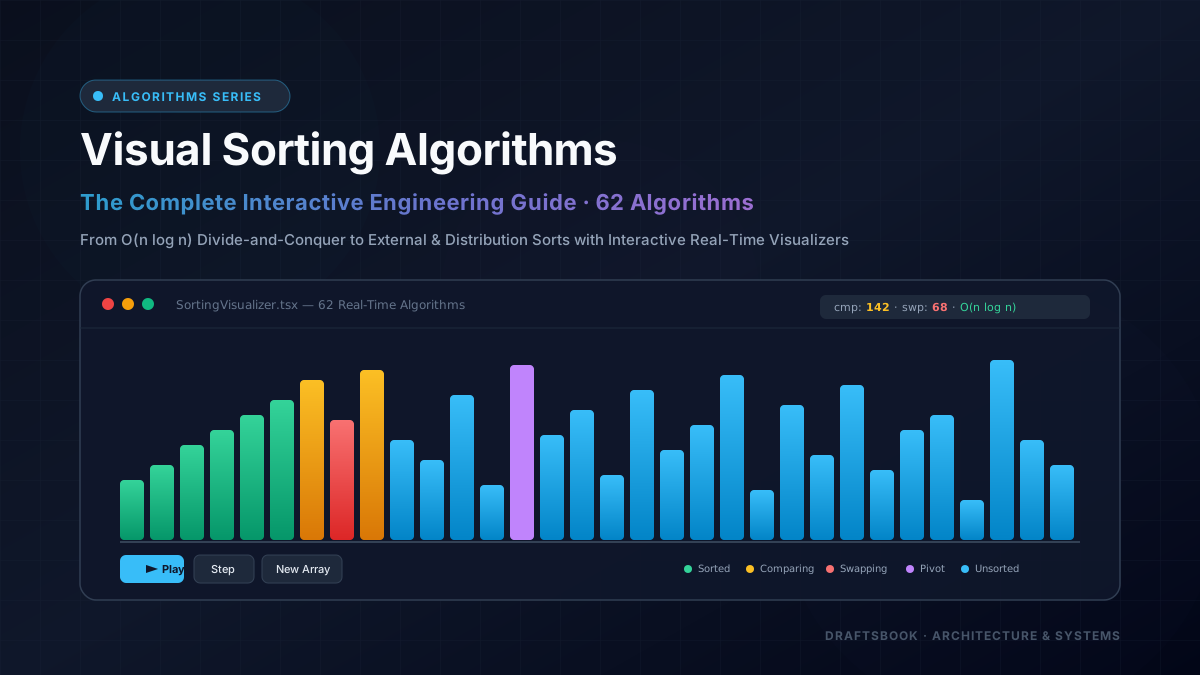
Shell Sort
Insertion Sort, but on widely-spaced sub-arrays first. The gap shrinks each pass until a final gap of 1 finishes a nearly-sorted array fast.
How it works
Shell Sort, invented by Donald Shell in 1959, was one of the first sub-quadratic sorts. It chooses a sequence of gaps g₁ > g₂ > ... > 1 and runs gapped insertion sorts in sequence.
- Pick a gap sequence (e.g., n/2, n/4, ..., 1, or Ciura's tuned [701, 301, 132, 57, 23, 10, 4, 1]).
- For each gap
g, do an insertion sort where the "neighbor" ofiisi − g. - Continue with smaller gaps. The final pass with
g = 1is plain insertion sort, but the array is now almost sorted, so it runs close to linear.
Time complexity depends heavily on the gap sequence. With Ciura's sequence, empirical performance is near O(n log² n); theoretical worst-case bounds reach O(n^{4/3}) with Sedgewick gaps.
Complexity
Interactive visualization
Pseudocode
procedure shellSort(A):
  gaps ← [701, 301, 132, 57, 23, 10, 4, 1]
  for gap in gaps where gap < n:
    for i from gap to n − 1:
      temp ← A[i]; j ← i
      while j ≥ gap and A[j − gap] > temp:
        A[j] ← A[j − gap]; j ← j − gap
      A[j] ← temp
JavaScript implementation
function shellSort(arr) {
  const gaps = [701, 301, 132, 57, 23, 10, 4, 1];
  for (const gap of gaps) {
    if (gap >= arr.length) continue;
    for (let i = gap; i < arr.length; i++) {
      const temp = arr[i];
      let j = i;
      while (j >= gap && arr[j - gap] > temp) {
        arr[j] = arr[j - gap]; j -= gap;
      }
      arr[j] = temp;
    }
  }
  return arr;
}
Pros and cons
Pros
- Sub-quadratic without recursion or extra memory.
- Simple, branchy code — friendly on embedded targets.
- Adapts to the input: nearly-sorted runs are fast.
- Open optimization space — different gap sequences trade analysis for speed.
Cons
- Not stable.
- Worst-case bound depends on gap sequence — and the optimal sequence is still an open problem.
- Loses to merge/quick sort for large n.
When to use it
- Embedded systems where binary size matters and you need better than O(n²).
- Medium arrays (n < 10⁵) when simplicity is valued.
- Avoiding recursion for stack-limited environments.
Related reading
Sleep Sort: Mechanism, Complexity Analysis & Interactive Visualizer
A unique concurrency-based sorting algorithm: spawns a separate thread for each element, sleeping for a duration proportional to the element value before writing it to the output.
By Md. Harun-Or-Roshid
Cube Sort: Mechanism, Complexity Analysis & Interactive Visualizer
A parallel dimension sorting algorithm: organizes elements in a 3D coordinate cube and sorts vectors along the height, width, and depth axes sequentially to achieve sorted order.
By Md. Harun-Or-Roshid
Patience Sort: Mechanism, Complexity Analysis & Interactive Visualizer
A card-game inspired sorting algorithm: distributes elements onto a series of piles such that each pile's top is \(\ge\) the incoming value, then performs a multi-way merge across pile tops.
By Md. Harun-Or-Roshid
Library Sort: Mechanism, Complexity Analysis & Interactive Visualizer
A gapped variation of Insertion Sort: leaves empty slots (gaps) in the array, allowing elements to be inserted in \(O(1)\) shift time on average by avoiding massive shifts.
By Md. Harun-Or-Roshid