Quick Sort: Mechanism, Complexity Analysis & Interactive Visualizer
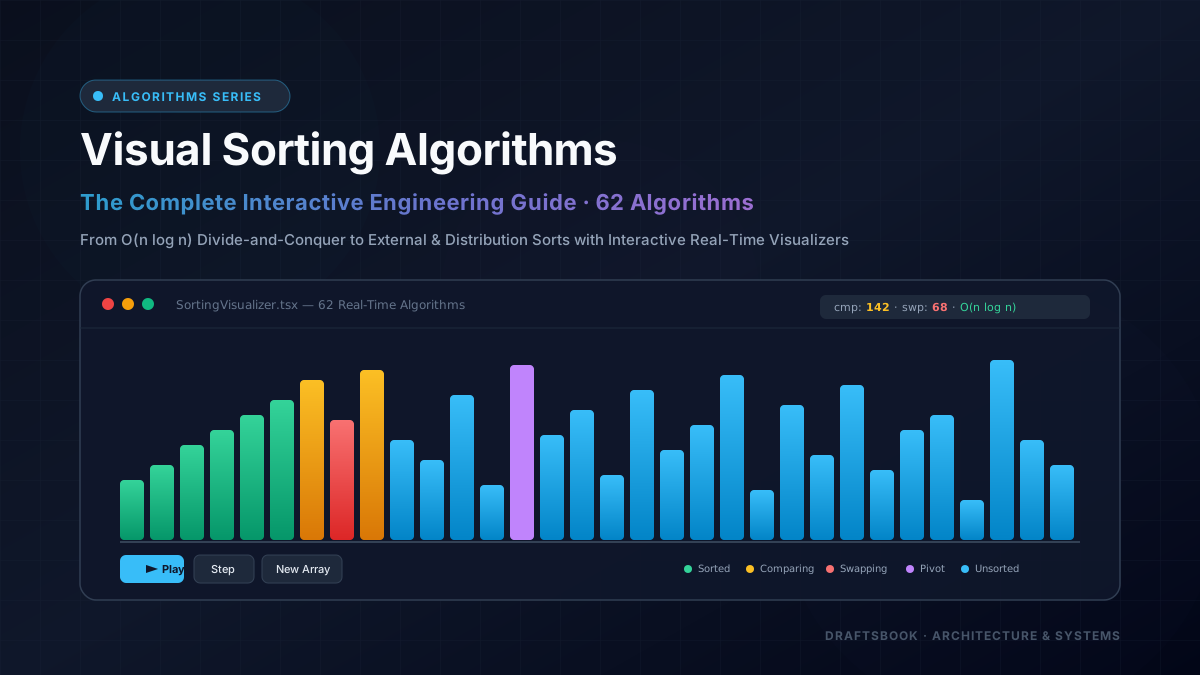
Quick Sort
Choose a pivot, partition the array around it, recurse on each side. Average O(n log n) with tiny constants — the default sort in many languages.
How it works
Quick Sort flips the merge sort idea: instead of doing trivial split + heavy combine, it does heavy split (partition) + trivial combine (nothing).
- Pick a pivot (often the last or middle element).
- Partition the array so that everything < pivot is to its left and everything > pivot is to its right.
- Recurse on each partition (the pivot is now in its final position).
The Lomuto partition scheme is shown here for clarity. The Hoare partition is faster in practice but harder to get right.
Quick Sort's magic: it sorts in place, the constant factors are tiny, and the partition step has excellent cache behavior. The catch is that a bad pivot choice degrades to O(n²) — the next three articles fix this.
Complexity
Interactive visualization
Pseudocode
procedure quickSort(A, lo, hi):
  if lo < hi:
    p ← partition(A, lo, hi)
    quickSort(A, lo, p − 1)
    quickSort(A, p + 1, hi)

procedure partition(A, lo, hi):
  pivot ← A[hi]; i ← lo − 1
  for j from lo to hi − 1:
    if A[j] ≤ pivot: i ← i + 1; swap A[i], A[j]
  swap A[i + 1], A[hi]
  return i + 1
JavaScript implementation
function quickSort(arr, lo = 0, hi = arr.length - 1) {
  if (lo < hi) {
    const p = partition(arr, lo, hi);
    quickSort(arr, lo, p - 1);
    quickSort(arr, p + 1, hi);
  }
  return arr;
}
function partition(arr, lo, hi) {
  const pivot = arr[hi];
  let i = lo - 1;
  for (let j = lo; j < hi; j++) {
    if (arr[j] <= pivot) {
      i++;
      [arr[i], arr[j]] = [arr[j], arr[i]];
    }
  }
  [arr[i + 1], arr[hi]] = [arr[hi], arr[i + 1]];
  return i + 1;
}
Pros and cons
Pros
- Average O(n log n) with very small constants — the fastest comparison sort in practice.
- In-place; only the recursion stack adds memory.
- Excellent cache locality from sequential partition passes.
- Tail-recursion optimizes to O(log n) stack.
Cons
- Worst case O(n²) on bad pivot choice — degrades catastrophically on sorted input.
- Not stable.
- Recursion depth can blow the stack without tail-call optimization.
When to use it
- General-purpose in-memory sort when stability isn't required.
- Standard library default in C's qsort, std::sort, Java primitive sort.
- Pairs naturally with introspective fallbacks (IntroSort).
Related reading
Sleep Sort: Mechanism, Complexity Analysis & Interactive Visualizer
A unique concurrency-based sorting algorithm: spawns a separate thread for each element, sleeping for a duration proportional to the element value before writing it to the output.
By Md. Harun-Or-Roshid
Cube Sort: Mechanism, Complexity Analysis & Interactive Visualizer
A parallel dimension sorting algorithm: organizes elements in a 3D coordinate cube and sorts vectors along the height, width, and depth axes sequentially to achieve sorted order.
By Md. Harun-Or-Roshid
Patience Sort: Mechanism, Complexity Analysis & Interactive Visualizer
A card-game inspired sorting algorithm: distributes elements onto a series of piles such that each pile's top is \(\ge\) the incoming value, then performs a multi-way merge across pile tops.
By Md. Harun-Or-Roshid
Library Sort: Mechanism, Complexity Analysis & Interactive Visualizer
A gapped variation of Insertion Sort: leaves empty slots (gaps) in the array, allowing elements to be inserted in \(O(1)\) shift time on average by avoiding massive shifts.
By Md. Harun-Or-Roshid