Cartesian Tree Sort: Mechanism, Complexity Analysis & Interactive Visualizer
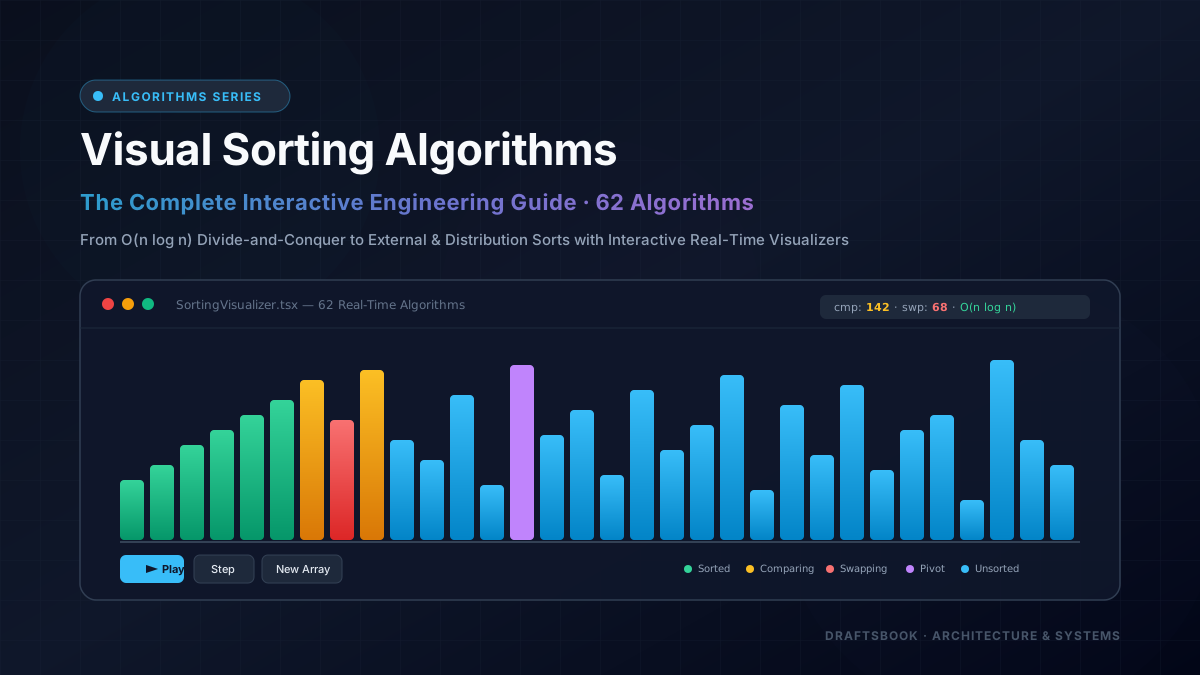
Cartesian Tree Sort
An adaptive, heap-based algorithm: build a min-heap structured Cartesian tree in linear time, then sort by repeatedly pulling the minimum element into a priority queue.
How it works
A Cartesian Tree is a binary tree where the parent node has a smaller value than its children (min-heap property), and an in-order traversal of the tree reconstructs the original array. Cartesian Tree Sort operates in two key steps:
- Tree Construction: Build a Cartesian Tree from the input array in
O(n)time. This is achieved using a stack to trace the rightmost path of the tree and make local adjustments. - Sorting Phase: Initialize a priority queue (min-heap) with the root of the Cartesian tree. In each step, pop the minimum node from the queue, write its value to the sorted array, and push its left and right children into the priority queue. Repeat until the queue is empty.
Complexity
O(n) time if the input is already sorted, and degrades gracefully to O(n log k) where k is the number of inversions or "runs".Interactive visualization
Pseudocode
procedure cartesianTreeSort(A):
  n ← length(A)
  left ← array of size n filled with -1
  right ← array of size n filled with -1
  stack ← empty stack

  for i from 0 to n - 1:
    last ← -1
    while stack is not empty and A[top(stack)] > A[i]:
      last ← pop(stack)
    if stack is not empty:
      right[top(stack)] ← i
    if last ≠ -1:
      left[i] ← last
    push(stack, i)

  root ← stack[0]
  pq ← new MinPriorityQueue()
  pq.push(root)

  sortedIndex ← 0
  while pq is not empty:
    curr ← pq.popMin()
    A[sortedIndex] ← values[curr]
    sortedIndex ← sortedIndex + 1
    if left[curr] ≠ -1:
      pq.push(left[curr])
    if right[curr] ≠ -1:
      pq.push(right[curr])
JavaScript implementation
function cartesianTreeSort(arr) {
  const n = arr.length;
  if (n === 0) return arr;

  const left = new Array(n).fill(-1);
  const right = new Array(n).fill(-1);
  const stack = [];

  for (let i = 0; i < n; i++) {
    let last = -1;
    while (stack.length > 0 && arr[stack[stack.length - 1]] > arr[i]) {
      last = stack.pop();
    }
    if (stack.length > 0) {
      right[stack[stack.length - 1]] = i;
    }
    if (last !== -1) {
      left[i] = last;
    }
    stack.push(i);
  }

  const root = stack[0];
  const pq = [root]; // simple array to act as priority queue
  const sorted = [];

  while (pq.length > 0) {
    let minIdx = 0;
    for (let k = 1; k < pq.length; k++) {
      if (arr[pq[k]] < arr[pq[minIdx]]) {
        minIdx = k;
      }
    }
    const curr = pq.splice(minIdx, 1)[0];
    sorted.push(arr[curr]);
    if (left[curr] !== -1) pq.push(left[curr]);
    if (right[curr] !== -1) pq.push(right[curr]);
  }

  for (let i = 0; i < n; i++) {
    arr[i] = sorted[i];
  }
  return arr;
}
Pros and cons
Pros
- Adaptive: O(n) runtime for sorted inputs.
- Relies on min-heap property but avoids building an entire heap.
- Low number of comparisons when input contains sorted subsequences.
Cons
- Requires O(n) extra space to represent left/right child arrays.
- High overhead for construction stack and heap maintenance.
- Unstable sorting order (equal keys may be reordered).
When (not) to use it
- Nearly sorted arrays: Extremely fast on data that contains long presorted intervals.
- When memory is constrained: Avoid this algorithm when memory footprint is limited, as the auxiliary parent-child arrays consume significant space.
- Standard tasks: Timsort or standard Quick Sort are generally preferred due to much lower constant factors.
Related reading
Sleep Sort: Mechanism, Complexity Analysis & Interactive Visualizer
A unique concurrency-based sorting algorithm: spawns a separate thread for each element, sleeping for a duration proportional to the element value before writing it to the output.
By Md. Harun-Or-Roshid
Cube Sort: Mechanism, Complexity Analysis & Interactive Visualizer
A parallel dimension sorting algorithm: organizes elements in a 3D coordinate cube and sorts vectors along the height, width, and depth axes sequentially to achieve sorted order.
By Md. Harun-Or-Roshid
Patience Sort: Mechanism, Complexity Analysis & Interactive Visualizer
A card-game inspired sorting algorithm: distributes elements onto a series of piles such that each pile's top is \(\ge\) the incoming value, then performs a multi-way merge across pile tops.
By Md. Harun-Or-Roshid
Library Sort: Mechanism, Complexity Analysis & Interactive Visualizer
A gapped variation of Insertion Sort: leaves empty slots (gaps) in the array, allowing elements to be inserted in \(O(1)\) shift time on average by avoiding massive shifts.
By Md. Harun-Or-Roshid