Bucket Sort: Mechanism, Complexity Analysis & Interactive Visualizer
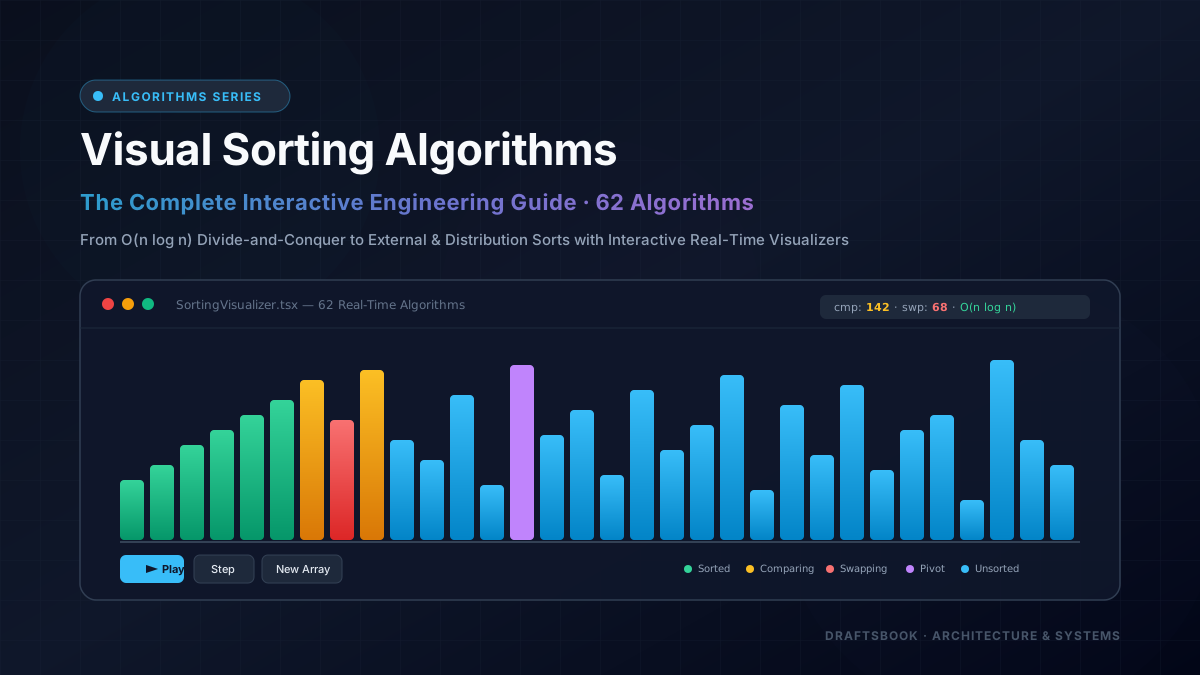
Bucket Sort
A distribution-based sorting algorithm that partitions elements into a finite number of buckets, sorts each bucket individually (using Insertion Sort), and then merges them.
How it works
Bucket Sort works by dividing the interval of input values into equal-sized sub-intervals (buckets). Each input value is placed into its corresponding bucket, sorted, and then gathered sequentially.
- Create an array of empty buckets.
- Distribute the elements from the input array into the buckets based on their values relative to the range (minimum and maximum).
- Sort each non-empty bucket using a simple sorting algorithm like Insertion Sort.
- Visit all buckets in order and copy their sorted elements back into the original array.
Complexity
Interactive visualization
Pseudocode
procedure bucketSort(A):
  n ← length(A)
  min, max ← findMinMax(A)
  numBuckets ← floor(n / 2)
  buckets ← array of numBuckets empty lists
  range ← max - min

  for i from 0 to n - 1:
    bucketIdx ← floor(((A[i] - min) / range) * (numBuckets - 1))
    buckets[bucketIdx].append(A[i])

  idx ← 0
  for i from 0 to numBuckets - 1:
    insertionSort(buckets[i])
    for j from 0 to length(buckets[i]) - 1:
      A[idx] ← buckets[i][j]
      idx ← idx + 1
JavaScript implementation
function bucketSort(arr) {
  const n = arr.length;
  if (n <= 1) return arr;

  let min = arr[0];
  let max = arr[0];
  for (let i = 1; i < n; i++) {
    if (arr[i] < min) min = arr[i];
    if (arr[i] > max) max = arr[i];
  }

  if (min === max) return arr;

  const numBuckets = Math.max(2, Math.floor(n / 2));
  const buckets = Array.from({ length: numBuckets }, () => []);
  const range = max - min;

  for (let i = 0; i < n; i++) {
    const bucketIdx = Math.floor(((arr[i] - min) / range) * (numBuckets - 1));
    buckets[bucketIdx].push(arr[i]);
  }

  let idx = 0;
  for (let i = 0; i < numBuckets; i++) {
    insertionSort(buckets[i]);
    for (let j = 0; j < buckets[i].length; j++) {
      arr[idx++] = buckets[i][j];
    }
  }
  return arr;
}

function insertionSort(arr) {
  const len = arr.length;
  for (let i = 1; i < len; i++) {
    const key = arr[i];
    let j = i - 1;
    while (j >= 0 && arr[j] > key) {
      arr[j + 1] = arr[j];
      j--;
    }
    arr[j + 1] = key;
  }
}
Pros and cons
Pros
- Extremely fast O(n + k) linear-time execution on uniformly distributed data.
- Highly effective when input elements are floating-point numbers distributed uniformly over a range.
- Stable sorting algorithm (using a stable inner sort like Insertion Sort).
Cons
- Not an in-place sort, requires auxiliary memory.
- Performance degrades to O(n²) if keys cluster into a single bucket.
- Requires knowledge of range (min/max) beforehand.
When to use it
- Uniformly Distributed Data: when elements are evenly spread over an interval (such as percentage values or decimal probabilities).
- Float Sorting: ideal for sorting floats in the range [0, 1).
Related reading
Sleep Sort: Mechanism, Complexity Analysis & Interactive Visualizer
A unique concurrency-based sorting algorithm: spawns a separate thread for each element, sleeping for a duration proportional to the element value before writing it to the output.
By Md. Harun-Or-Roshid
Cube Sort: Mechanism, Complexity Analysis & Interactive Visualizer
A parallel dimension sorting algorithm: organizes elements in a 3D coordinate cube and sorts vectors along the height, width, and depth axes sequentially to achieve sorted order.
By Md. Harun-Or-Roshid
Patience Sort: Mechanism, Complexity Analysis & Interactive Visualizer
A card-game inspired sorting algorithm: distributes elements onto a series of piles such that each pile's top is \(\ge\) the incoming value, then performs a multi-way merge across pile tops.
By Md. Harun-Or-Roshid
Library Sort: Mechanism, Complexity Analysis & Interactive Visualizer
A gapped variation of Insertion Sort: leaves empty slots (gaps) in the array, allowing elements to be inserted in \(O(1)\) shift time on average by avoiding massive shifts.
By Md. Harun-Or-Roshid